Caerostris darwini, known as Darwin's bark spider, is a marvel of natural engineering. Endemic to Madagascar, this species weaves the largest webs ever recorded, with structures spanning waterways up to 25 meters wide. Its silk, considered the toughest biological material, surpasses steel and Kevlar in tenacity, making it a fascinating subject for scientific visualization and computational biomechanics.
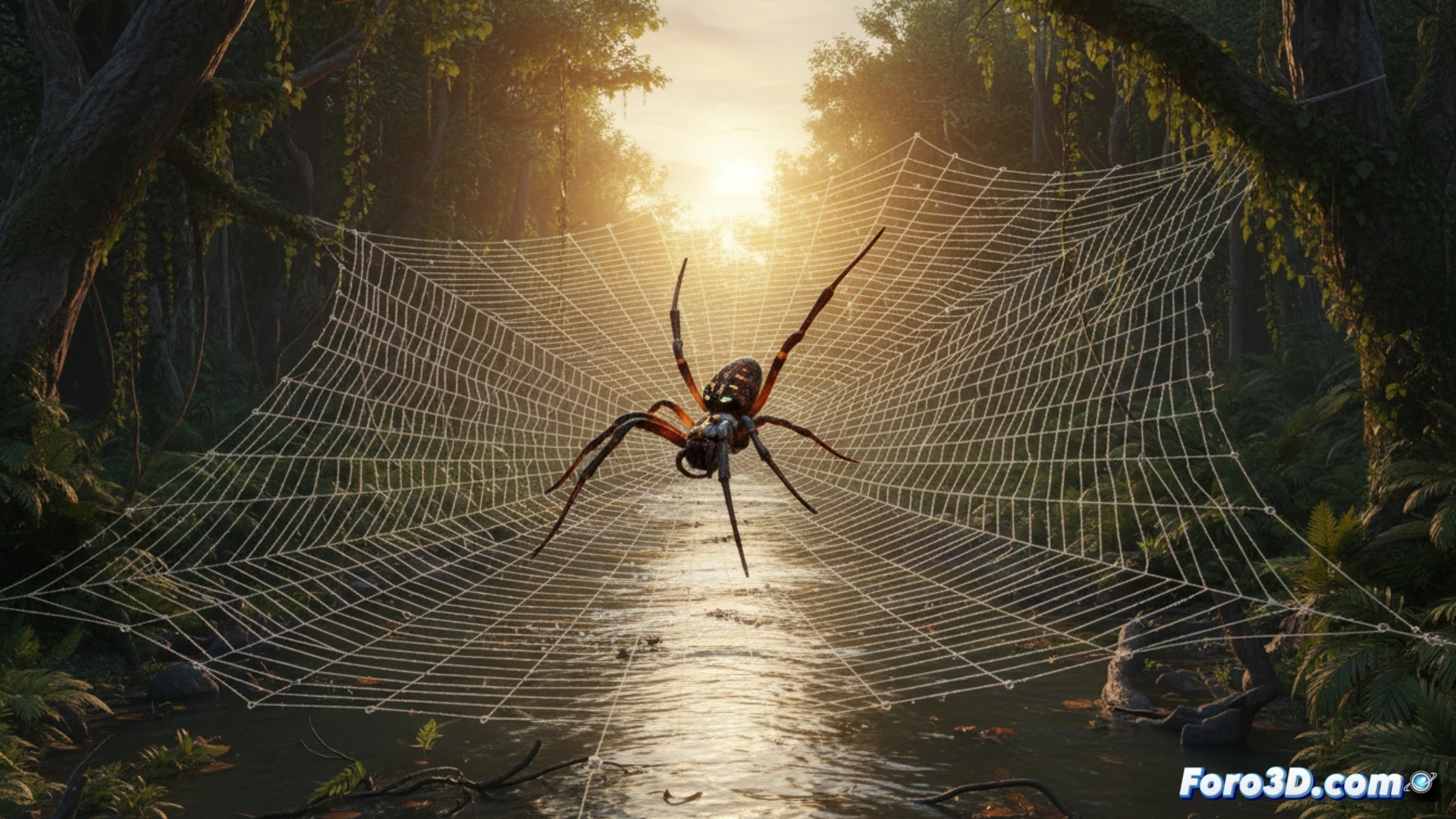
Anatomical reconstruction and simulation of biomechanical properties 🕸️
For an interactive documentary, the first step is to model the arachnid's morphology. Caerostris darwini features a robust cephalothorax and a voluminous abdomen with bark-like patterns that aid camouflage. However, the technical core lies in simulating its silk-producing glands, specifically the major ampullates. In 3D, we can recreate the molecular structure of the MaSp1 protein (Major Ampullate Spidroin 1) and visualize how its arrangement in beta-sheets gives it a tensile strength of up to 1.6 GPa. The simulation must model the intersection of anchor threads, radii, and spiral, calculating the distributed tension to support prey such as dragonflies and small birds.
The choreography of wind and fiber 🌬️
Beyond the material's toughness, the spider's behavior is key. Simulating the bridge flight, where the spider releases a thread that the wind carries to the opposite bank, requires integrating fluid physics. Modeling in 3D how Madagascar's rural breeze tenses and positions the primary cable over the river is a technical challenge that offers a spectacular view. Visualizing this process not only educates about evolutionary adaptation but also inspires the development of new synthetic biomaterials, demonstrating that nature remains the best engineer.
What organic modeling and tensile structure simulation techniques in 3D allow for the most accurate replication of the complex geometry and mechanical properties of Caerostris darwini's silk in its riverine web for scientific visualization?
(PS: at Foro3D we know that even manta rays have better social bonds than our polygons)