The Brisingida starfish, found in the depths of Nazca, has a morphology radically different from its coastal relatives. Its extremely elongated arms, covered in calcareous spines, allow it to rise above the seafloor to intercept suspended particles. This article explores the scientific visualization process to digitally recreate this creature, analyzing how the shape of its appendages responds to a filter-feeding strategy in vertical ocean currents.
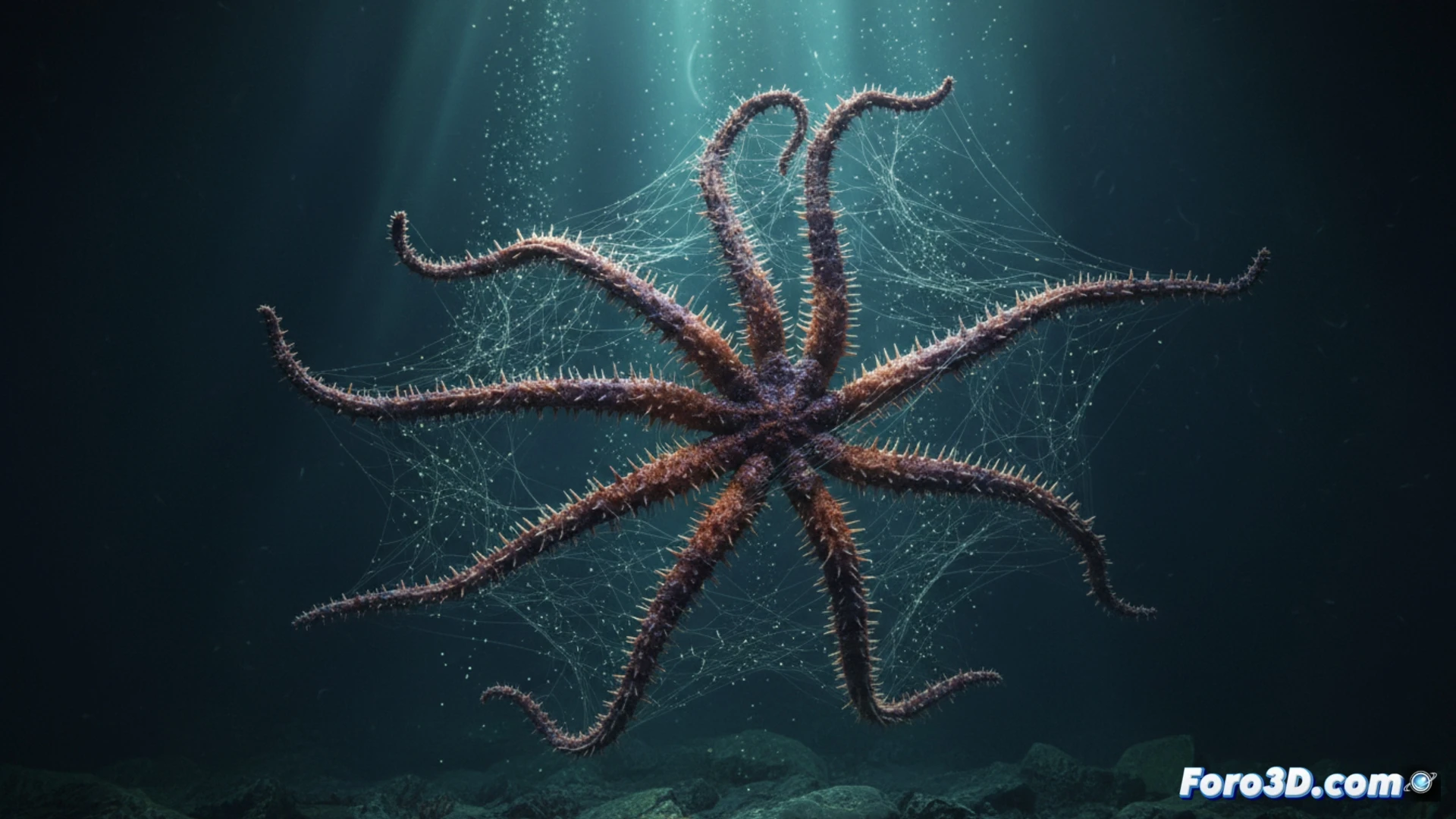
Morphological Reconstruction from Bathymetric Data 🌊
To model the Brisingida in 3D, the first step is capturing photogrammetric references of preserved specimens. The base mesh must prioritize the relationship between the central disc and the radial length, which can exceed 40 centimeters in adult specimens. The arms require a specific topology with subdivisions on the lateral spines, called pedicellariae. By applying a displacement modifier based on exoskeleton roughness maps, we can texture the protrusions. The greatest technical challenge lies in simulating the weightlessness of the arms, as in their natural habitat they remain rigid thanks to the hydrostatic pressure of their water vascular system. For the filtering animation, a particle system is implemented that travels along the arm's surface, replicating the ciliary movement that directs plankton toward the central mouth.
Visualization as a Discovery Tool 🔬
Beyond aesthetic realism, the 3D model of the Brisingida allows marine biologists to simulate flow dynamics that would be impossible to observe in situ at 4,000 meters depth. By rendering cross-sections of the arms, the complex structure of the ambulacral channels is visualized. This approach not only educates the public about the biodiversity of the Nazca trenches but also offers a platform to hypothesize about the evolution of radial symmetry in low-light, high-pressure environments.
What specific technical challenges does CFD simulation of the fluid-structure interaction between the spiny arms of the Brisingida and the currents of the Nazca depths present to achieve a visually accurate and scientifically valid 3D model?
(PS: fluid physics for simulating the ocean is like the sea: unpredictable and you always run out of RAM)