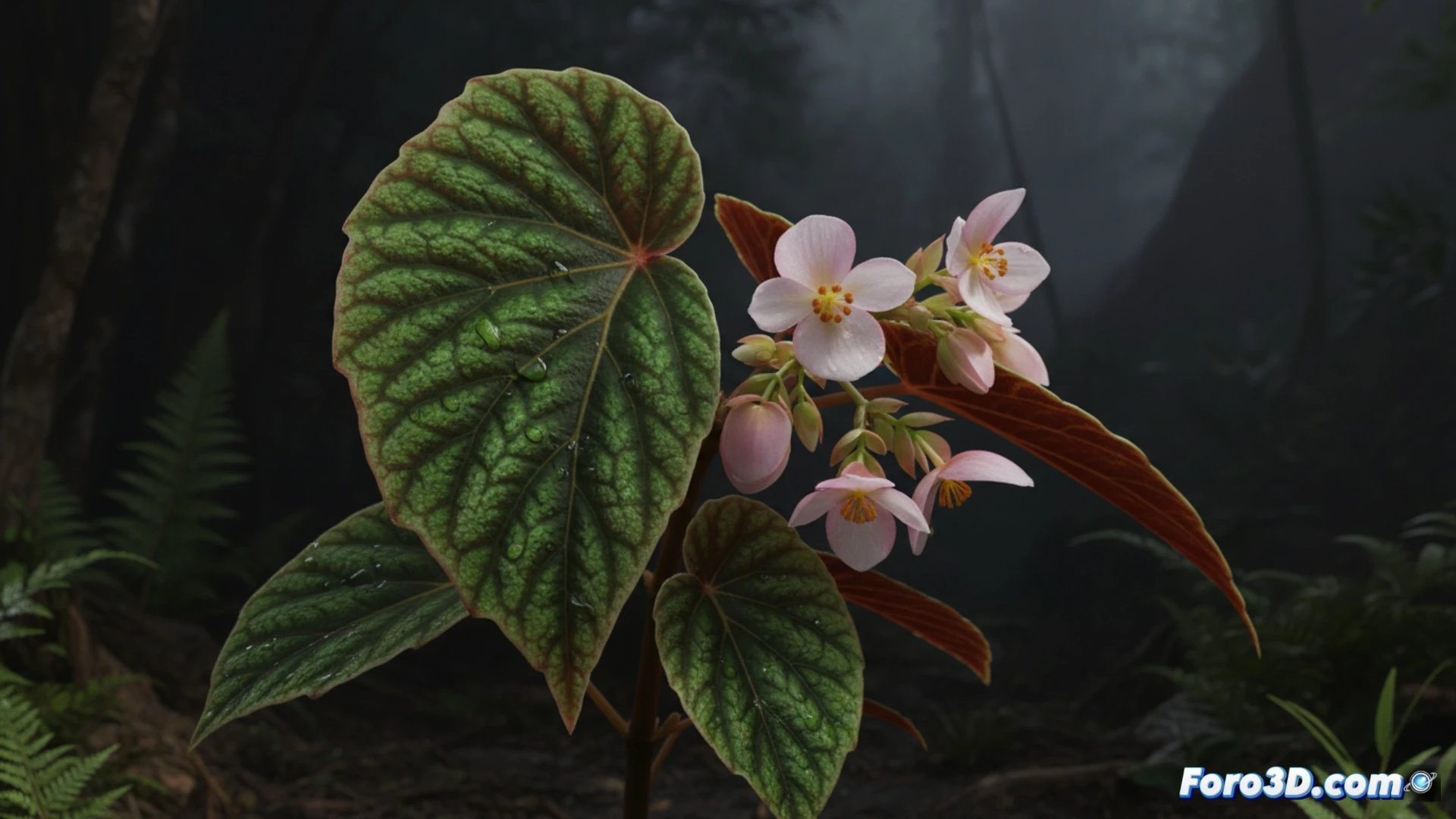
The Begonia saolaensis, discovered in the Annamite Range, represents a fascinating challenge for scientific visualization. This plant, named after the cryptic saola, possesses a unique floral morphology that requires detailed study. For 3D artists specialized in botany, replicating its asymmetrical leaves and waxy petals involves a deep analysis of textures and structures at a microscopic level, using references from preserved specimens without disturbing its fragile ecosystem.
Photogrammetry and polygonal modeling of specimens 🌿
The main technique for documenting this species is close-range photogrammetry, applied to herbarium specimens or seedlings cultivated ex situ. Between 80 and 120 images are captured with cross-polarized light to eliminate harsh shadows, then processed in software such as Agisoft Metashape. The result is a high-resolution mesh that reveals the pubescence of the stems and the reticulate venation of the leaves. For the flower, it is crucial to manually model the yellow stamens and the inferior ovary, using displacement maps based on micrographs to achieve the realism necessary for rigorous scientific visualization.
Virtual reconstruction of the Asian unicorn's habitat 🦌
Beyond the plant, the project aims to digitally recreate its microhabitat in the Annamite Range. Integrating Begonia saolaensis into a 3D environment with a closed canopy, high humidity, and calcareous soil allows visualizing the ecological symbiosis with the saola. This reconstruction, illuminated with diffuse light and volumetric fog, not only serves for outreach but also functions as a passive conservation tool. By digitizing the species, we avoid mass collection and offer botanists a perfect digital twin for anatomical studies with no environmental impact.
How would you 3D model the asymmetrical leaf patterns of Begonia saolaensis to accurately reflect its adaptive microevolution in the Annamite Range?
(PS: if your manta ray animation doesn't excite, you can always add documentary-style music from channel 2)