The recent description of Capitojoppa amazonica, known as the vampire wasp, has captured the attention of the entomological community due to its extreme morphology. This species, endemic to the Peruvian Amazon, possesses a disproportionately large head relative to its body, a trait that makes it an ideal subject for scientific visualization. In this article, we will explore how 3D modeling allows us to virtually dissect its anatomy, from the exoskeleton to its peculiar mouthparts, to better understand its role as a parasitoid.
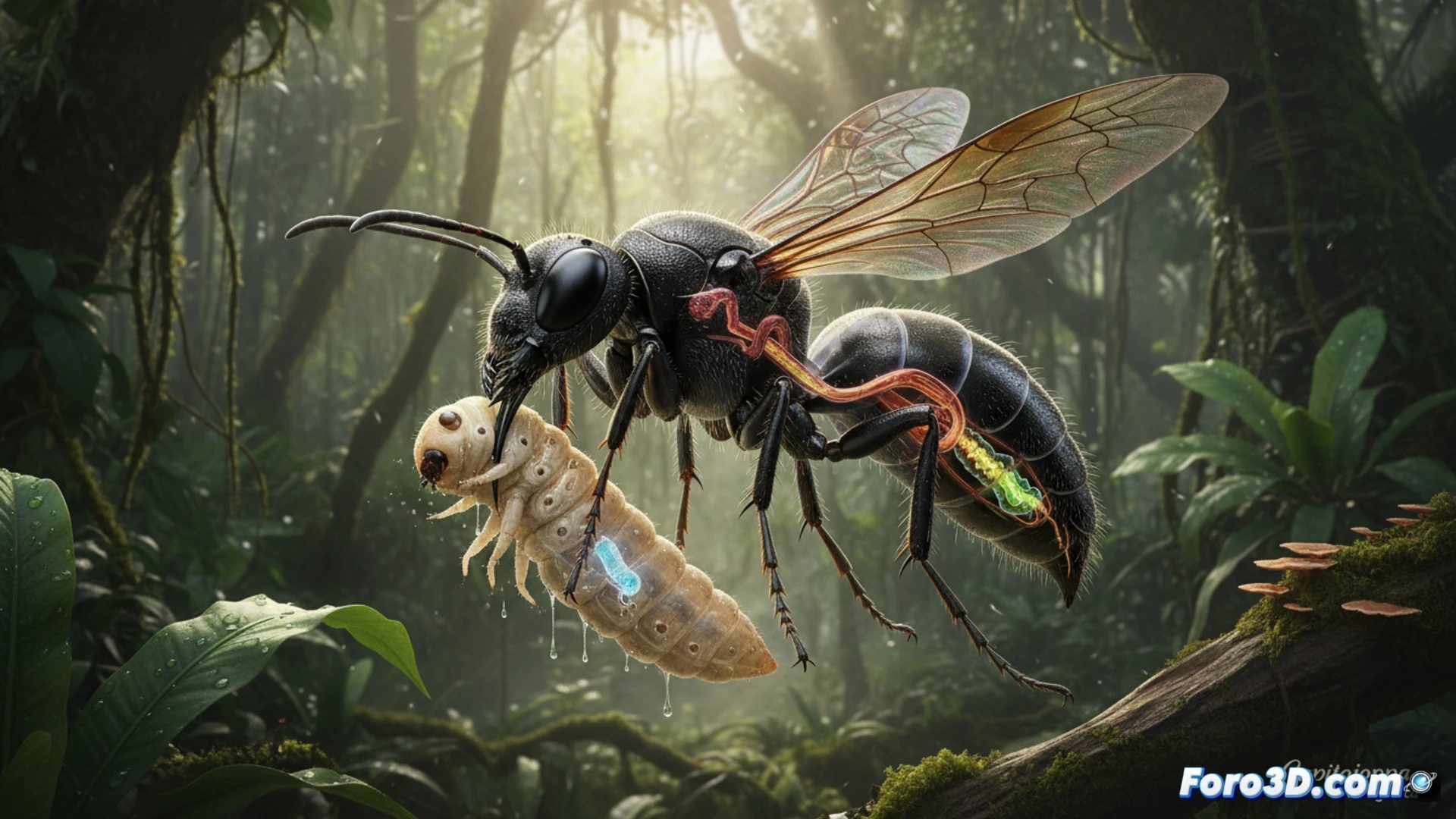
Anatomical Reconstruction and Mouthparts for Scientific Visualization 🧬
For the 3D modeling of Capitojoppa amazonica, it is crucial to prioritize the accuracy of its cephalic tagma. The head, which can reach up to 40% of the total insect volume, houses robust mandibles and modified chewing mouthparts adapted for predation. Using photogrammetry techniques from museum specimens and micro-CT data, we can generate a high-resolution polygonal mesh. Texturing must reflect the sclerotized chitin and sensory setae it uses to locate its prey, typically larvae of other insects. The key to the model is representing the articulation of the head capsule to simulate how the wasp inserts its mouthparts and sucks hemolymph, a behavior that defines it as a vampire wasp.
Behavioral Simulation and the Value of the Model for Entomology 🦟
Beyond static anatomy, 3D animation allows us to recreate the parasitic cycle of this species in a virtual environment. We can simulate the wasp's stalking flight, followed by the precise attack where it uses its massive head as an anchor to immobilize the victim. Visualizing the feeding process, where it extracts body fluids, is vital for scientific outreach and education. For entomologists studying the Amazon, an interactive 3D model of this vampire wasp offers an invaluable alternative to direct field observation, enabling analysis of its biomechanics and ecology without the logistical challenges of such a remote habitat.
What 3D modeling techniques do you recommend to accurately represent the structure of the vampire wasp's ovipositor and its parasitic function in the Amazon ecosystem?
(PS: at Foro3D we know that even manta rays have better social bonds than our polygons)