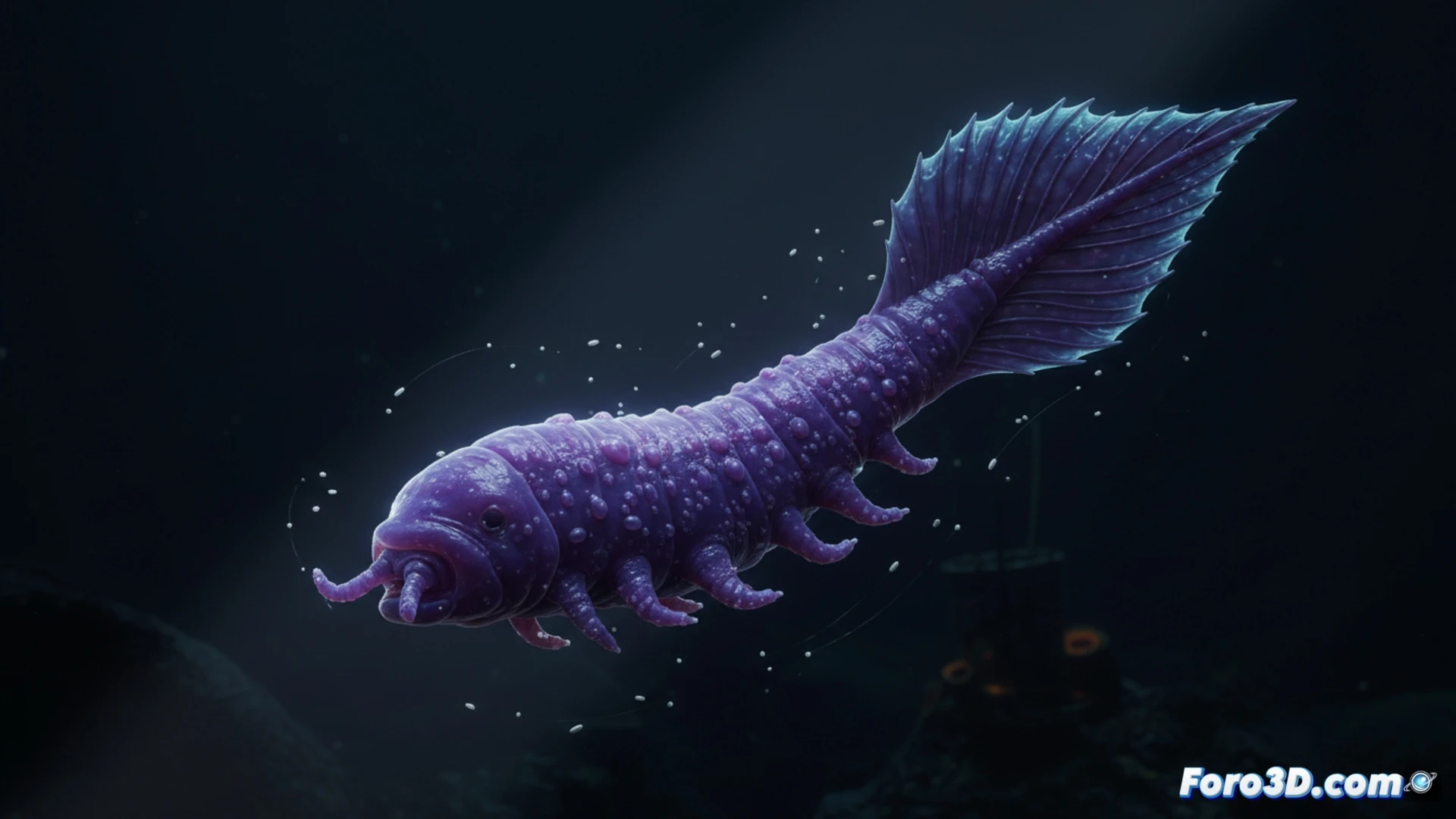
The abyssal plain of the Pacific Ocean is home to one of the most fascinating creatures for scientific visualization: the Psychropotes sp., known as the Gummy Squirrel of the Deep. This swimming sea cucumber displays an intense purple color and a gelatinous texture that challenges conventional CGI materials. Its most distinctive feature is a sail-shaped tail, used to move through the water column. Digitally reconstructing this holothurian requires meticulous analysis of videos captured by ROVs (Remotely Operated Vehicles), where artificial lighting distorts the perception of the specimen's natural hue.
Anatomical Reconstruction and Displacement Simulation 🐙
The modeling process begins with low-quality photogrammetry of expedition footage, followed by digital sculpting in ZBrush to capture the swollen and translucent morphology of the body. The greatest technical challenge lies in simulating the sail-shaped tail, a hydrostatic structure that acts as both a rudder and a propeller. To emulate its undulating movement, soft body dynamics simulations are applied in Houdini, adjusting gravity and water viscosity at 4000 meters depth. Shading requires an advanced subsurface scattering (SSS) shader to replicate the purple gelatin, combined with a particle system for the mucus coating its epidermis, creating an accurate model for biological research purposes.
Visualization of the Abyssal Ecosystem for Outreach 🌊
Beyond the anatomical model, the scientific visualization of Psychropotes sp. requires recreating its habitat: the abyssal plain, an environment of perpetual darkness and extreme pressure. Lighting the scene with point light sources that mimic the spotlights of an ROV allows contextualizing the creature's behavior. This approach serves not only for documentaries but also for oceanographers to study the species' biomechanics without disturbing the ecosystem. The photorealistic representation of its vertical displacement, driven by that caudal sail, transforms cold scientific data into an immersive visual experience, bringing the public closer to the wonders of the hadal zone.
What 3D modeling techniques allow for the most accurate representation of the gelatinous and translucent texture of Psychropotes sp. for realistic scientific visualization in the Pacific abyssal plain?
(PS: if your manta ray animation doesn't excite, you can always add some documentary music from channel 2)