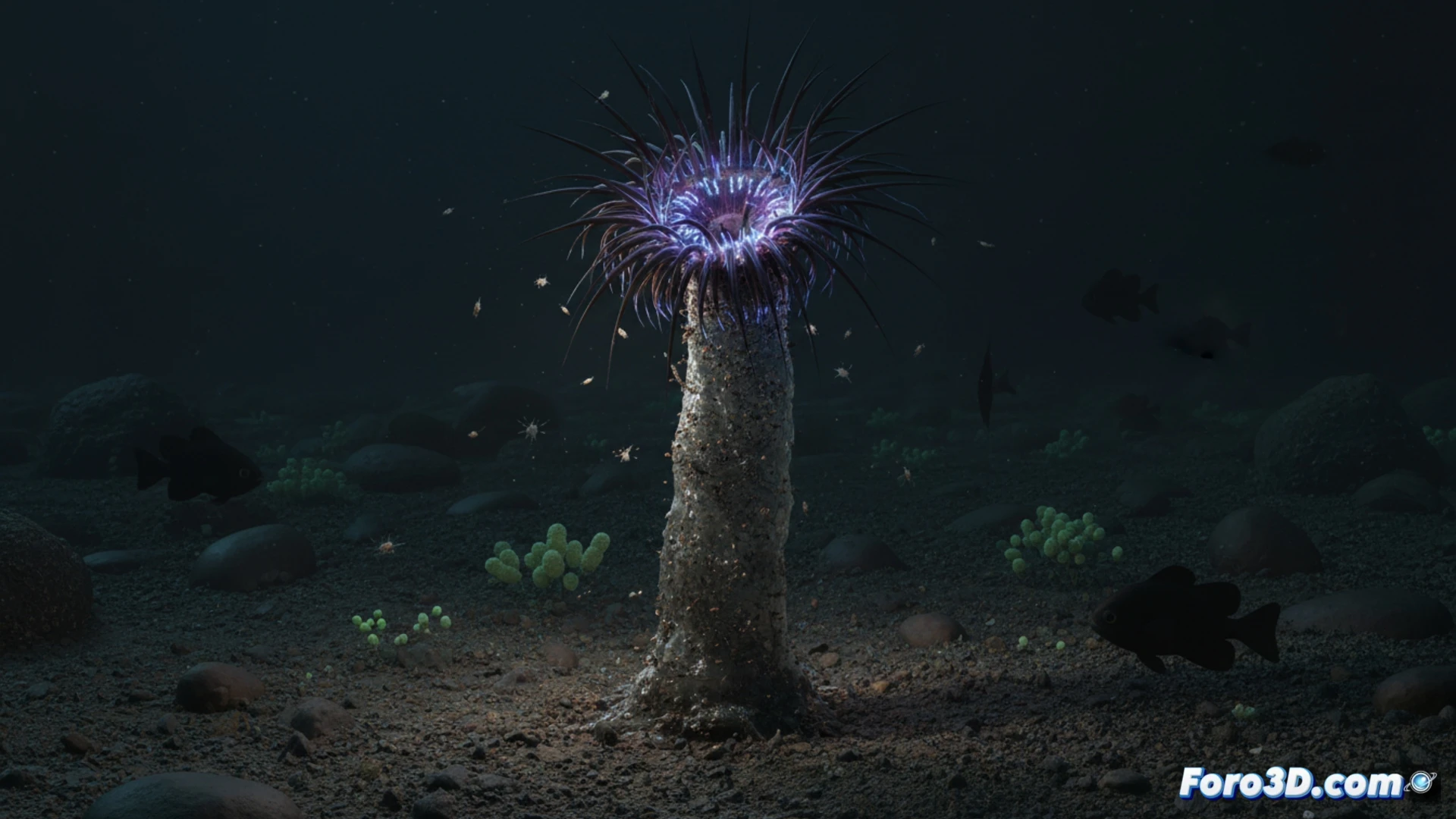
The discovery of a tube anemone (Ceriantharia sp.) in the abyssal plains of New Zealand presents a fascinating challenge for scientific visualization. This organism builds tubes of mucus and sediment over a meter long, a behavior that requires detailed 3D representation to understand its anatomy and ecology in an extreme environment of high pressure and total darkness.
Underwater Photogrammetry and Scientific Rendering 🌊
To accurately model Ceriantharia sp., the workflow begins with underwater photogrammetry. Hundreds of high-resolution images are captured from remotely operated vehicles (ROVs) in the abyssal plains. These images are processed in software like Agisoft Metashape to generate a point cloud and a polygonal mesh of the animal and its sediment tube. The next step is scientific rendering in Blender or Maya, where volumetric shaders are applied to simulate the mucous texture of the tube and the translucency of the tentacles. The animation must show the tube-building process, where the anemone secretes mucus that traps sediment particles. Lighting is adjusted to emulate ambient bioluminescence, avoiding artificial reflections that could distort the research.
The Challenge of the Invisible: Modeling What Cannot Be Seen 🐙
The biggest technical challenge is not modeling what the cameras capture, but what they hide. The meter-long tube is mostly buried in the abyssal sediment. Scientific visualization must infer its complete structure using resistivity tomography data or biomechanics-based models. By rendering the cross-section of the tube, we can illustrate how the anemone retracts and how the mucus solidifies. This 3D representation not only serves to publicize the discovery but also allows marine biologists to formulate hypotheses about the structural strength of the tube against abyssal currents, data impossible to obtain through direct observation.
What 3D modeling techniques allow for accurately reconstructing the structure of an abyssal organism like the New Zealand tube anemone from limited exploration data?
(PS: at Foro3D we know that even manta rays have better social connections than our polygons)