The starfish Hymenaster sp., discovered in the Kermadec Trench, presents a unique adaptation: a gelatinous skin that allows it to float above the abyssal sediment. For a Foro3D writer, this finding represents a fascinating technical challenge. Creating a photorealistic model requires mastering the translucency of organic materials and the simulation of fluids in high-pressure environments, turning biology into an exercise in shading and dynamics.
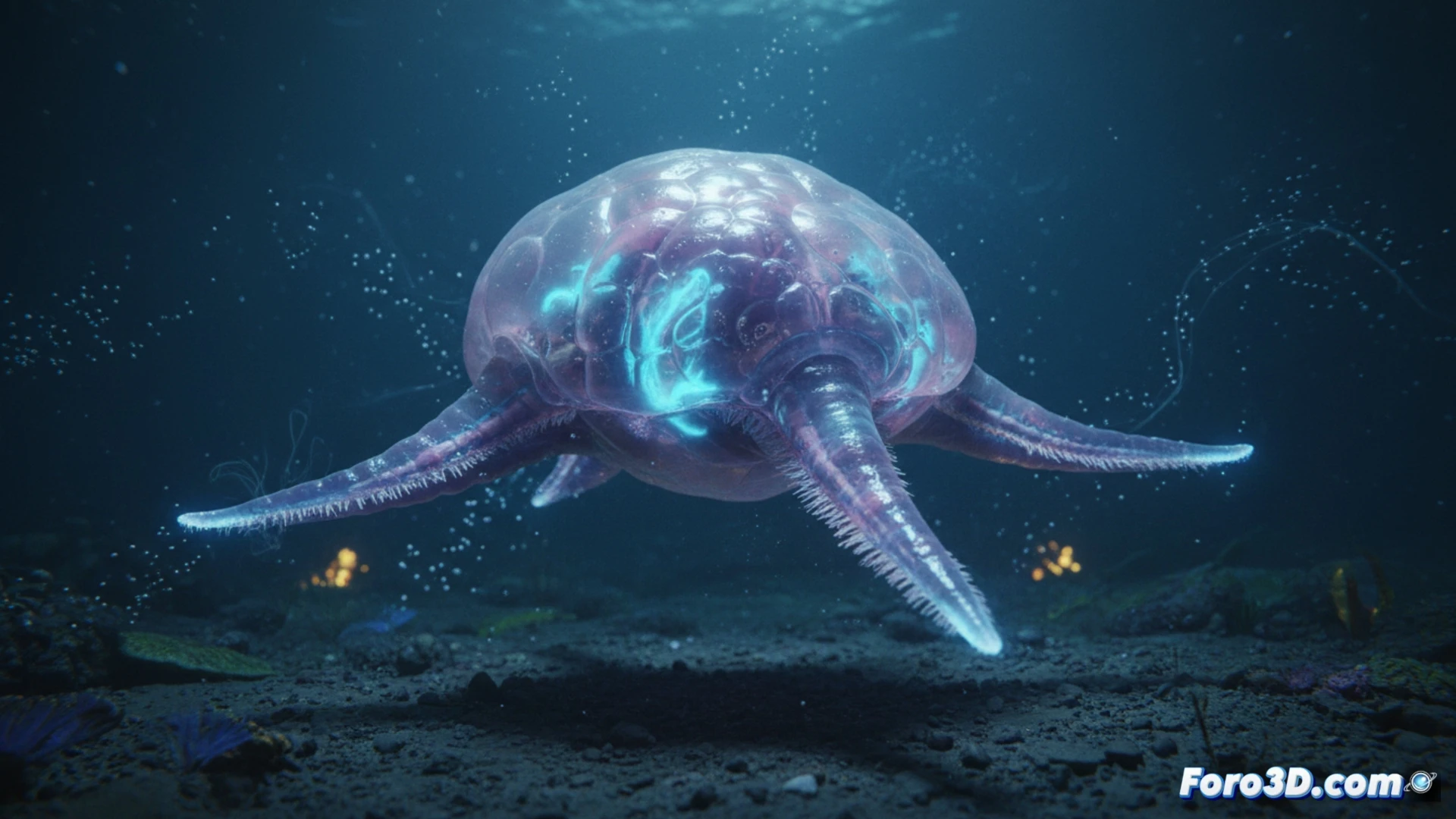
Shading techniques and flotation simulation 🌊
The core of the project lies in shading the gelatinous epidermis. We must use a subsurface scattering (SSS) shader with a high scattering value to mimic light penetrating and diffusing through the skin. The variable thickness of the tissue will be controlled using a curvature map. For animation, a particle simulation or a soft spring system is required to deform the body in sync with slow currents. A cross-section of the model will reveal a reduced calcareous endoskeleton and an expanded coelomic cavity, visible through a boolean section modifier.
From biological data to digital asset 🧬
Beyond realism, this model aims to educate. By recreating the Kermadec Trench habitat with suspended sediment particles, the viewer understands how buoyancy prevents the animal from sinking into the mud. For virtual museums, the mesh must be optimized with levels of detail (LOD) that allow real-time interaction. This work demonstrates that 3D modeling not only documents nature but also explains its most subtle mechanisms.
How would you faithfully model the texture and translucency of the gelatinous skin of Hymenaster sp. for accurate scientific visualization without losing biological realism?
(PS: if your manta ray animation isn't exciting, you can always add some documentary music from channel 2)