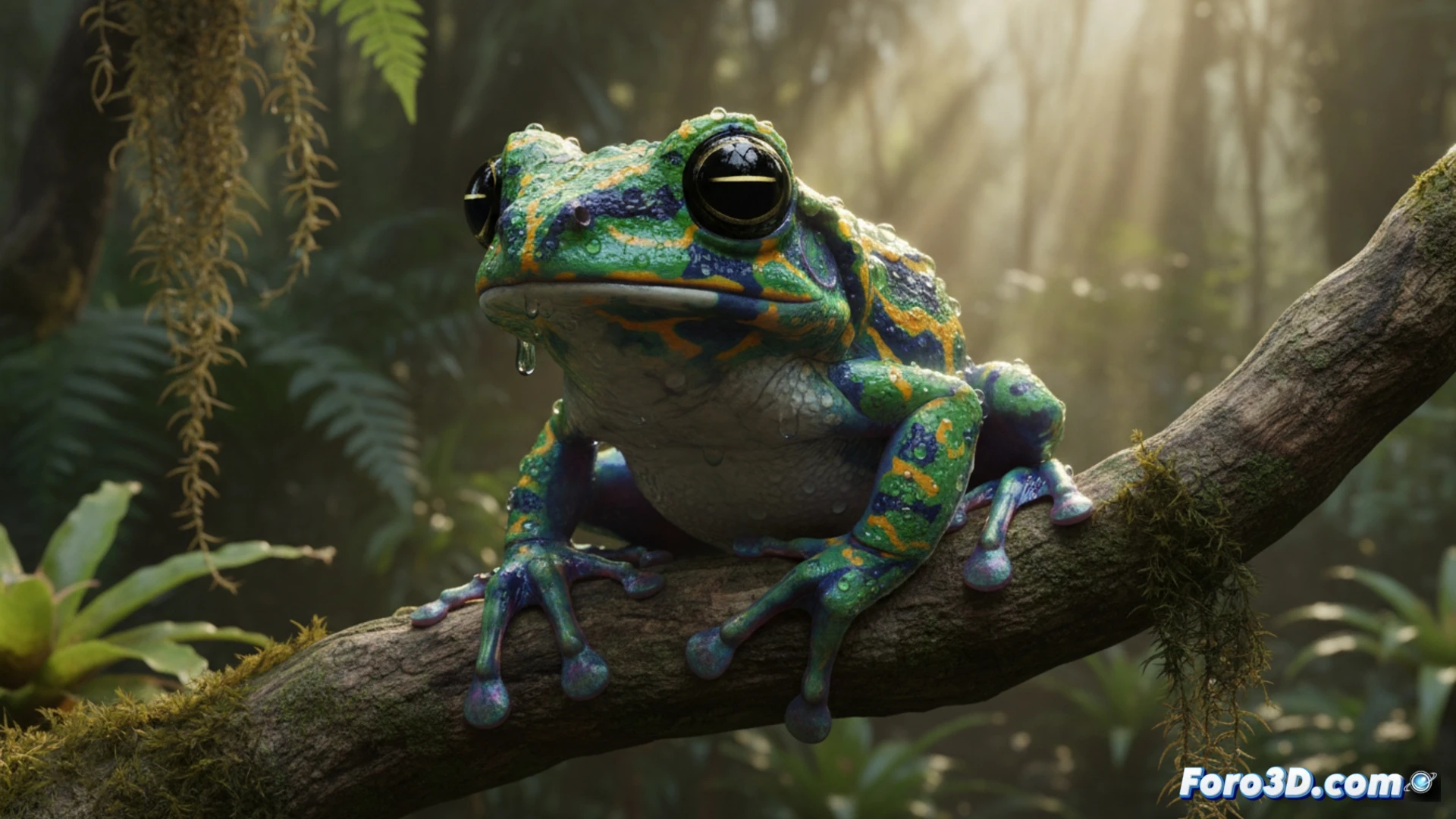
Science and fantasy have met on the misty slopes of Ecuador. Researchers have described a new species of amphibian, named Hyloscirtus tolkieni in honor of J.R.R. Tolkien. Its striking coloration, with orange spots on a dark green background and piercing yellow eyes, directly evokes the creatures of Middle-earth. For the scientific visualization community, this discovery represents a perfect case study of how 3D technology can capture the morphology of a species that seems to come straight out of a storybook.
Photogrammetry and Digital Anatomy of a Critical Species 🐸
From a technical standpoint, modeling Hyloscirtus tolkieni presents several challenges and opportunities. Its highly vascularized skin, with a specific granular texture, requires high-resolution photogrammetry techniques to capture the pores and small glands that define its surface. The coloration patterns, which act as camouflage among the lichens and mosses of its habitat, can be mapped using PBR (Physically Based Rendering) textures to achieve absolute realism in dynamic lighting environments. Furthermore, the structure of its adhesive toe discs, adapted for climbing rocks in torrents, is a key element for an accurate anatomical model, allowing biologists to study its locomotion without needing to handle live specimens.
The Bridge Between Reality and Tolkien Mythology 🌿
Beyond scientific accuracy, this 3D model offers an exceptional outreach tool. By rendering the frog in digital scenarios that mimic the Andean cloud forests, we can compare its forms with those of the Ents or the Elves of Lothlórien. This visual comparison, impossible to achieve in a traditional documentary, allows us to explain to the public how biological evolution generates aesthetic solutions that human fiction later idealizes. The 3D model thus becomes an ambassador for conservation, showcasing the real beauty of a species that needs protection from deforestation and climate change.
What specific technical challenges arise when 3D modeling a newly discovered species like Hyloscirtus tolkieni when photographic and biometric references are limited or come from specimens in non-ideal conditions?
(PS: fluid physics for simulating the ocean is like the sea: unpredictable and you always run out of RAM)