The fracture of a joint in a submarine pipeline is not a random event, but rather the consequence of accumulated microscopic damage under cyclic stress conditions. Wave action, fluctuating internal pressure, and electrochemical corrosion act synergistically to initiate and propagate cracks in stress concentration zones. This article explores how 3D material fatigue simulation allows visualizing the failure process and comparing the behavior of the original design with the actual collapse scenario. 🔧
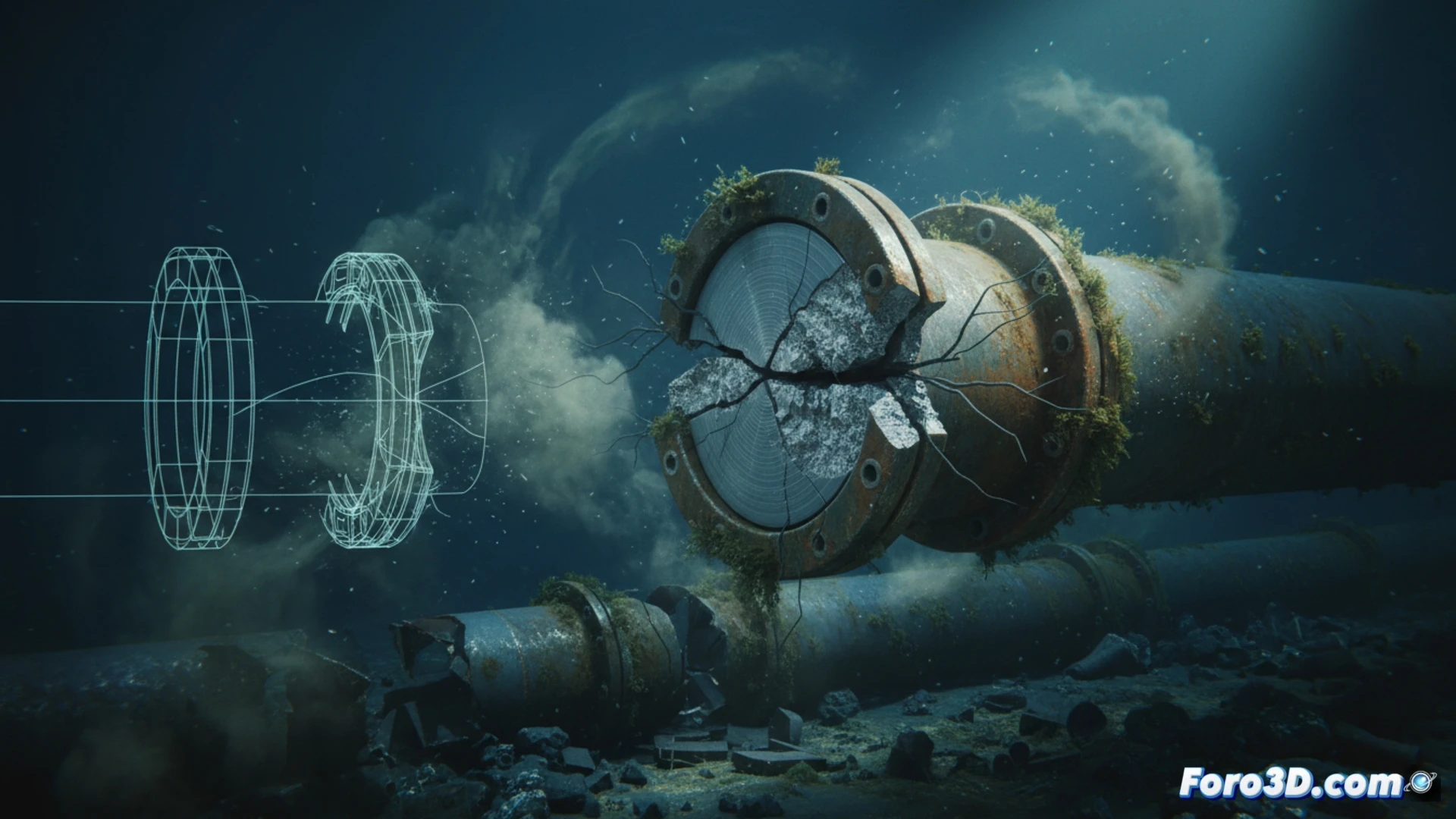
Numerical simulation of crack propagation under cyclic loading ⚙️
To model the failed joint, a parametric 3D model was built in finite element software, defining the exact geometry of the weld collar and the pipe wall thickness. Boundary conditions replicating the operating environment were applied: an internal pressure of 150 bar, an oscillating bending moment of 20 kNm generated by sea currents, and an accelerated corrosion profile in the weld zone. Fatigue analysis, based on Paris' law for crack growth, revealed that the von Mises equivalent stress was concentrated at a specific point in the joint, reaching peaks of 340 MPa. Stress heat maps showed a clear initiation zone in the weld bead, where the crack propagated at a rate of 0.5 mm per every 10,000 load cycles. The simulation visualized structural collapse after 1.2 million cycles, coinciding with field failure reports.
Lessons for design and failure prevention 🛠️
The 3D visualization of this process not only confirms the failure mechanism but also exposes the vulnerability of designs that do not consider multi-cycle fatigue in corrosive environments. The model allows virtual testing of solutions such as stress relief through larger curvature radii or the application of protective coatings. In this case, the simulation shows that a 15% increase in joint thickness would have delayed the appearance of the critical crack by 40%. For the engineer, the ability to predict and visualize structural collapse is the most powerful tool to prevent a joint from becoming the weak link in a submarine system.
In the 3D modeling of a submarine pipeline joint, how is information from environmental load cycles, such as currents and waves, integrated to accurately predict the location and initiation time of fatigue failure before macroscopic fracture manifests?
(PS: Material fatigue is like yours after 10 hours of simulation.)