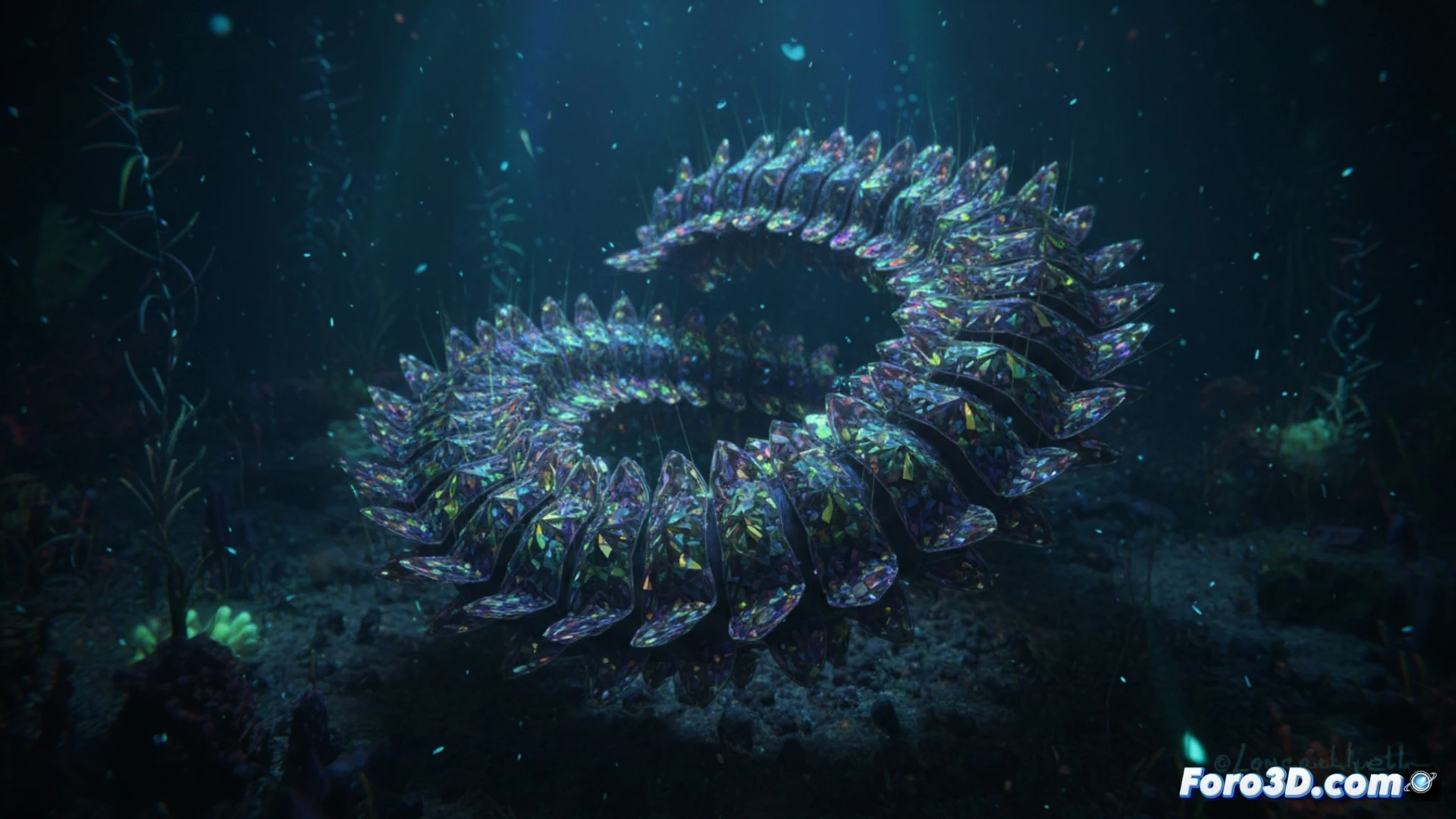
The discovery of the scaly Polychaeta worm in the Nazca Ridge, at a depth of 3,000 meters, presents a unique challenge for scientific visualization. Its scales, capable of decomposing light into a prismatic spectrum, require a 3D model that accurately reproduces the surface microstructure. This article explores the rendering and optical simulation techniques needed to recreate this phenomenon in a digital environment, allowing its study without access to the real specimen.
Digital reconstruction and bidirectional reflectance simulation 🔬
To model the prismatic effect, it is essential to capture the nanometric topography of the scales using focus photogrammetry or microCT. In Blender or Maya, a subsurface scattering shader with an anisotropic roughness map that mimics the parallel grooves of the cuticle can be applied. The bidirectional scattering distribution function (BSDF) must include a diffraction component, simulating spectral separation. Recreating the abyssal habitat involves setting up a single directional point light with exponential attenuation, equivalent to sunlight filtered at 3 km depth, and adding suspended sediment particles for a realistic volumetric effect.
Implications for interactive museum outreach 🎯
This 3D model allows comparing the structure of the Nazca polychaete with other bioluminescent polychaetes, such as the fire worm. In an interactive installation, the user could rotate the model and adjust the virtual depth, observing how the prismatic reflection fades as light absorption by water increases. This tool not only educates about optics in extreme ecosystems but also validates hypotheses about the function of these scales: possibly a camouflage or signaling mechanism in the abyssal darkness.
What specific challenges does optical fidelity and bathymetric data resolution present when 3D modeling the prismatic scales of the abyssal Polychaeta from the Nazca Ridge for scientific visualization?
(PS: at Foro3D we know that even manta rays have better social connections than our polygons)