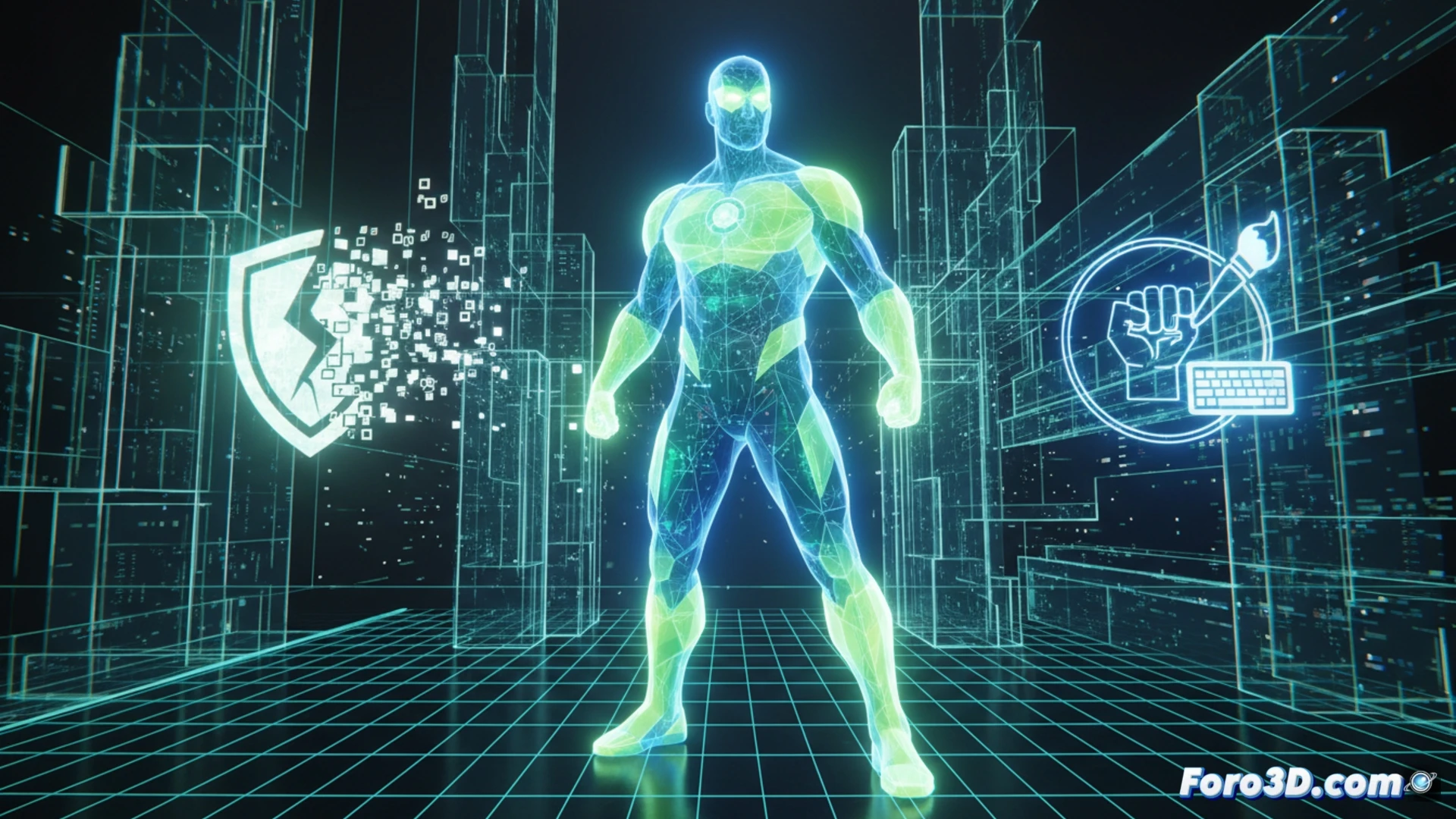
Doctor Spectrum, member of Marvel's Squadron Supreme, manipulates a power prism to generate solid light constructs. For a 3D modeler, this character presents a fascinating technical challenge: recreating translucent geometry and volumetric effects that simulate light matter. However, as it is Marvel intellectual property, any digital reproduction must consider the boundaries between artistic homage and legal infringement.
Solid light techniques in Blender with the power prism 🔮
To model Doctor Spectrum's constructs in Blender, it is recommended to use the Cycles render engine with volume nodes. The power prism can be represented as a glass object with a dispersion material (Glass BSDF with high IOR). Solid light structures (shields, beams, or platforms) are best achieved with low-poly meshes combined with a subdivision modifier and a translucent emission shader. For the color-changing effect, the Hue/Saturation node in the material can be animated. It is crucial to use procedural textures (clouds or Musgrave) within the volume to give it that ethereal texture characteristic of the comic.
Digital activism and the reinterpretation of icons ✊
Sharing a 3D model of Doctor Spectrum on platforms like Sketchfab or Thingiverse involves legal risk, as Marvel fiercely protects its catalog. However, digital activism finds in these characters a vehicle for social messages. A solid light model can be reused in animations that criticize the abuse of power or mass surveillance, transforming the hero into a symbol. The key lies in artistic transformation: if the model is used for a critical or educational work, it may qualify for fair use, although it is always advisable not to commercialize it without a license.
How can the 3D modeling of Doctor Spectrum's solid light constructs be used to reflect on the limits of copyright in digital art and the activist appropriation of corporate images?
(PS: if your virtual reality installation doesn't change the world, at least let it not lag)