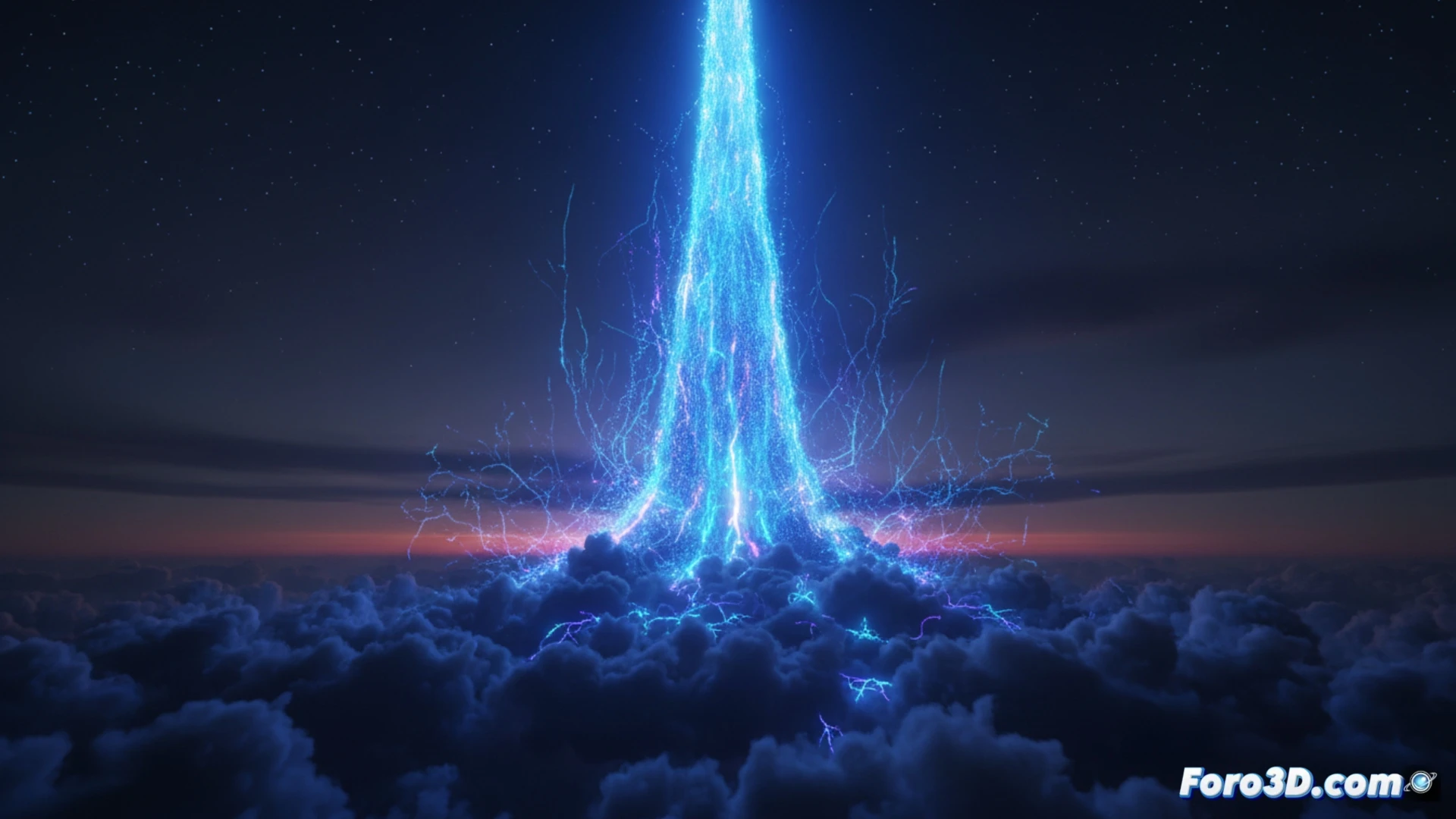
Blue Jets are electrical discharges that ascend from the top of storms into the stratosphere, reaching 50 km in height. Their characteristic blue color comes from the excitation of atmospheric nitrogen. Unlike common lightning, they are slower and more difficult to observe. To understand their dynamics, 3D scientific visualization becomes essential, allowing these phenomena to be modeled with specialized software.
Technical Workflow: VGSTUDIO MAX, COMSOL, and Mimics ⚡
Modeling a Blue Jet requires a multi-platform approach. First, Materialise Mimics can process radar data or high-resolution satellite imagery to segment clouds and the plasma column. Then, COMSOL Multiphysics, in its Bio-electromagnetism module, allows simulating the propagation of the electric field and the ionization of nitrogen in the atmosphere. Finally, Volume Graphics VGSTUDIO MAX imports these results for a volumetric representation. Here, charge density, plasma temperature, and blue light emission are visualized, applying transparencies and color maps to differentiate atmospheric layers.
Applications in Meteorology and Atmospheric Physics 🌩️
This workflow not only creates striking animations for outreach but also allows researchers to analyze energy transfer between the troposphere and stratosphere. By simulating nitrogen excitation in 3D, high-altitude thunderstorm patterns and their impact on atmospheric chemistry can be predicted. VGSTUDIO MAX's volumetric visualization turns complex data into analytical tools, revealing the internal structure of a phenomenon that, until recently, was invisible to science.
How can the electromagnetic dynamics of a Blue Jet be modeled to integrate it into a 3D visualization engine like Blender or Houdini, and what physical parameters are key to achieving a realistic simulation of its ascending behavior in the stratosphere
(PS: modeling manta rays is easy, the hard part is making them not look like floating plastic bags)