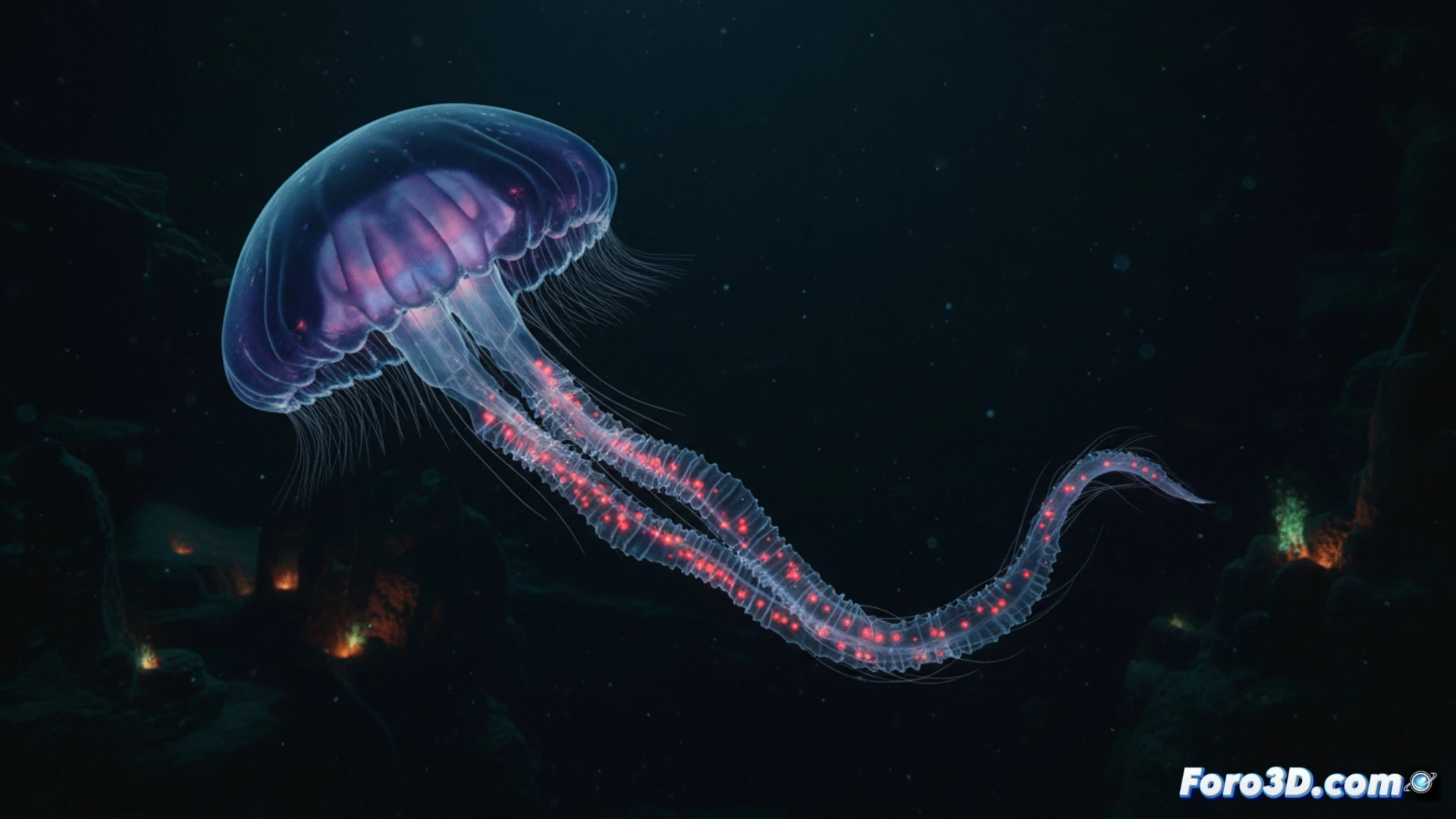
The oceanic midnight zone, a realm of perpetual darkness, harbors creatures of fascinating rarity. The newly described Atolla reinhardi, nicknamed the Monterey Crown Jellyfish, defies the standard morphology of its genus. Its most distinctive feature is a single hypertrophied tentacle, which can reach disproportionate lengths compared to the rest of its anatomy. This appendage, likely an adaptation for capturing prey in a low-density environment, represents both a challenge and a unique opportunity for scientific 3D visualization.
Technical challenges in anatomical reconstruction and bioluminescence simulation 🌊
For an accurate model, it is essential to start from tomography or photogrammetry data of preserved specimens. The main structure is a hemispherical bell with radial grooves that mimic a crown. The greatest challenge is the dynamic simulation of the hypertrophied tentacle, which must undulate with the hydrodynamics of the water column without intersecting the body. Texturing requires displacement maps for the stinging cells (cnidocytes) and emission maps to recreate bioluminescence. This light, typically blue or violet, must be animated as a defensive flash. Sectional cuts with transparency shaders will allow visualization of the gastrovascular cavity and the distribution of the diffuse nervous system, differentiating it from species like Atolla wyvillei that possess multiple long tentacles.
Evolutionary solitude as inspiration for design 🐙
The uniqueness of A. reinhardi invites us to reflect on extreme specialization. In an ecosystem where resources are scarce, investing all energy into a single massive tentacle, rather than several small ones, could be an optimized hunting strategy. Visualizing this anatomy is not just a technical exercise; it is a narrative about adaptive pressure. When rendering the scene, we can place the jellyfish floating in absolute blackness, with its long tentacle extending like a biological fishing line, reminding us that beauty in the depths often arises from the most pragmatic necessity.
What specific technical challenges arise when 3D modeling the transparency and bioluminescence of Atolla reinhardi, considering its habitat in the oceanic midnight zone?
(PS: modeling manta rays is easy; the hard part is making them not look like floating plastic bags)