The discovery of Poseidon's Squid (Mobydickia poseidonii) not only expands the tree of life but redefines our understanding of cephalopods. Recovered from the stomach of a sperm whale, this specimen represents an entirely new zoological family. For scientific visualization, this finding poses a fascinating challenge: reconstructing in 3D a creature of which we have barely any remains, using DNA data and tissue morphology to generate a rigorous and educational anatomical model.
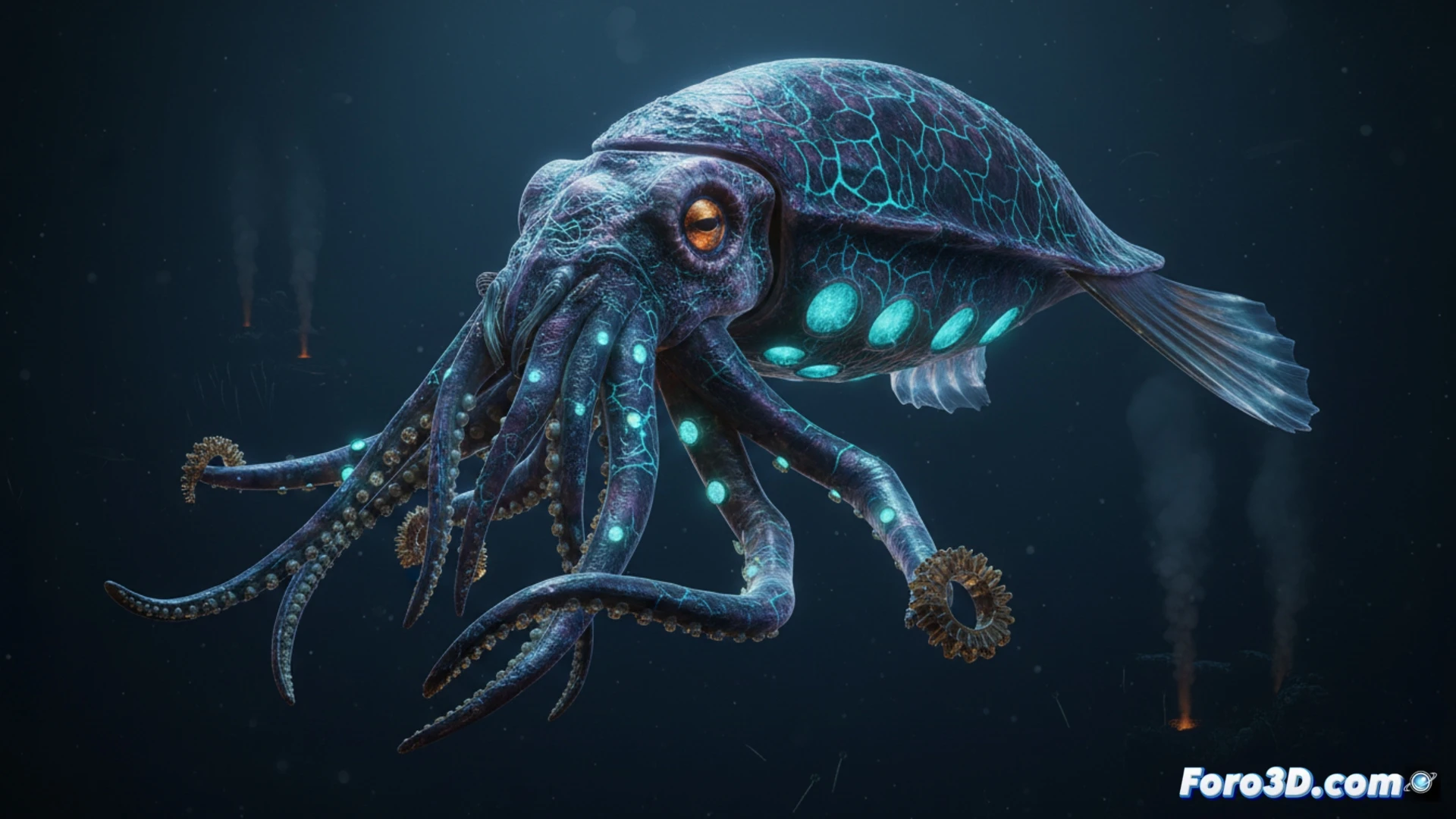
Anatomical reconstruction and comparative analysis in 3D environments 🦑
The modeling process for Mobydickia poseidonii begins with the digitization of available fragments. From microscopy images and descriptions of radulae and suckers, a virtual skeleton is generated. The key to the model lies in phylogenetic comparison: using morphing and rigging tools, characteristics from known families (such as Ommastrephidae) are interpolated to fill anatomical gaps. The result is a high-polygon 3D asset that allows interactive rotations, cross-sections, and simulations of locomotion in water. This model serves as a basis for visualizing predator-prey interaction with the sperm whale, recreating the hydrostatic pressure and bioluminescence of the abyssal habitat.
The value of digital art in modern taxonomy 🎨
Beyond aesthetics, the scientific visualization of Mobydickia poseidonii serves a critical function: democratizing access to a discovery that would otherwise remain locked in a jar of formaldehyde. By presenting a navigable 3D model, researchers can formulate hypotheses about its behavior and ecology without needing to handle the delicate original specimen. For the general public, this representation transforms abstract data into a tangible experience, connecting the excitement of the discovery with the precision of the scientific method.
What specific technical challenges does the 3D modeling of the bioluminescent structures and gelatinous morphology of Mobydickia poseidonii present to achieve accurate scientific photorealism in abyssal visualization environments?
(PS: fluid physics for simulating the ocean is like the sea: unpredictable and you always run out of RAM)