Millennia, a 4X strategy title developed in Unity, stands out for its system of historical eras that transforms both the game mechanics and the visual representation of the map. Using C# as the programming foundation, the studio has achieved a pipeline where the illustrated terrain tiles mutate in real-time, reflecting technological advances and cultural changes. This technical approach allows each game session to offer coherent visual progression without sacrificing real-time performance.
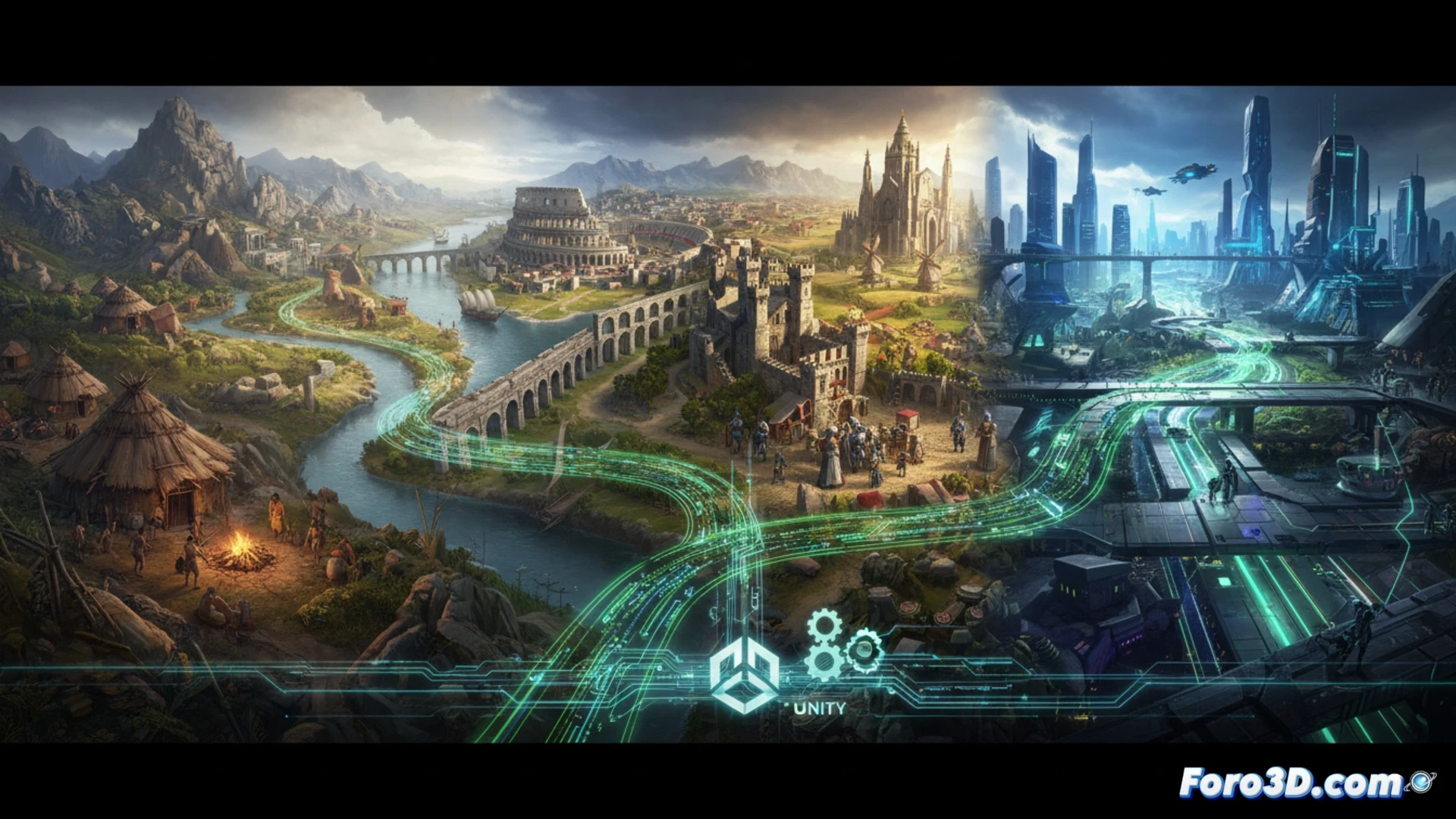
Technical implementation of the era system in Unity 🎮
To achieve the visual evolution of the map, Millennia employs a Scriptable Objects system in Unity that defines each era as an independent asset. Each tile, modeled as a GameObject with a dynamic MeshRenderer, changes its texture and geometry through a central controller written in C# that evaluates the player's progress. Optimization is achieved with texture atlases and LODs (Level of Detail) that reduce draw calls in areas far from the camera. Additionally, the use of coroutines and Unity's job system allows updating large portions of the map without blocking the main thread, maintaining the necessary fluidity in a 4X game where the camera constantly moves.
Lessons for developers: Pipeline and key tools 🛠️
The Millennia case demonstrates that a pipeline based on Unity and C# can handle the complexity of a 4X game without resorting to external engines. The key is to separate the state logic (eras) from the visual representation (tiles), using events and delegates to synchronize changes. For developers, the lesson is to prioritize a modular asset system from the start, where each era behaves as a visual and mechanical plugin. This avoids the bottleneck of having to redraw the map manually, allowing code and art to evolve in parallel.
How they implemented the era transition system in Millennia using Unity with C# so that each historical change modifies both the visual appearance and the 4X mechanics without breaking game balance
(PS: 90% of development time is polishing, the other 90% is fixing bugs)