Electrode migration in Deep Brain Stimulation (DBS) is a silent complication that compromises treatment efficacy in patients with Parkinson's disease or essential tremor. When electrode fixation lacks the necessary elasticity to absorb skull micromovements, displacement can nullify months of surgical planning. The combination of software such as Brainlab, Mimics, and Ansys Biomechanics now allows modeling this phenomenon with millimeter precision.
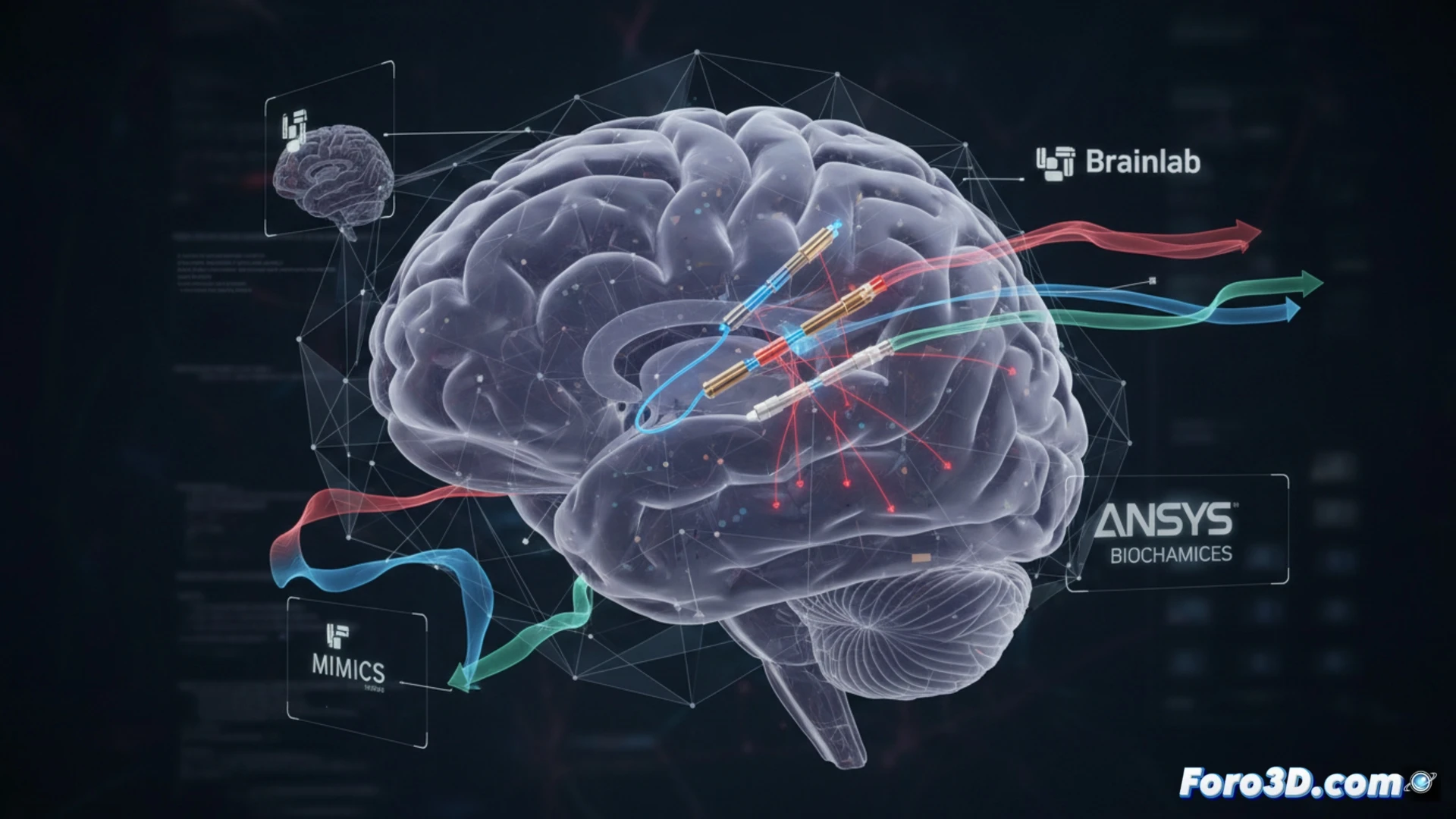
Workflow with Mimics, Brainlab, and Ansys Biomechanics 🧠
The process begins in Mimics, where brain structures and the skull are segmented from MRIs and CT scans. The three-dimensional model is exported to Brainlab to define the ideal surgical trajectory and electrode position. Subsequently, in Ansys Biomechanics, viscoelastic properties are assigned to brain tissue, and a specific Young's modulus for titanium or polyurethane is assigned to the electrode. The simulation applies cyclic loads that mimic the patient's physiological movements, visualizing stress distribution at the tissue-electrode interface. The results reveal critical points where insufficiently elastic fixation generates shear forces that initiate migration.
Towards intelligent and predictable fixation 🔧
Biomechanical simulation not only diagnoses the problem but also allows redesigning the anchoring system. By varying parameters such as the fixation clip's stiffness or the electrode's depth, biomedical engineers can find the combination that minimizes displacement without damaging the parenchyma. This approach, which combines 3D surgical planning with finite element validation, is transforming DBS into a safer and more durable procedure, reducing the need for reoperations.
How 3D simulation of electrode migration in DBS affects the prediction of therapeutic failures in patients with Parkinson's disease.
(PS: If you 3D print a heart, make sure it beats... or at least doesn't cause copyright issues.)