Jacob Dzwinel's team has released Midnight Fight Express, a title that demonstrates how an accessible engine like Unity can be combined with professional tools to achieve impactful results. This isometric beat 'em up not only stands out for its stylized violence, but also for a solid technical foundation worth analyzing. From motion capture to reactive lighting, the game is a case study for independent developers looking to polish their graphics pipeline without a triple-A budget.
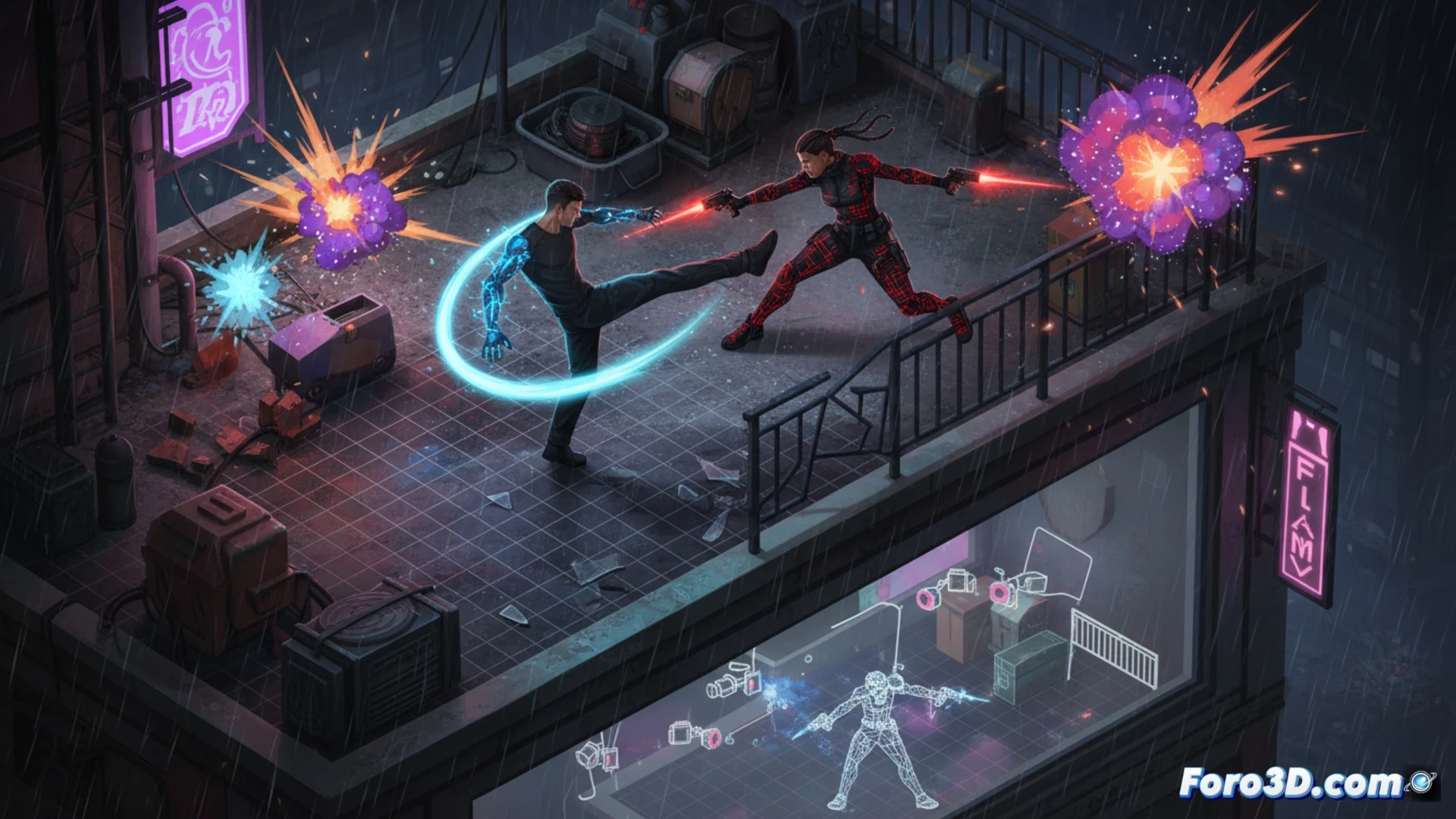
Xsens Capture and Maya Modeling for Fluid Animation 🎮
One of the game's pillars is its animation system, powered by Xsens suits for motion capture. This hardware allows recording complex human movements and transferring them directly to a polygonal character. In Midnight Fight Express, the use of Xsens avoids the typical stiffness of isometric games, where the top-down camera often hides animation details. The captured data is cleaned and retargeted in Autodesk Maya, adjusting transitions so that punches have weight and dodges feel natural. For an indie developer, investing in an Xsens system (even rented) can be more cost-effective than hours of manual keyframing, especially when seeking realism in fast-paced combat.
Dynamic Lighting as Visual Narrative 💡
The game's grimy urban aesthetic would not be effective without dynamic lighting that reacts to combat. Unity here allows a subtle but powerful technical trick: point lights activate with each impact, creating flashes that guide the player's attention amidst the chaos. This not only improves visual legibility but also reinforces the sense of impact. For developers, the advice is clear: do not underestimate lights as a gameplay tool. A reactive lighting system, even a simple one, can transform a static scene into a living one without the need for ultra-realistic textures.
Considering that Midnight Fight Express uses Unity and Maya for its isometric action, how does Jacob Dzwinel's team optimize performance and collision detection to maintain fluidity in combat with multiple enemies on screen using an isometric camera?
(PS: shaders are like mayonnaise: if they break, you start all over again)