The promise of perovskite solar cells faces a silent enemy: material fatigue. After thermal cycles, the encapsulation develops microcracks that act as gateways for moisture. This process not only degrades the crystalline structure but also drastically reduces the device's efficiency. Understanding this failure through 3D modeling is key to extending its lifespan. 🔬
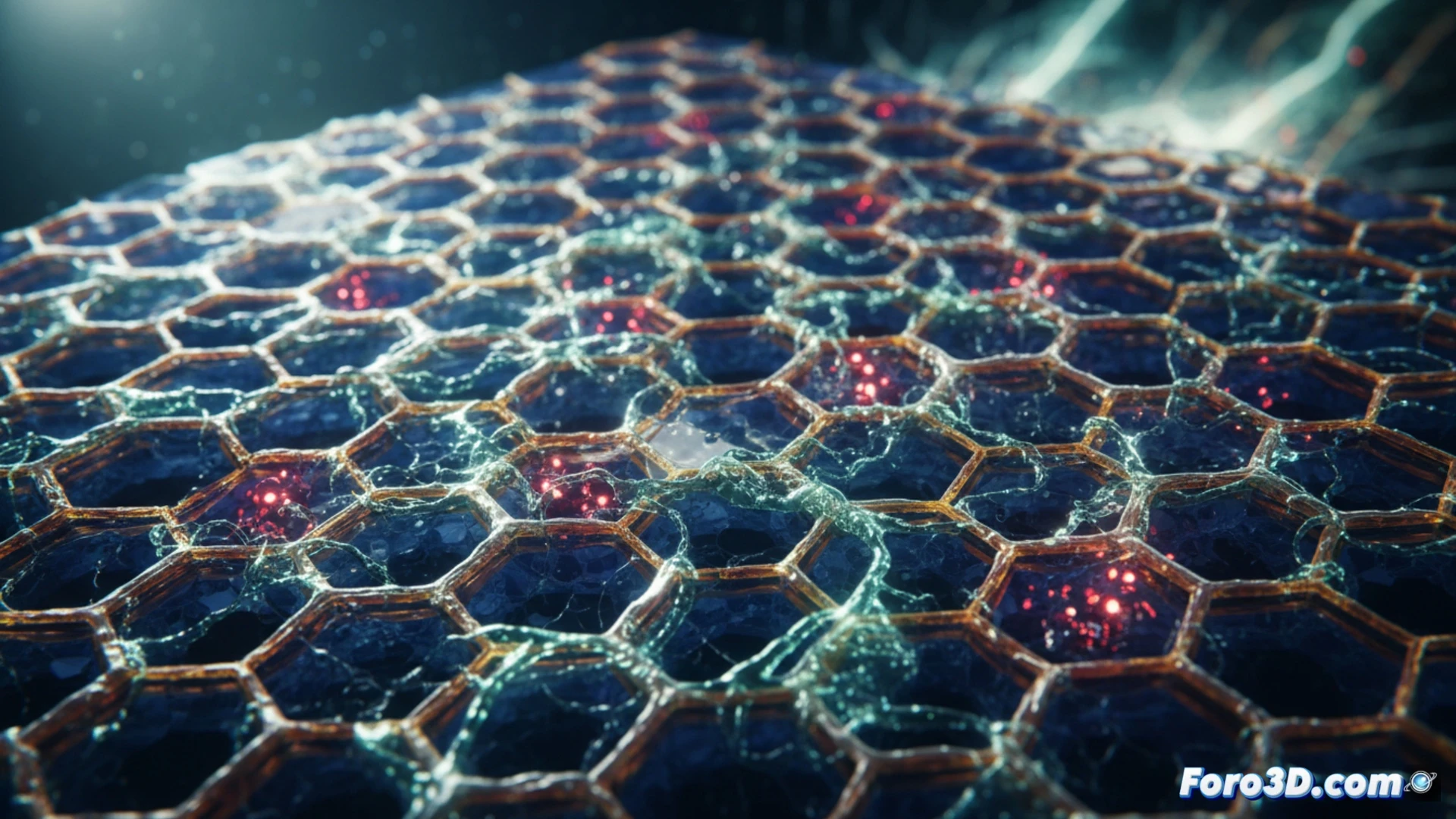
Multiphysics Analysis of Crystalline Degradation 🧊
To visualize this phenomenon, the workflow begins with Volume Graphics, where real microcracks in the encapsulation are scanned and reconstructed in 3D. This geometric model is exported to COMSOL Multiphysics, where the Solid Mechanics and Species Transport modules are coupled. The simulation calculates how moisture infiltrates through the cracks under cyclic stress, triggering the decomposition of the perovskite crystal lattice. The results, processed in MATLAB, generate moisture concentration maps and fatigue curves that predict the exact point of structural failure.
Lifespan Prediction: The Sealing Challenge ⏳
The simulation reveals that the cell's lifespan depends not only on the active material but also on the integrity of the encapsulation. By cross-referencing fatigue data with chemical degradation kinetics, design thresholds can be established. The true technical challenge is no longer just efficiency, but the engineering of barriers that withstand environmental fatigue. Mastering this modeling is the path toward commercially viable perovskite.
How do 3D simulations model the effect of moisture on microcrack propagation during thermal cycles in perovskites?
(PS: Material fatigue is like yours after 10 hours of simulation.)