The recent explosion incident in a green hydrogen electrolyzer has brought the spotlight onto a silent enemy: material fatigue. The failure synopsis points to microcracks in the membrane that allowed the explosive mixture of gases. This is not a random accident, but the logical consequence of a mechanical and thermal degradation process that, ignored in simulations, culminates in a catastrophic collapse.
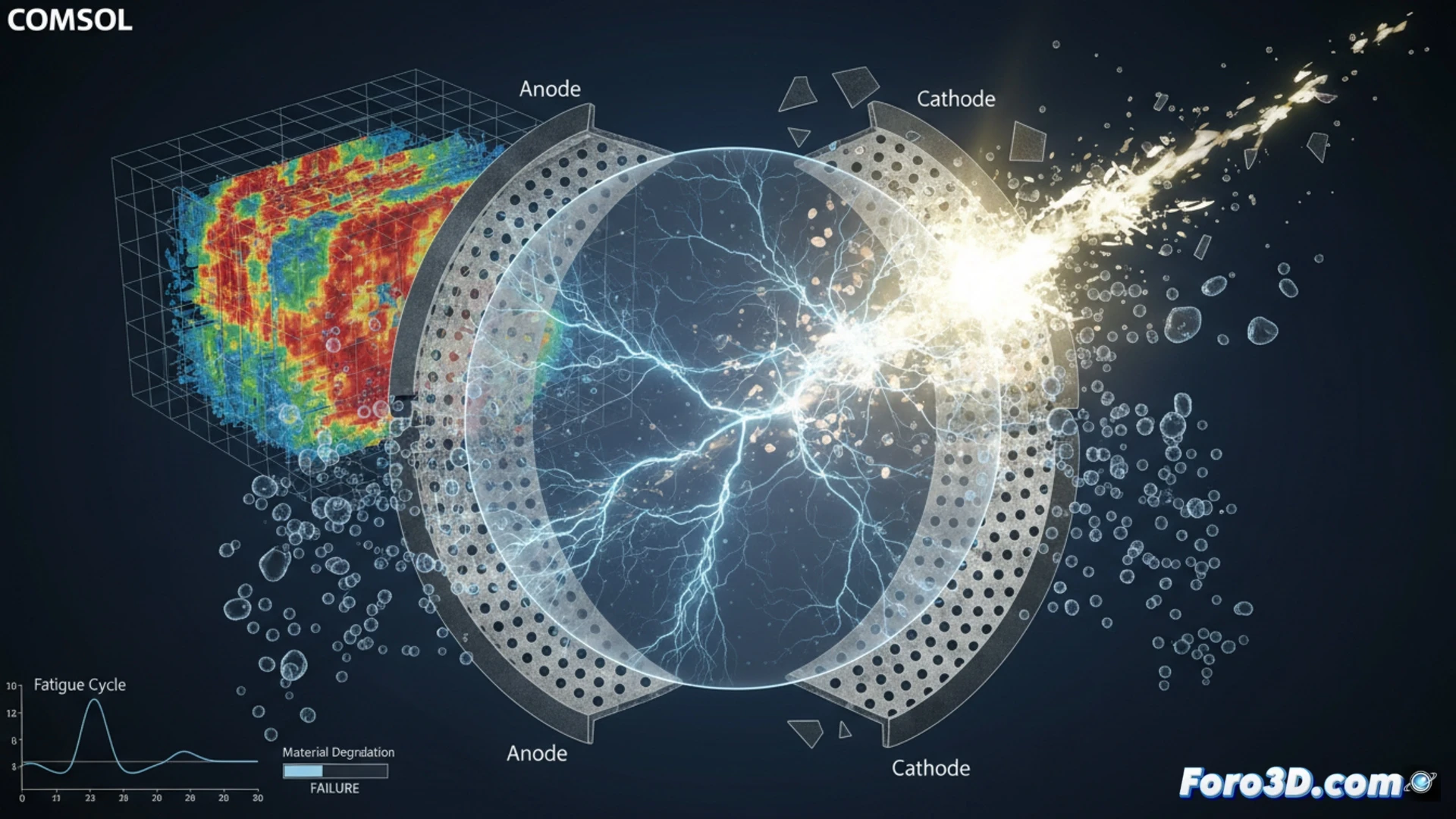
Multiphysics Simulation: From microcrack to gas mixture 🔬
To understand the collapse, we must recreate the process. In COMSOL Multiphysics, we model the membrane under pressure and temperature cycles. The fatigue module reveals stress concentration points at the electrode-membrane interface, where cyclic stress generates submillimetric microcracks. Once the crack initiates, the coupled model of fracture mechanics and species transport allows visualizing how hydrogen and oxygen begin to mix through the crack. Using Volume Graphics, we analyze real tomographies of damaged membranes to validate the crack morphology, while SolidWorks provides the exact geometry of the electrolyzer to define boundary conditions and safety thresholds in the design.
Lessons for design: The invisible threshold ⚠️
The error was not the explosion, but failing to predict fatigue. Simulations show that microcracks do not appear from a single overload, but from the accumulation of thermal and mechanical cycles. A safe design must include a fatigue life analysis that establishes a stress concentration threshold below which the membrane operates without risk of crack nucleation. Ignoring this limit is inviting disaster. Simulation is not a luxury; it is the barrier between energy efficiency and catastrophe.
As an engineer, what finite element simulation methodology do you recommend to accurately model the propagation of microcracks in polymer electrolyzer membranes subjected to pressure and temperature cycles, and what fatigue parameters do you consider critical for predicting catastrophic failures like the recent green hydrogen explosion incident?
(PS: Material fatigue is like yours after 10 hours of simulation.)