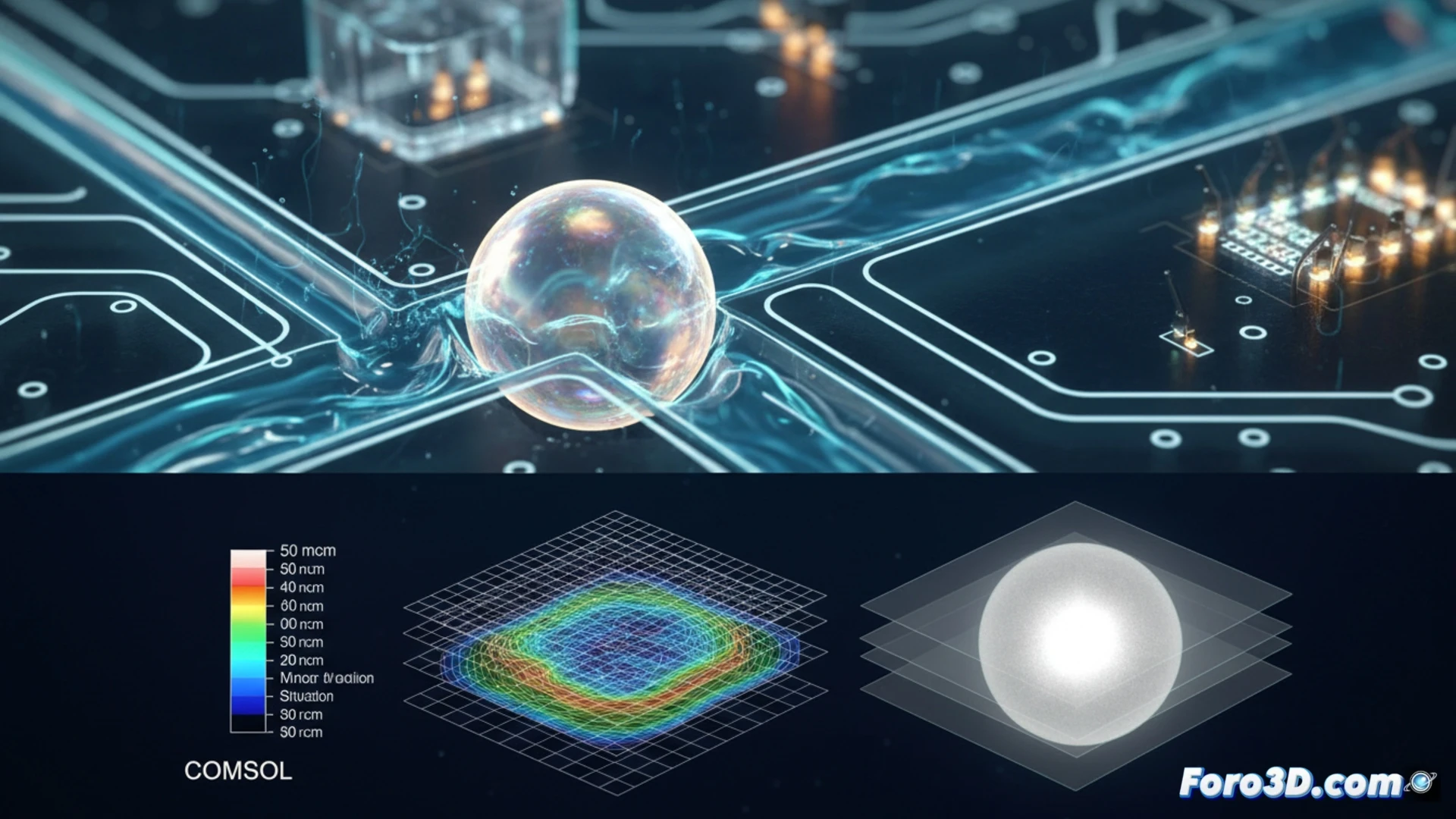
When an epidemic strikes, diagnostic speed is critical. However, a batch of biofluidic chips began producing false negatives, compromising outbreak containment. The cause was not a reagent error, but a microscopic manufacturing defect: an air bubble trapped in a mixing channel just 50 microns wide, blocking laminar flow and altering reaction kinetics.
Micro-CT and Multiphysics Simulation: The Chip Autopsy 🔬
To locate the defect without destroying the device, micro-computed tomography (micro-CT 3D) with sub-micrometer resolution was used. The volumetric data was processed in Volume Graphics VGSTUDIO MAX and Dragonfly, revealing the bubble as a spherical discontinuity in the channel. With this real geometry, a simulation was run in COMSOL Multiphysics. The multiphysics model coupled computational fluid dynamics (CFD) and species transport. The results confirmed that the bubble created a stagnant recirculation zone, preventing homogeneous mixing of the analyte with the reagent and reducing the detection signal by 40%.
Lessons for Precision Microfabrication ⚙️
This case demonstrates that, at the 50-micron scale, a simple air bubble acts as an unwanted shut-off valve. The integration of micro-CT as a non-destructive inspection technique, along with predictive simulation in COMSOL, allows semiconductor and lab-on-a-chip device manufacturers to identify critical air entrapment points in channel design. The final 3D visualization in KeyShot not only serves to document the failure but also to educate design teams on the importance of corner geometry and filling pressure in micrometer-scale assembly processes.
Considering that trapped microbubbles in 50-micron channels are a recurring failure in the manufacturing of these chips, which 3D microfabrication technique, such as two-photon lithography or two-photon polymerization printing, offers superior resolution for designing bubble traps or channel geometries that prevent their formation without compromising flow rate or integrity?
(PS: 180nm are like relics: the smaller they are, the harder they are to see with the naked eye)