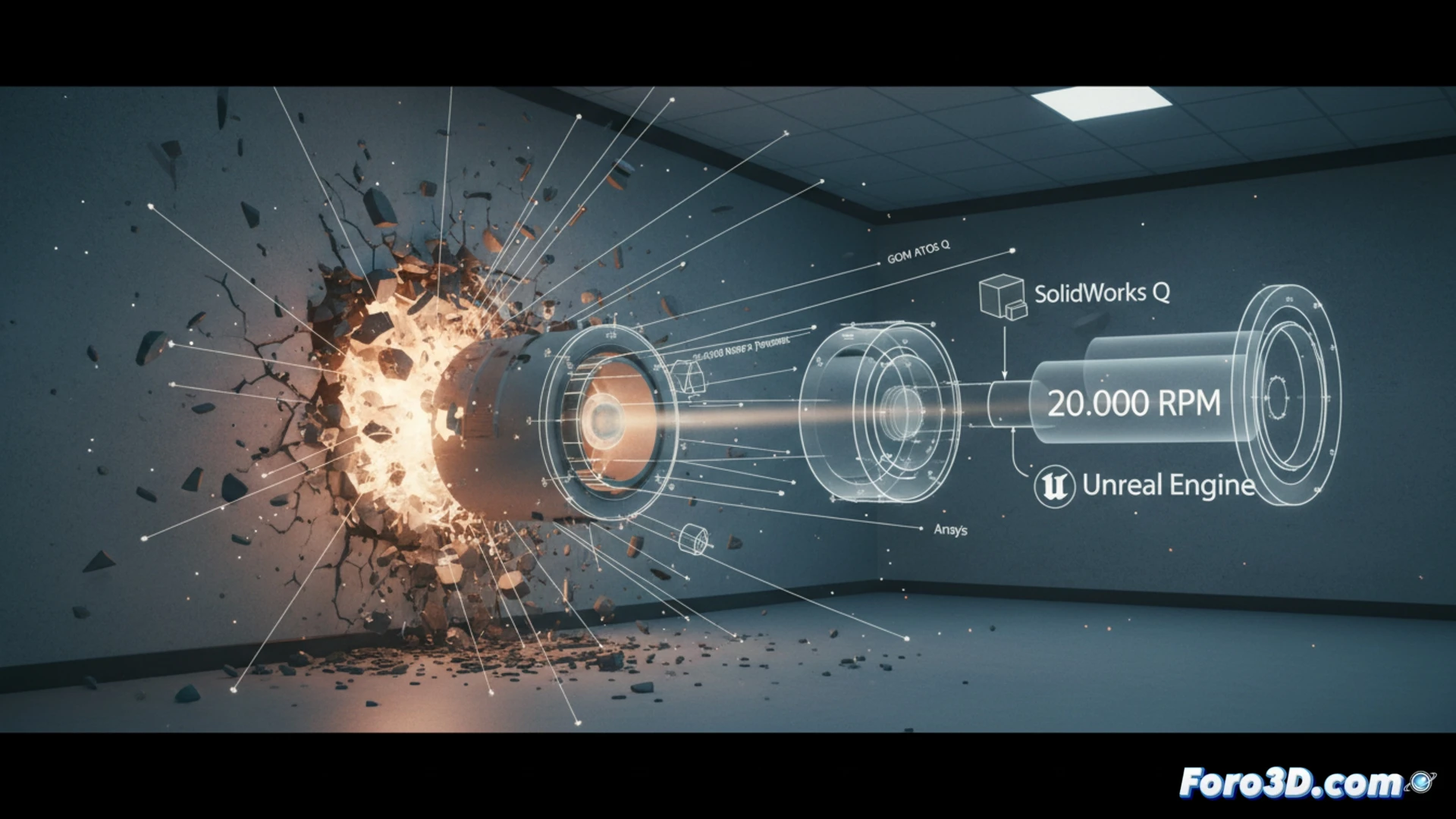
A laboratory centrifuge exploded at 20,000 RPM, launching its rotor through the building like a projectile. 3D scanning with the GOM ATOS Q revealed the cause: a micro-air bubble trapped in the metal casting. This microscopic defect generated a catastrophic imbalance, turning the machine into a kinetic bomb. The accident, though violent, allowed the development of a forensic pipeline combining optical metrology and dynamic simulation to prevent future disasters.
Forensic Reconstruction: From Scanning to Rigid Body Dynamics 🔬
The forensic team digitized the deformed rotor with a GOM ATOS Q scanner, capturing every crack and porosity. The data was imported into SolidWorks to reconstruct the original CAD model and the post-explosion geometry. In Ansys Rigid Body Dynamics, the rotation up to 20,000 RPM was simulated, introducing the micro-bubble as a density variation of 0.03 grams. The pipeline calculated the kinetic energy released upon impact: 450 kilojoules, equivalent to the detonation of 100 grams of TNT. The simulation validated that the bubble, invisible to the naked eye, shifted the center of mass enough to fracture the support in 0.2 seconds.
Visualization and Lessons for Industrial Safety ⚙️
Using Unreal Engine, engineers recreated the rotor's trajectory through walls and equipment, generating a training video for inspectors. The conclusion is clear: quality controls in foundries must include computed tomography or ultrasound to detect micro-bubbles. This case demonstrates that a 0.1-millimeter defect can release enough energy to destroy a laboratory. Safety lies not only in RPM limits but in the homogeneity of the material at the microscopic level.
Would you simulate the event with Houdini or a game engine?