The integration of graphene into optical components promises to revolutionize photonics, but its sensitivity to ultraviolet radiation poses serious durability challenges. A recent failure study of a graphene lens exposed to UV has shown that delamination is not a random event, but a process governed by the micro-topography of the interface. Using a combination of atomic force microscopy (AFM), GOM Inspect software for 3D metrology, and image processing algorithms in MATLAB, researchers have successfully mapped the shear and lift-off zones of the material with nanometer precision.
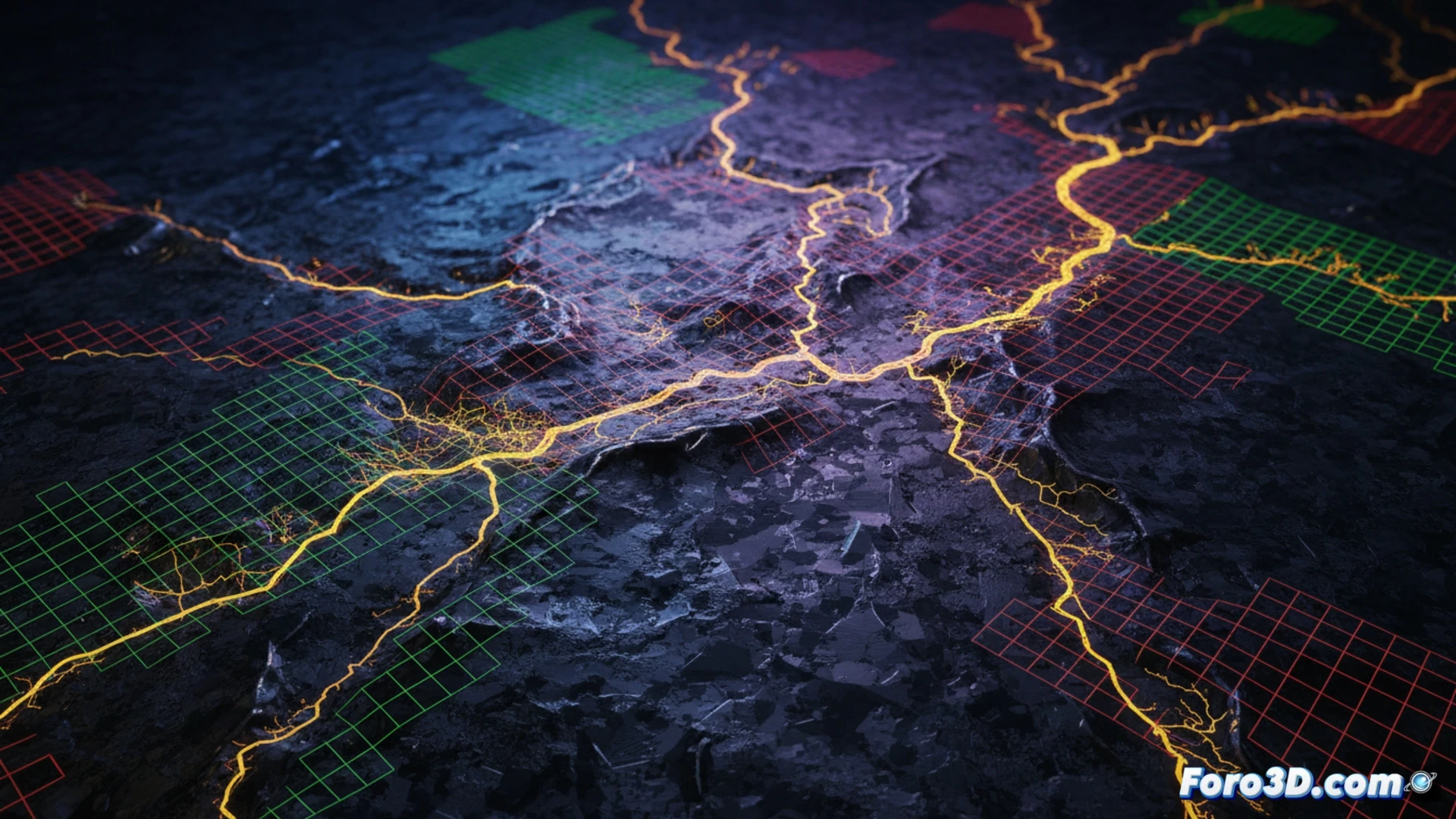
Analytical workflow: from AFM topography to failure map 🔬
The process begins with the acquisition of topographic data using AFM in tapping mode, generating point clouds with sub-nanometer lateral resolution. These surfaces are imported into GOM Inspect to remove background noise and correct global tilt, obtaining a flat reference surface. Subsequently, MATLAB processes the height matrices to calculate roughness parameters such as Ra and Rq, but the true finding lies in the detection of local height gradients. By applying a modified Sobel filter and dynamic thresholds, regions where the slope exceeds a critical angle, indicative of incipient delamination, are identified. Cross-correlation analysis between phase maps and topography allows distinguishing between surface wrinkles and true adhesion failures, a crucial step for understanding the failure mechanism.
Implications for solid-state optics design 💡
The ability to predict degradation in graphene lenses through micro-topography offers a roadmap for designing more robust protective coatings and interface architectures. This approach not only validates the utility of AFM as a quality control tool but also demonstrates that mathematical image processing can convert raw topographic data into lifetime indicators. For the materials science community, this method represents a bridge between laboratory characterization and device engineering, enabling the anticipation of failures before they compromise advanced optical systems such as those used in quantum communications or high-precision sensors.
How does the micro-topography revealed by AFM affect the optical functionality of graphene lenses after exposure to UV radiation?
(PS: Visualizing materials at the molecular level is like looking at a sandstorm with a magnifying glass.)