A temperature increase of just a few micro-Kelvins was enough for a quantum processor to lose its delicate superposition state. The cause pointed to a heat leak from infrared radiation, but the origin was invisible to the naked eye. Thanks to a combined workflow of volumetric scanning and 3D thermal simulation, engineers located a micro-pore in the Helium-3/Helium-4 mixing chamber of the dilution refrigerator.
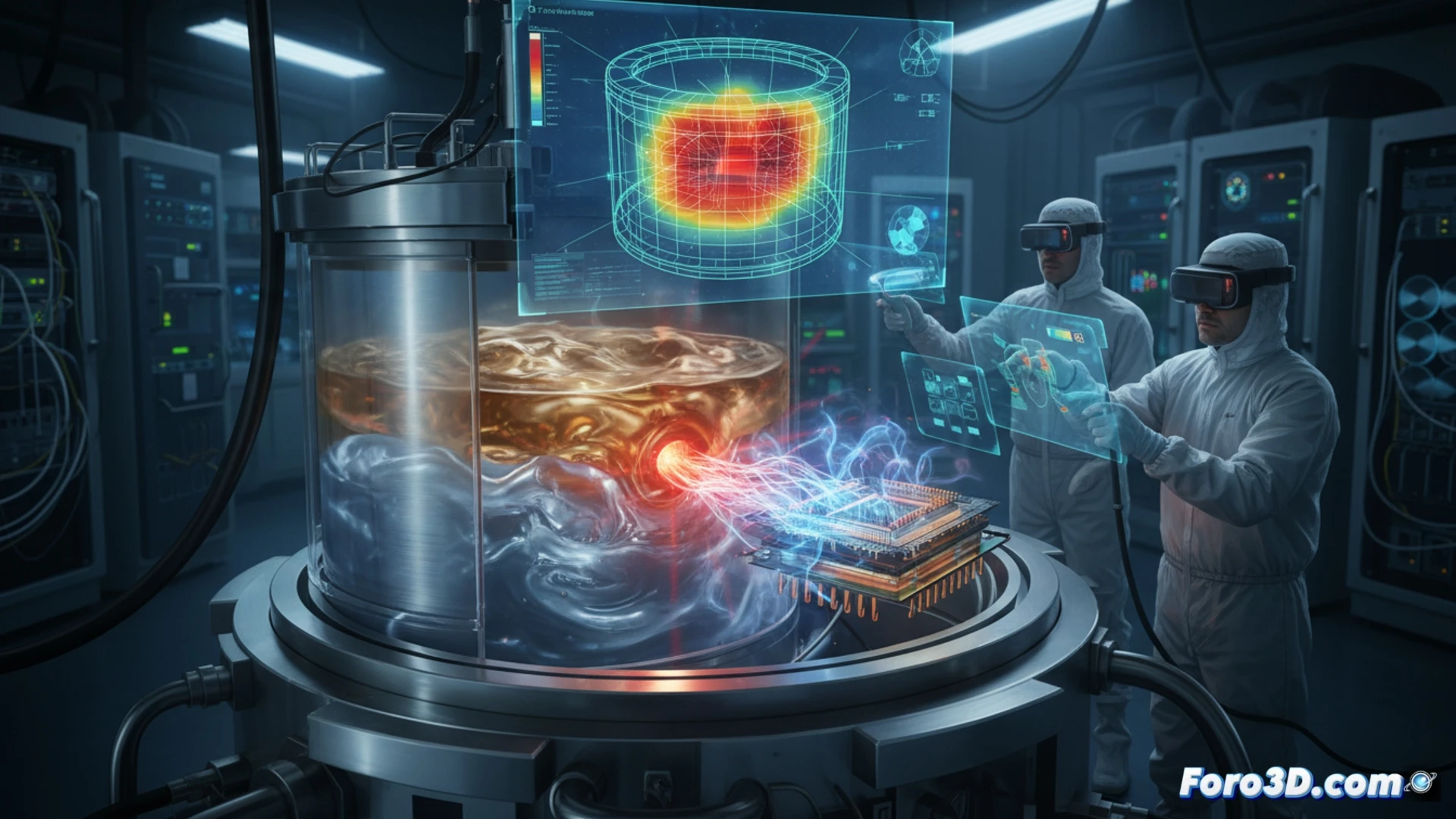
Simulation workflow for cryogenic defect detection 🔬
The process began with a high-resolution computed tomography scan of the mixing chamber block, processed in Volume Graphics to reconstruct the exact geometry of the suspected micro-pore. This volumetric mesh was exported to COMSOL Multiphysics, where blackbody radiation heat transfer was modeled at milli-Kelvin temperatures. The thermal analysis revealed that the pore, with sub-micrometer dimensions, acted as a waveguide for parasitic infrared radiation. To validate the model, a complementary study was performed in SolidWorks Thermal Analysis, confirming that the thermal gradient induced by the defect was sufficient to break qubit coherence.
Microfabrication as the frontier of quantum coherence ⚛️
This case demonstrates that the greatest enemy of a quantum computer is not just electrical noise, but the geometric perfection of its cryogenic components. A single micro-pore, a defect that would be irrelevant in the conventional semiconductor industry, becomes a thermal catastrophe at the quantum scale. The integration of tools like COMSOL and Volume Graphics not only enables fault diagnosis but establishes a new quality standard for precision microfabrication in ultra-low temperature systems.
How can heat transfer through a micro-pore in the mixing chamber be mathematically modeled to predict the critical temperature threshold that induces quantum coherence loss in a superconducting processor?
(PS: simulating a 200mm wafer is like making a pizza: everyone wants a slice)