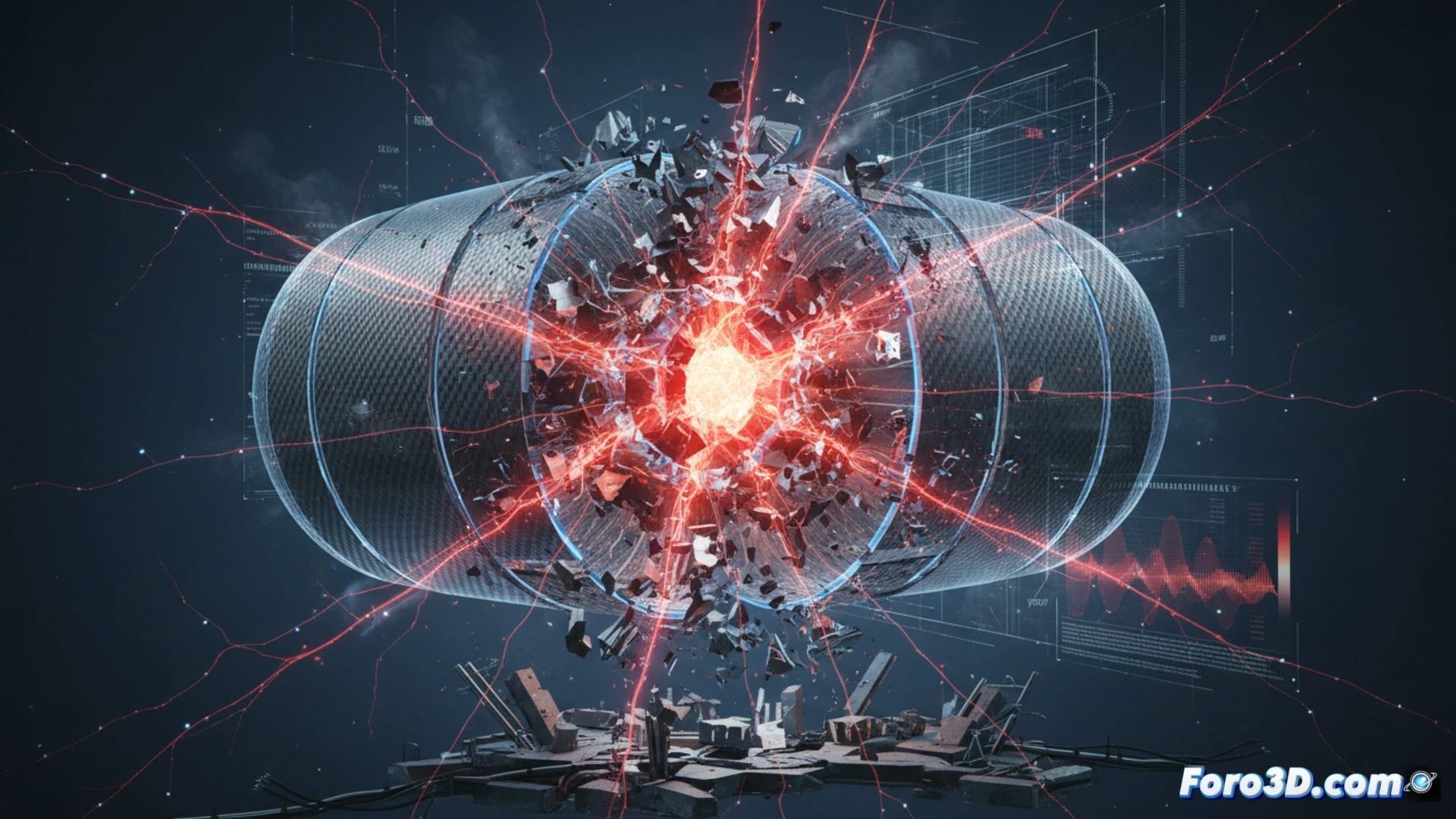
The explosion of a hydrogen tank at 700 bar during a pressure test was not a random accident. Forensic analysis of the debris, using 3D filament reconstruction, revealed the root cause: insufficient overlap in the carbon fiber winding at the vessel neck. This failure, detected through computed tomography, demonstrates how a microscopic manufacturing defect can trigger a catastrophe in energy storage infrastructure.
Forensic methodology: Tomography and fatigue simulation 🔬
The forensic team used Volume Graphics VGSTUDIO MAX to digitize the tank fragments. The software allowed reconstructing the orientation of each carbon filament, creating a three-dimensional map of the winding pattern. By comparing this model with the original design, the critical zone where the lack of overlap generated a stress concentration was identified. Subsequently, the geometry was imported into nCode to run a fatigue simulation under cyclic pressure. The results confirmed that the micro-crack initiated precisely in that region, propagating unstably until catastrophic rupture. SolidWorks was used to validate the theoretical structural integrity against the actual observed behavior.
Lessons for composite material simulation ⚙️
This case underscores the need to integrate 3D inspection into the lifecycle of hydrogen tanks. Fatigue simulation should not be limited to ideal models; it must include the real variability of the winding process. The combination of VGSTUDIO MAX for defect characterization and nCode for residual life prediction offers a robust methodology to prevent failures. Ignoring the microstructure of the composite material is ignoring the seed of fracture.
What specific finite element simulation techniques allow accurately modeling the nucleation and propagation of micro-cracks in hydrogen tanks subjected to cyclic pressure loads, and how are these data integrated with forensic 3D reconstruction to determine the remaining useful life of the component?
(PS: Material fatigue is like yours after 10 hours of simulation.)