A state-of-the-art luxury watch stops without warning, defying the logic of high horology. After weeks of analysis, the cause is not an assembly error or obvious wear, but a submicrometric deformation in the silicon bridge of the escapement. Thanks to the combination of micro-CT and simulation software, engineers were able to identify how variations of just a few microns generated a blockage due to residual energy, a classic failure of material fatigue in ultra-precise components. 🔍
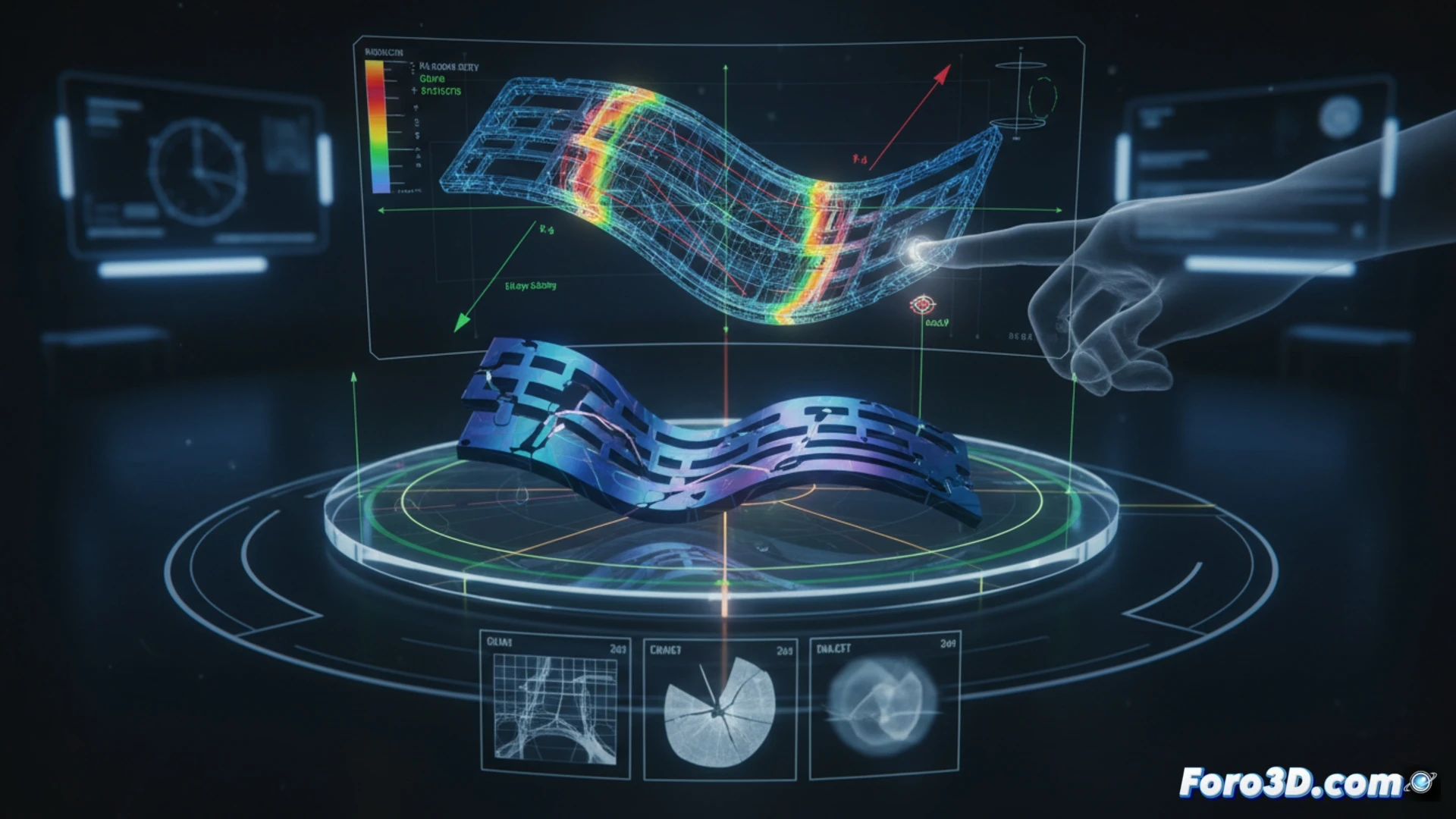
Scanning, meshing, and simulation of residual stresses in silicon components 🛠️
The process began with scanning the escapement using micro-CT, obtaining a point cloud with submicrometric resolution. This data was imported into VGSTUDIO MAX to generate a high-fidelity volumetric mesh, capturing imperfections invisible to optical microscopes. Subsequently, the model was transferred to SolidWorks, where cyclic loads simulating the escapement cycle were applied. Using GOM Inspect, a digital image correlation (DIC) analysis was performed to map local deformations. The simulation revealed that a 2-micron variation in the geometry of the silicon bridge concentrated residual stresses at a critical point, causing premature fatigue that blocked the escapement upon releasing accumulated energy.
Lessons for fatigue simulation in high-precision materials ⚙️
This case demonstrates that in high horology, the boundary between success and mechanical failure is measured in microns. Silicon, although ideal for its low friction and thermal stability, is vulnerable to stress concentrations that go unnoticed in nominal designs. The integration of micro-CT with FEM simulation allows engineers to predict these fatigue points before production, reducing costs and improving reliability. For the watchmaking industry, this approach not only resolves failures but also redefines quality standards in high-performance components.
How can computed microtomography applied to a silicon escapement detect fatigue failures that go unnoticed in traditional durability tests in luxury watchmaking?
(PS: Material fatigue is like yours after 10 hours of simulation.)