A recent incident with a smart contact lens prototype has brought the mechanical fatigue of flexible components into the spotlight. During testing, a chemical leak in the tester's eye triggered a forensic investigation. The main hypothesis points to constant blinking as the source of cyclic stress on the thin-film micro-battery, breaking its delicate polymer encapsulation.
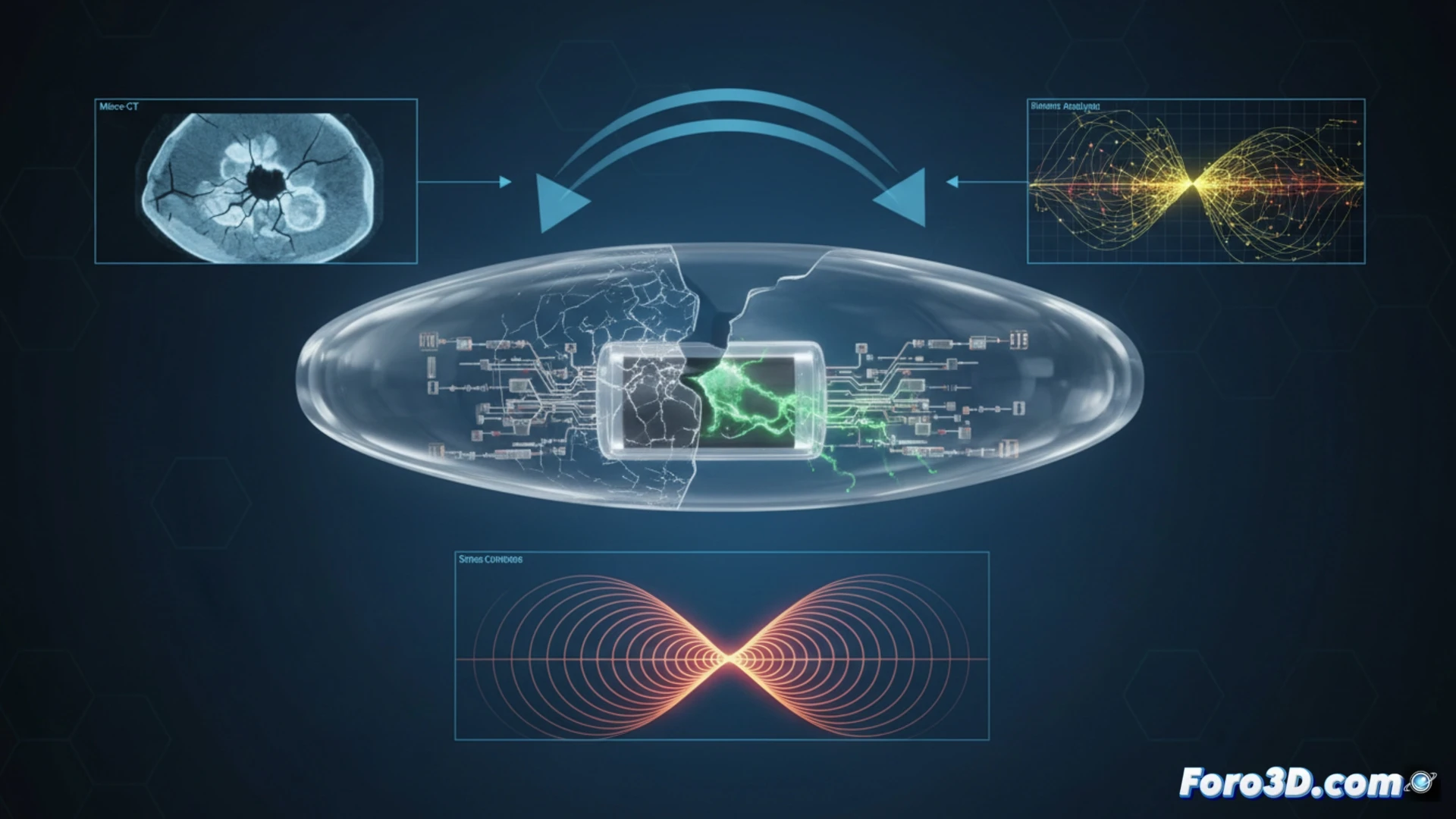
Forensic Analysis with Micro-CT and Multiphysics Simulation 🔬
The analysis team used a combined workflow to determine the root cause of the failure. First, a micro-CT scan of the damaged device was performed, and the data was processed in VGSTUDIO MAX. This software allowed for a 3D visualization of the polymer encapsulation fracture, identifying microcracks in the area of greatest lens curvature. In parallel, a model was built in SolidWorks to recreate the exact geometry of the battery. This model was exported to COMSOL Multiphysics, where an electrochemical analysis coupled with structural mechanics was applied to simulate the repetitive stress of blinking, calculating the material's fatigue life.
Lessons for Flexible Battery Design ⚙️
This case demonstrates that the integrity of flexible electronic components depends not only on chemistry but also on the mechanics of human movement. The combination of micro-CT and finite element simulation allows engineers to predict failure points before production. For future iterations, it is recommended to redesign the encapsulation with more resilient polymers and distribute the battery into smaller segments to better absorb the deformation from blinking without generating fractures.
How does the accumulation of fatigue damage in the components of a smart lens battery influence the degradation of its electrochemical and structural performance over charge and discharge cycles, and what micro-CT parameters allow predicting this mechanical failure before it occurs?
(PS: Material fatigue is like yours after 10 hours of simulation.)