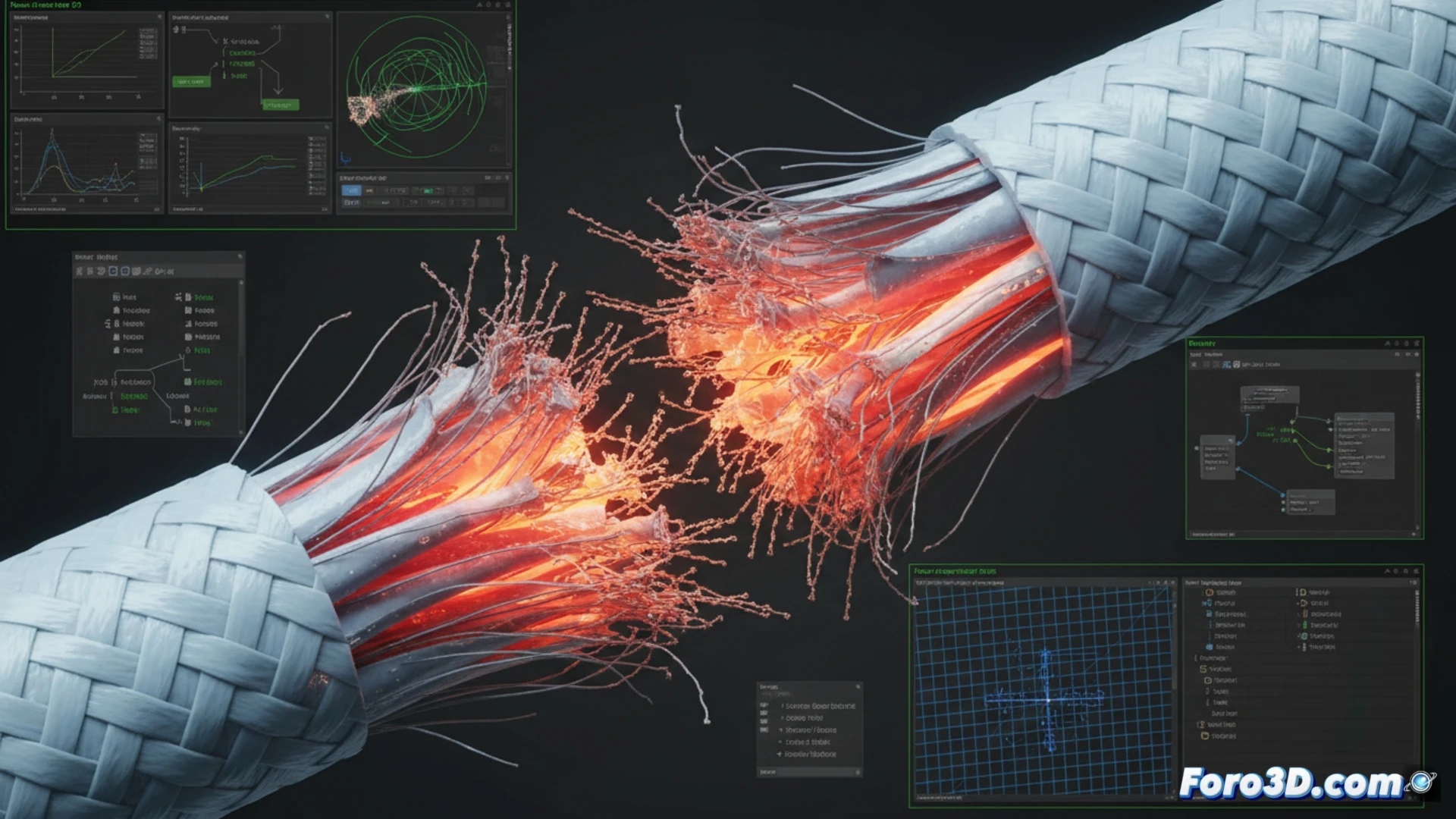
A recent forensic analysis of a failed bungee cord has shown that critical material degradation occurs internally, with no visible external signs. Using a Nikon micro-CT, zones of localized thermal degradation generated by friction between internal strands during cyclic loads were identified. This finding redefines inspection protocols in extreme sports, where safety depends on detecting what the human eye cannot see. 🔬
Technical workflow: from volumetric scanning to dynamic simulation 🛠️
The process began with a high-resolution volumetric scan using a Nikon micro-CT, which captured the internal structure of the cord in 3D. The images revealed cavities and microscopic melting points between the strands, evidence of friction fatigue. This geometric model was imported into LS-DYNA to simulate behavior under repetitive loads. The explicit dynamics solver modeled the contact between strands, reproducing localized heat generation and loss of strength. In parallel, a surface scan with an Artec Space Spider digitized the external geometry to validate the absence of visible damage. Finally, Blender integrated the volumetric and surface data, generating a visualization that correlates internal failure with the zones of highest simulated thermal stress.
Blind safety: the need for advanced non-destructive inspections ⚠️
The breakage of a bungee cord is not a random event, but the result of accumulated fatigue that touch and sight cannot detect. This case demonstrates that visual inspection, standard in the industry, is insufficient. The combination of micro-CT and simulation with LS-DYNA not only explains the failure but also allows predicting the remaining useful life of cords in service. For the extreme sports industry, adopting these non-destructive techniques is not a technical option, it is an ethical obligation.
How can micro-CT data be integrated into LS-DYNA finite element models to accurately predict the remaining useful life of a bungee cord subjected to thermal fatigue cycles?
(PS: Material fatigue is like yours after 10 hours of simulation.)