The papyrus scrolls carbonized by the eruption of Mount Vesuvius in 79 AD are so fragile that any attempt to unroll them destroys them. However, a workflow combining high-energy micro-CT, deep segmentation with Dragonfly, and AI algorithms in MATLAB is achieving the impossible: reading these texts without opening the objects. The key lies in detecting traces of lead ink within the 3D structure of the papyrus, a process that redefines the limits of digital archaeology. 🔥
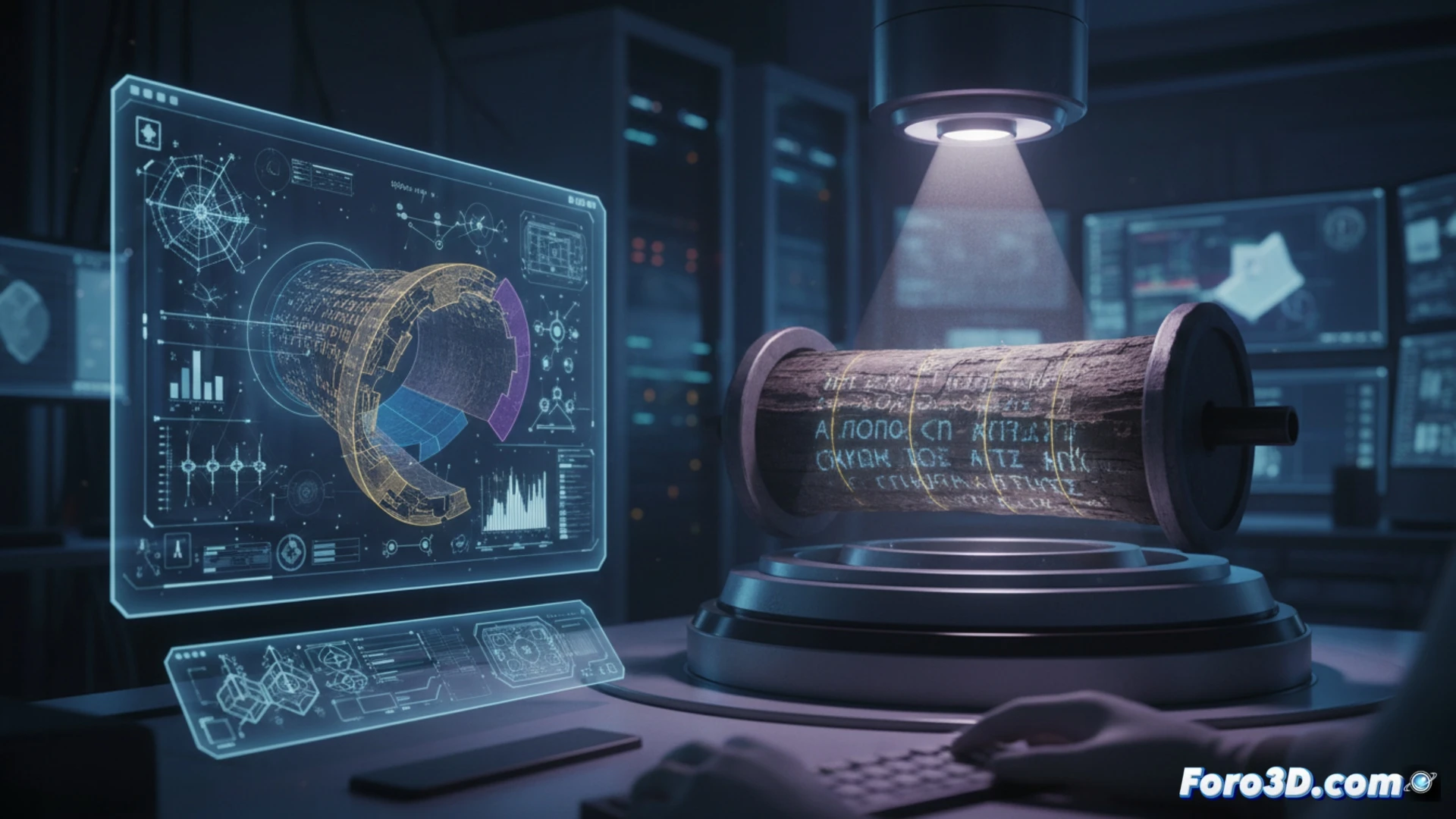
Technical workflow: from tomography to readable text 🖥️
The process begins with a high-energy micro-CT scan, capable of penetrating the dense carbonized mass of the scroll. The resulting volumetric reconstructions are processed in Volume Graphics VGSTUDIO MAX, where artifact correction and initial layer alignment are performed. Subsequently, Dragonfly software applies deep segmentation techniques to digitally isolate the extremely thin layers of papyrus, which are compressed and deformed. The real challenge is ink detection. Here, MATLAB comes into play, running an AI algorithm trained to identify subtle density differences that indicate the presence of lead in the ink, even when it is mixed with the carbon of the papyrus. The result is a 3D map of the letters, enabling virtual unrolling and text reading.
The impact of AI on heritage preservation 🏛️
This breakthrough not only recovers lost voices from antiquity but also establishes a new paradigm for the study of historical materials. By eliminating the need for physical manipulation, irreversible deterioration of artifacts is avoided. The combination of VGSTUDIO MAX for visualization, Dragonfly for segmentation, and MATLAB for AI inference demonstrates that engineering and data science tools have become essential allies of history, allowing us to read books that had been sealed for two millennia.
What specific technical challenges does the virtual restoration of carbonized papyri using micro-CT and artificial intelligence algorithms present, and how could they be overcome for future applications in digital archaeology?
(PS: and remember: if you can't find a bone, you can always model it yourself)