The Wagyu beef market, known for its exquisite marbling, has been the target of a sophisticated fraud. Using 3D micro-computed tomography, researchers have identified patterns of intramuscular fat that do not correspond to the animal's natural biology. The technique reveals that artificial lipids were injected to simulate high-quality marbling in low-value cuts, exposing a deceptive practice in luxury exports.
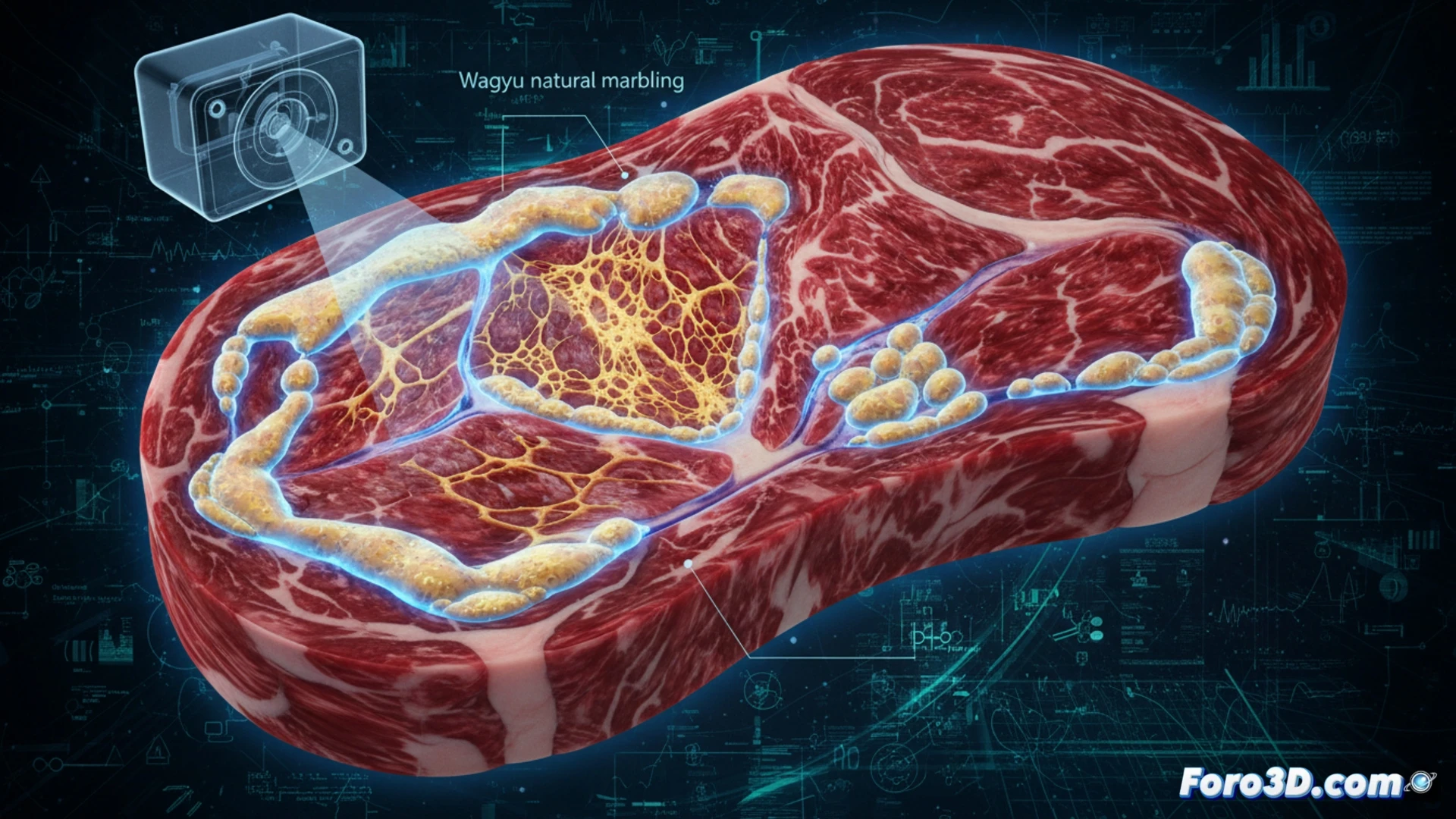
Forensic pipeline: Acquisition, segmentation, and statistical analysis 🔬
The workflow begins with the acquisition of volumetric data via micro-CT, capturing the three-dimensional microstructure of the meat with isotropic resolution. In Dragonfly, a semi-automatic segmentation of intramuscular fat is performed, separating the veins from the lean tissue through adaptive thresholding and watershed algorithms. Quantitative analysis in MATLAB focuses on the morphology of the veins: metrics of tortuosity, sphericity, and connectivity are calculated. In natural marbling, fat forms continuous dendritic networks with directional anisotropy. In the counterfeit sample, the analysis reveals disconnected spherical clusters, with a pore size distribution following a narrow Gaussian function, characteristic of a homogeneous injection and not of fractal biological growth. This statistical mismatch is the forensic signature of the fraud.
Forensic visualization and evidence presentation 🖥️
For judicial documentation and technical dissemination, VGSTUDIO MAX is used for porosity analysis and the generation of vein thickness maps, highlighting the injected regions with a spectral color. Hyper-realistic visualization in KeyShot applies translucent materials and volumetric shadows, allowing even an untrained eye to distinguish the artificial texture. The result is a visual report where natural fat appears as a fluid and organic system, while the counterfeit fat appears as a network of isolated globules, an irrefutable proof of industrial manipulation.
How can one differentiate, at a microstructural level and through volumetric analysis of Micro-CT 3D data, a pattern of artificially injected fat infiltration from the natural distribution of marbling in a genuine Wagyu beef cut?
(PS: don't forget to calibrate the laser scanner before documenting the scene... or you might be modeling a ghost)