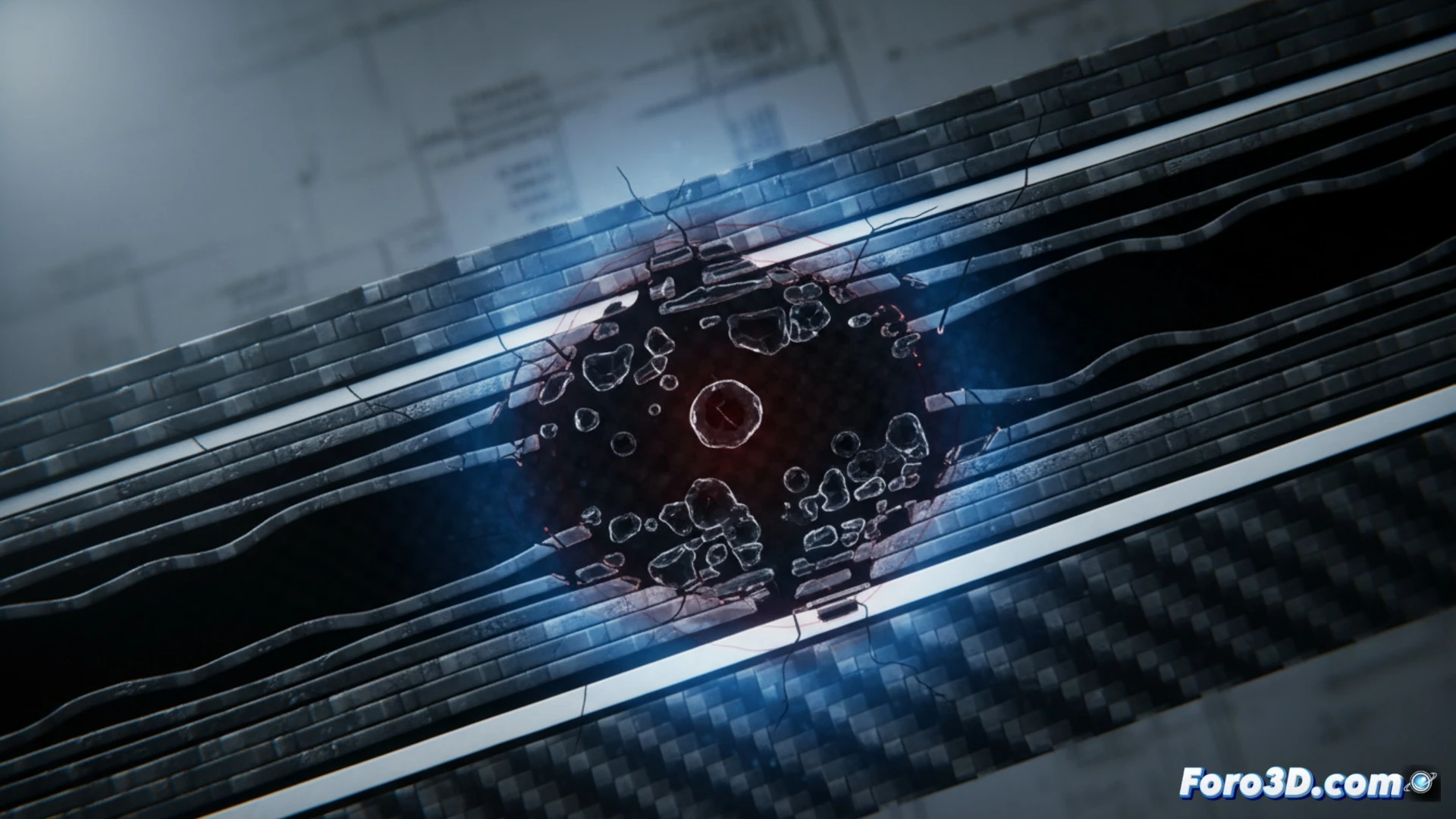
A Formula 1 racing helmet failed catastrophically after being struck by high-speed debris. The initial investigation ruled out poor design and pointed to an internal defect: micro-bubbles of air trapped within the carbon fiber laminate. These cavities, invisible to the naked eye, expanded during autoclave curing, creating zones of structural weakness that collapsed under the stress of the impact.
Micro-CT Analysis and Impact Simulation with LS-DYNA 🛡️
To identify the origin of the failure, engineers turned to micro-CT analysis, which revealed a network of micro-bubbles aligned in the intermediate layer of the laminate. These bubbles formed due to insufficient vacuum extraction during the autoclave curing process. With the scan data, the actual geometry of the defect was imported into SolidWorks to model the part. Subsequently, an impact simulation was run in Ansys LS-DYNA, recreating the velocity and mass of the debris. The solver showed that the micro-bubbles acted as stress concentrators, initiating a brittle fracture that propagated rapidly. Finally, GOM Inspect was used to compare the simulated deformation with that of the actual helmet, validating the predictive model.
Lessons for Safety in Motorsports 🏎️
This case demonstrates that material fatigue in composites depends not only on cyclic loading but also on imperceptible manufacturing defects. The combination of micro-CT and LS-DYNA allows teams to predict failure points before they occur. For the industry, the lesson is clear: quality control in the autoclave must be rigorous, and impact simulation must be a non-negotiable standard. A driver's safety depends on every carbon fiber being free of bubbles.
As an engineer, my question is: How is fatigue simulation due to micro-bubbles integrated into current F1 helmet certification protocols to predict hidden failures under dynamic impacts?
(PS: Material fatigue is like yours after 10 hours of simulation.)