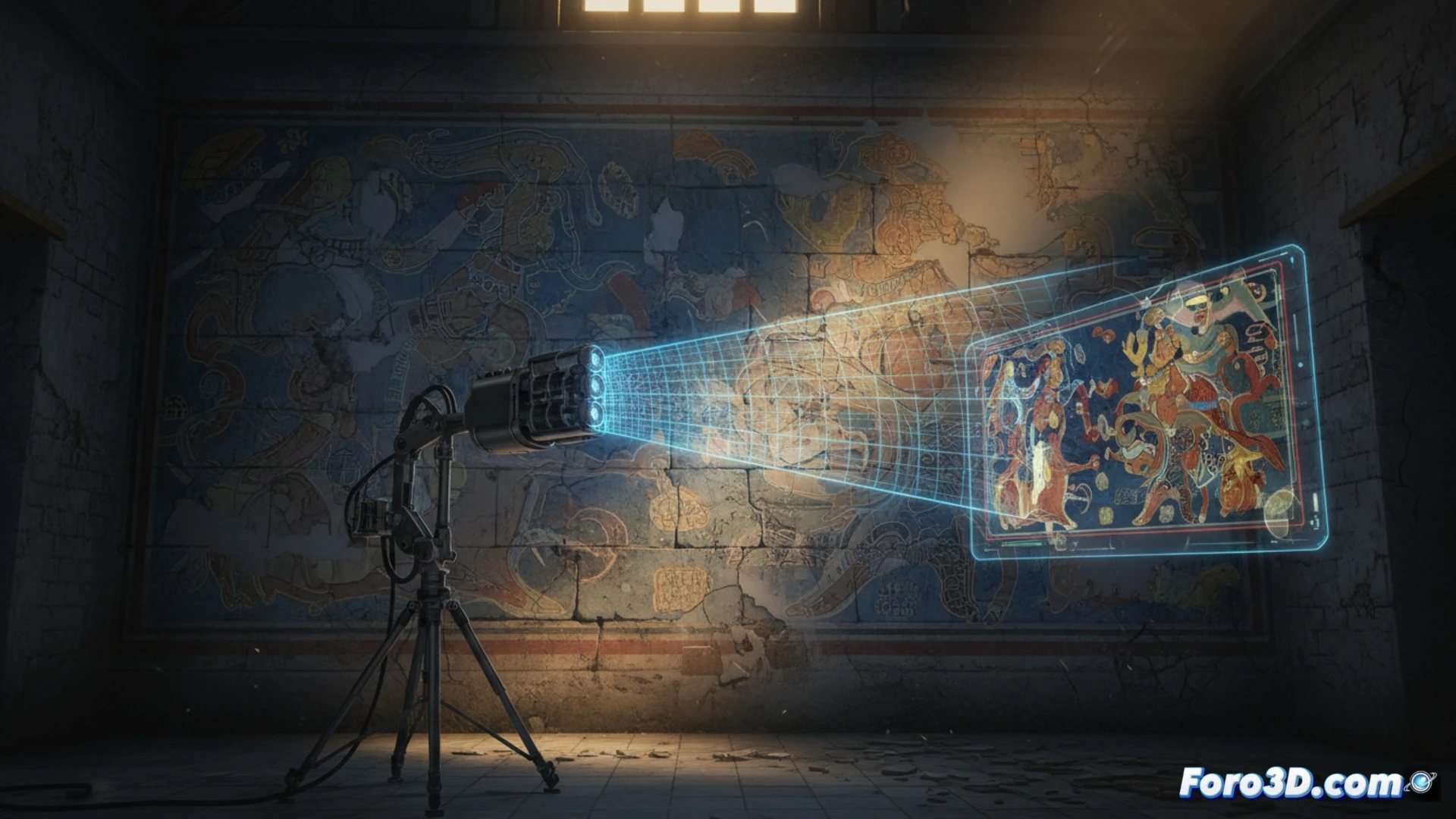
The restoration of cultural heritage has reached a technical milestone by recovering a historical mural that was accidentally erased. The key was not a speculative reconstruction, but the analysis of the residual pigment layer. Using a high-precision structured light scanner, variations in thickness of just a few microns were detected in the paint that remained adhered to the wall. These differences, invisible to the human eye, contained the exact topographic information of the original brushstrokes.
Technical workflow: from scanning to digital relief 🛠️
The process began with the Artec Space Spider scanner, capable of capturing geometry with an accuracy of up to 0.05 mm. By illuminating the surface with structured light patterns, the sensor recorded the micro-elevations of the remaining pigment. The resulting point cloud was imported into ZBrush for digital sculpting. There, the technician isolated the residual paint layers from the underlying wall texture, inverting the relief to generate a positive model of the lost artwork. Finally, in Adobe Substance 3D, the color and reflectance of the original material were reproduced, while Maya was used to integrate the virtual model into a heritage visualization context.
The heritage value of reading paint thickness 🎨
This technique demonstrates that pictorial matter, even when almost imperceptible, holds a faithful record of the artist's hand. Unlike traditional restoration, which may require the addition of new materials, micron scanning allows for a non-invasive and reversible intervention. The result is not an artistic interpretation, but an exact virtual copy of the original work. For the conservation field, this opens the door to recovering erased murals, worn paintings, or eroded reliefs without ever touching the physical artwork.
What ethical and technical implications arise from using generative artificial intelligence models to reconstruct the missing microns of pigment in an erased mural, considering that digital intervention could alter the artist's original intention?
(PS: Restoring virtually is like being a surgeon, but without blood stains.)