The launch of Suicide Squad: Kill the Justice League has presented Rocksteady with a major technical challenge: maintaining the narrative quality of its previous titles within a massive open world. The engine used, Unreal Engine 4, is the foundation upon which a vibrant Metropolis is built, but the true achievement lies in how the studio has managed the transition from closed, linear environments to a living, reactive city without sacrificing character detail.
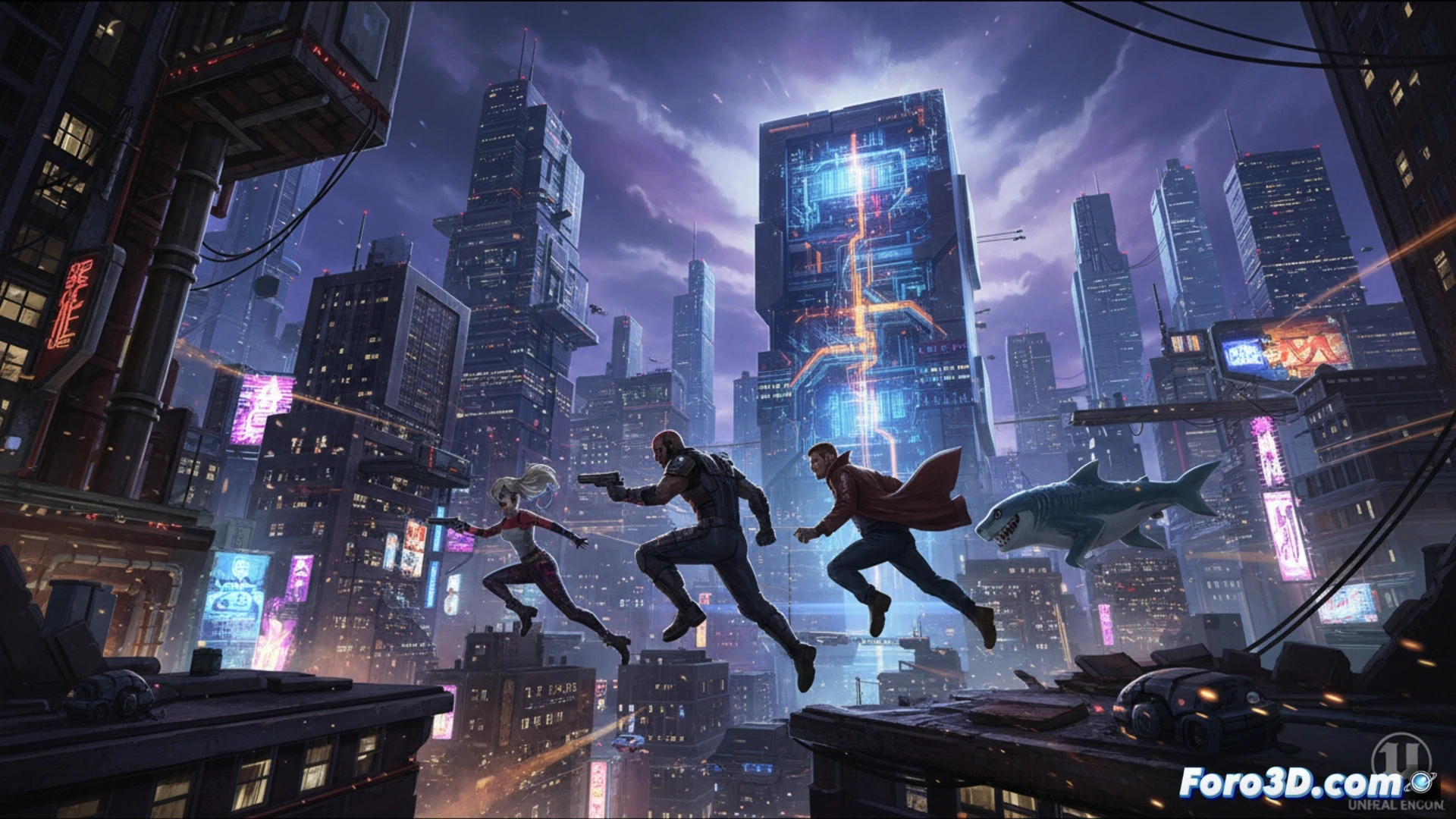
Facial Animation and City Streaming Optimization 🎭
The biggest technical challenge has been the coexistence of two systems that are often antagonistic: rendering a city at scale and high-fidelity facial animations. For cinematics, Rocksteady has implemented a facial capture system that uses high-density blendshapes combined with facial bone rigging (joints) in Unreal Engine 4, allowing for micro-expressions without the need for pre-rendering. However, to keep this smooth in an open world, the studio relied on a data streaming system (HLOD) that prioritizes loading skin and eye textures when the camera approaches a character, actively unloading city LODs in the background. The vibrant daytime lighting is achieved through a dynamic directional light system that interacts with constant dust and smoke particles, simulating Metropolis's smog without collapsing the rendering pipeline.
The Performance Dilemma in Dense Environments ⚙️
Despite the advances, the game exposes an uncomfortable truth for current development: the barrier between cinematic quality and real-time gameplay remains blurry. While the protagonists' body animations are fluid and reactive, the NPCs and city traffic show a clear reduction in animation rate to maintain 60 FPS. Rocksteady's decision to prioritize constant particle effects (explosions, debris) over crowd simulation suggests that, to achieve an open world with detailed heroes, sacrificing ambient AI remains the most technically viable path.
How Unreal Engine 4 handles the dynamic loading of textures and assets to avoid performance drops when rendering an open and detailed metropolis like Suicide Squad's without compromising fluidity in multiplayer combat
(PS: optimizing for mobile is like trying to fit an elephant into a Mini Cooper)