A high-gradient aerial tramway in a mining area suffered a catastrophic cabin slip. The failure was attributed to loss of braking capacity due to asymmetric wear on the steel jaws. The main hypothesis pointed to contamination by silica dust, an extremely abrasive substance present in the environment. To confirm this, a forensic engineering pipeline was deployed, combining laser metrology, fatigue simulation, and 3D visualization, detailing the material degradation mechanism.
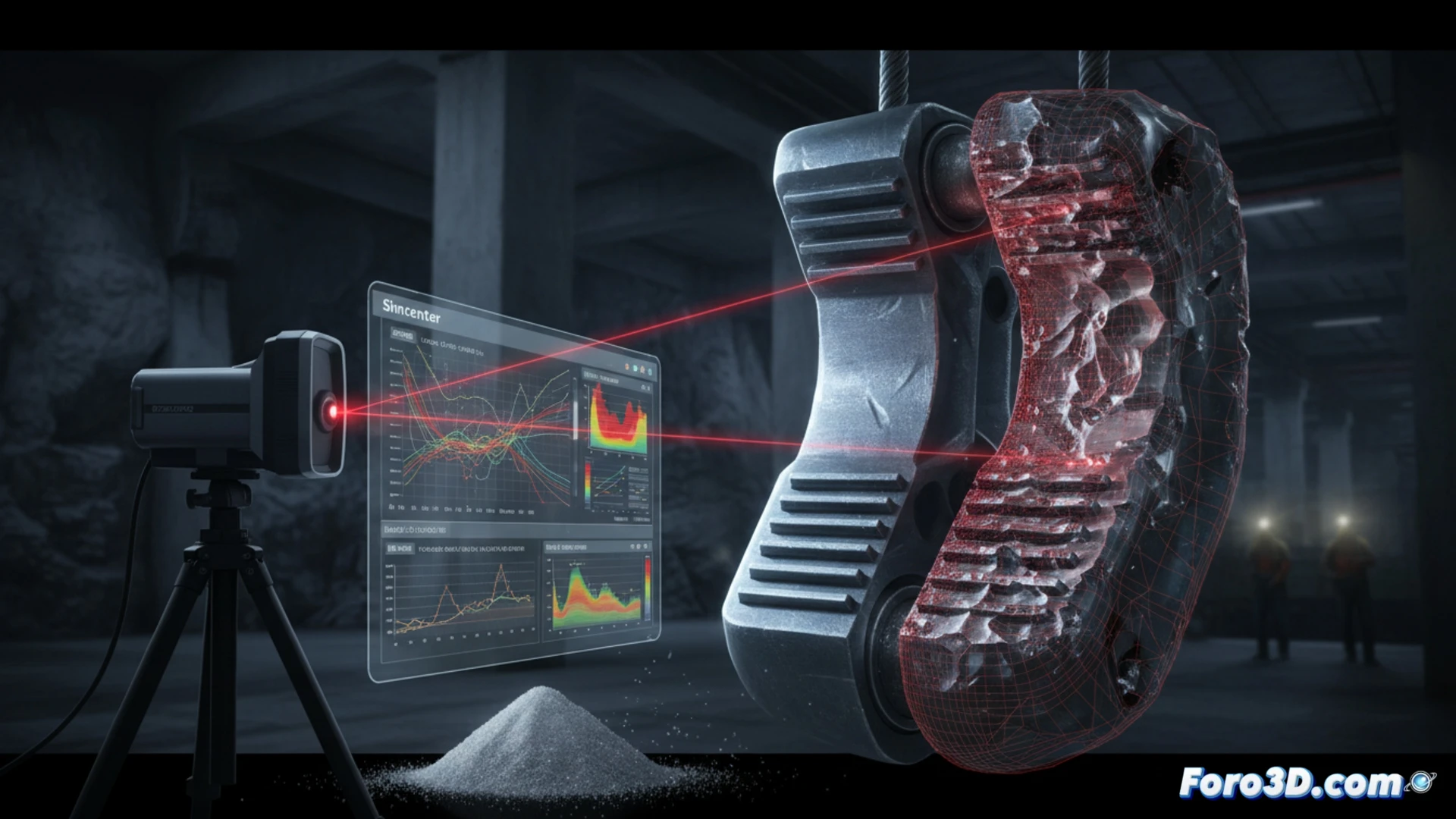
Forensic workflow: Scanning, CAD comparison, and abrasive simulation 🛠️
The process began with high-precision laser scanning of the worn jaws. The resulting point clouds were imported into GOM Inspect for geometric comparison against the nominal CAD model. The analysis revealed a material loss exceeding 15% in the contact area, with a non-uniform wear pattern indicating directional abrasive attack. Subsequently, these deviation data were integrated into Siemens Simcenter. There, the flow of silica particles trapped between the jaw and the cable was modeled, simulating their effect as an abrasive that accelerates steel fatigue through micro-cutting and cyclic plastic deformation. The correlation between the measured wear zones and the simulated stresses confirmed that contamination drastically reduced the component's lifespan, from millions of cycles to just thousands under dusty conditions.
Failure visualization and lessons for predictive maintenance 🔍
To communicate the finding, Autodesk Maya was used to generate an animation of the progressive wear, showing how the asymmetry in abrasion generated a torsional moment that misaligned the jaw, further reducing the effective contact surface area. This case demonstrates that in environments with silica dust, visual inspection is insufficient. The integration of laser metrology and fatigue simulation allows not only diagnosing the failure but also predicting the degradation rate, optimizing maintenance intervals, and selecting surface coatings more resistant to abrasion.
What role did 3D laser scanning play in detecting micro-deformations in the jaws before the Simcenter fatigue model revealed the abrasive wear failure?
(PS: Material fatigue is like yours after 10 hours of simulation.)