An attacker gains access to a secure facility using a silicone mask manufactured with a high-resolution 3D printer. The Lidar facial recognition system, designed to be infallible, does not detect the impersonation. However, subsequent forensic analysis reveals the truth: the mask's point cloud contains a unique signature of imperfections, a digital echo of the 3D printer itself. This case marks a before and after in the auditing of physical deepfakes. 🎭
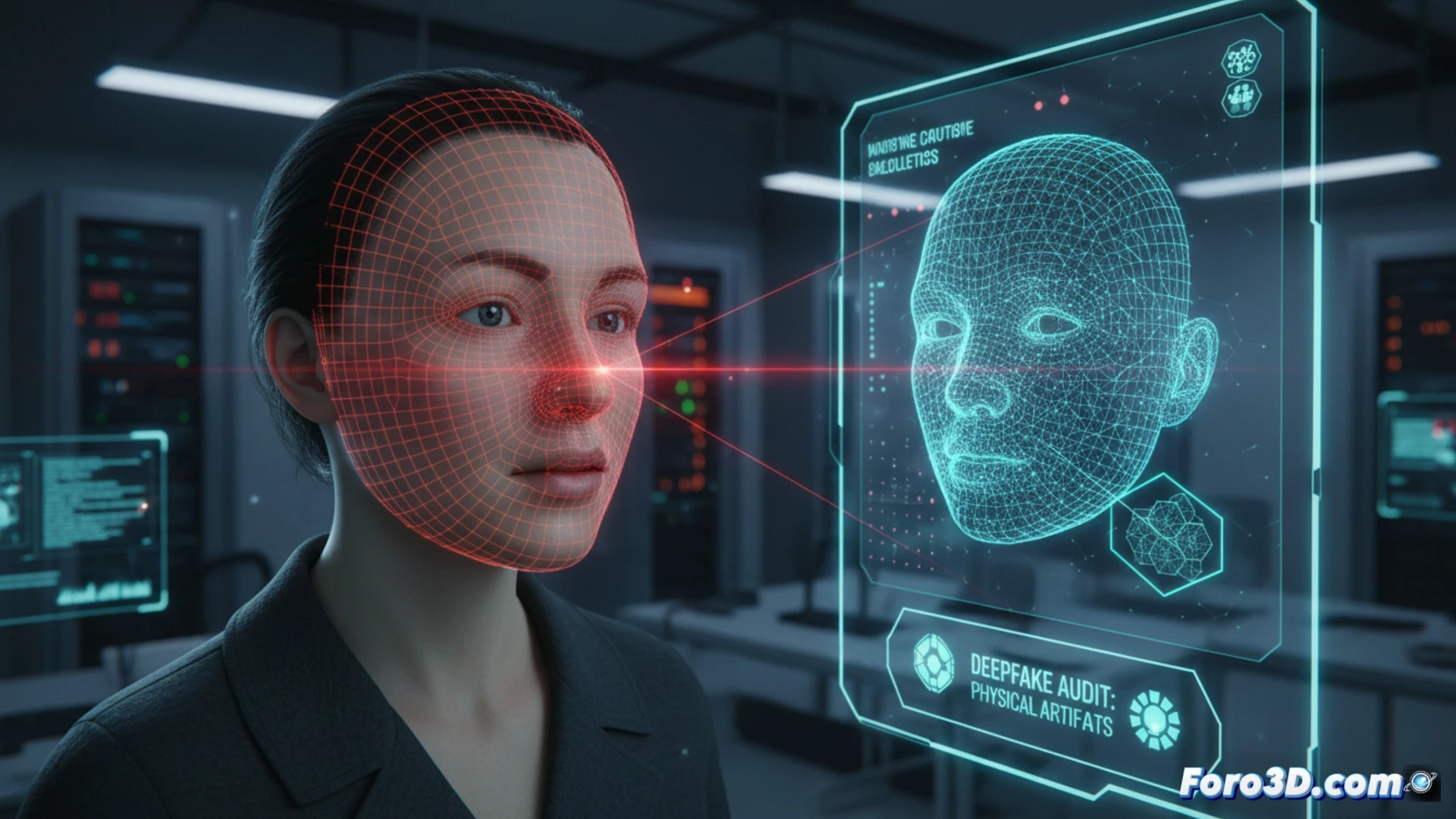
Forensic workflow: from point cloud to print signature 🔍
The process begins with a high-resolution scan of the real face and the seized mask, using Artec Studio to capture dense and precise point clouds. The next step is executed in GOM Control X, where a surface comparison is performed. The software calculates geometric deviations between both point clouds, revealing the micro-imperfections inherent to additive manufacturing: striations, porosity, and layer patterns that do not exist on real skin. Finally, MeshLab and ZBrush are used to clean the noise and isolate the printer's signature, a digital fingerprint impossible to replicate on a biological face.
Deepfake auditing must embrace the physical world 🛡️
This attack demonstrates that modern biometrics is vulnerable not only to digital deepfakes, but also to hyper-realistic physical replicas. Security auditing can no longer be limited to software; it must include the inspection of tangible objects. Point cloud comparison and analysis of manufacturing imperfections are essential tools for any forensic expert. Fraud is no longer hidden only in pixels, but in the silicon and plastic of a mask.
Can a state-of-the-art Lidar authentication system distinguish between a hyper-realistic silicone mask manufactured with 3D printing and a real human face, or is the precision of geometric scanning still vulnerable to materials that mimic skin reflectivity?
(PS: Detecting deepfakes is like playing Where's Wally? but with suspicious pixels.)