The catastrophic failure in an aerospace test bench, caused by the ultra-fast closure of a faulty valve in a cryogenic line, perfectly illustrates the danger of water hammer. This phenomenon generates pressure shock waves that can fracture metal components in milliseconds. Tools like Autodesk Fusion 360 and Star-CCM+ allow modeling this fluid dynamics and the resulting stress to anticipate fatigue failures in materials subjected to extreme temperatures.
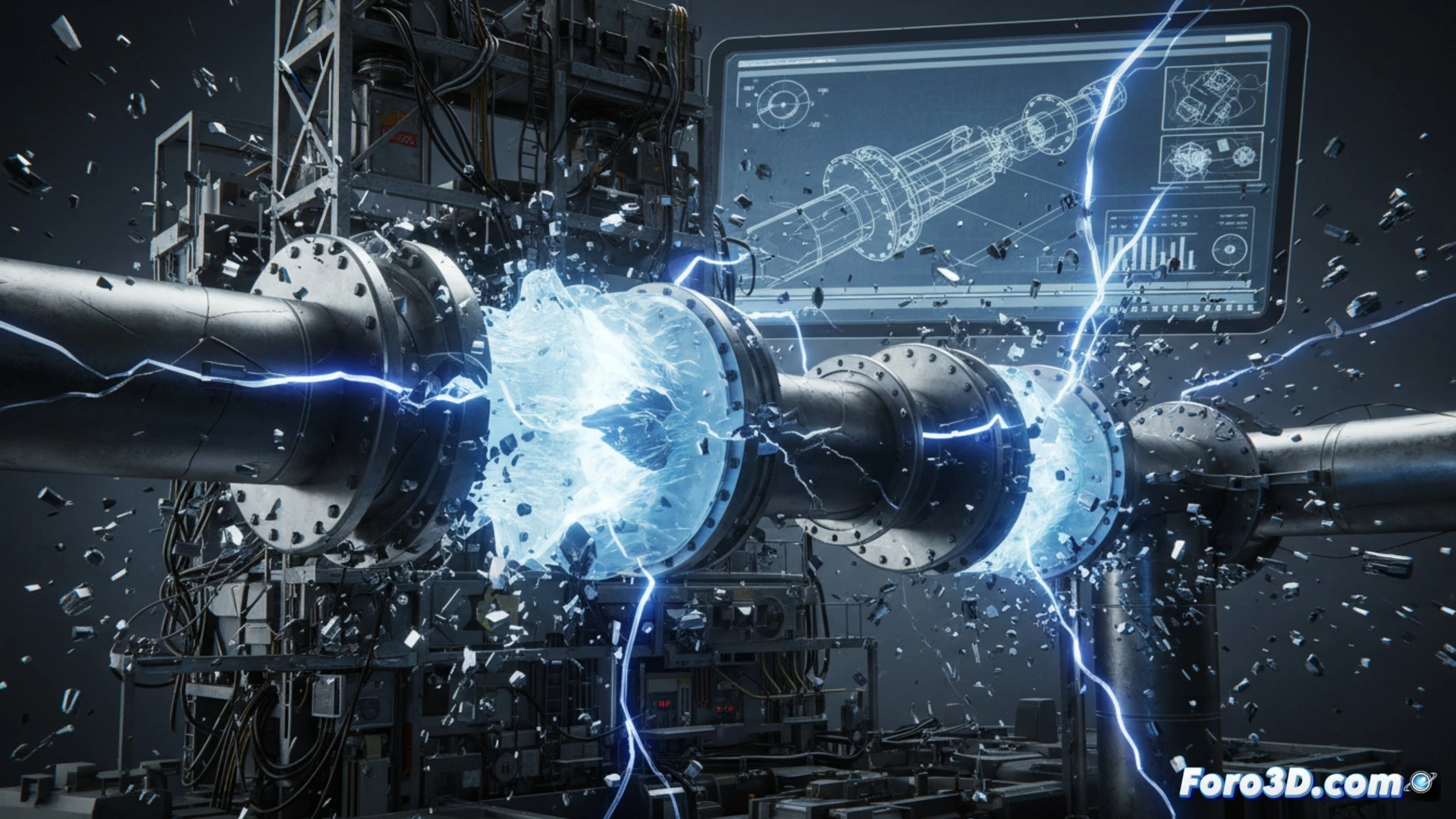
Modeling cryogenic water hammer with Star-CCM+ and Fusion 360 💥
CFD simulation with Star-CCM+ is key to visualizing the propagation of the pressure wave inside the cryogenic pipe. By inputting the closure profile of the faulty valve (response time less than 10 ms), the software calculates the transient pressure peak, known as Joukowsky overpressure. This pressure field is exported as a boundary load to a structural analysis in Fusion 360. There, cyclic fatigue is evaluated in the welds and bends of the line, identifying stress concentration points where plastic deformation exceeds the elastic limit of cryogenic stainless steel.
Failure prevention through digital twins 🔧
3D simulation not only reconstructs the accident but also allows designing slow-closing valves or pressure accumulators. By integrating RealityCapture to scan the actual geometry of the damaged test bench and comparing it with the fatigue model from Fusion 360, engineers validate the correlation between the simulation and the actual fracture. This workflow transforms a catastrophic failure into a design lesson, demonstrating that material fatigue simulation is the ultimate barrier against water hammer in cryogenic systems.
In a 3D material fatigue simulation for a cryogenic water hammer, how is the combined effect of extreme thermal stresses and the transient pressure peak modeled to predict the exact location of the initial crack in an aerospace valve?
(PS: Material fatigue is like yours after 10 hours of simulation.)