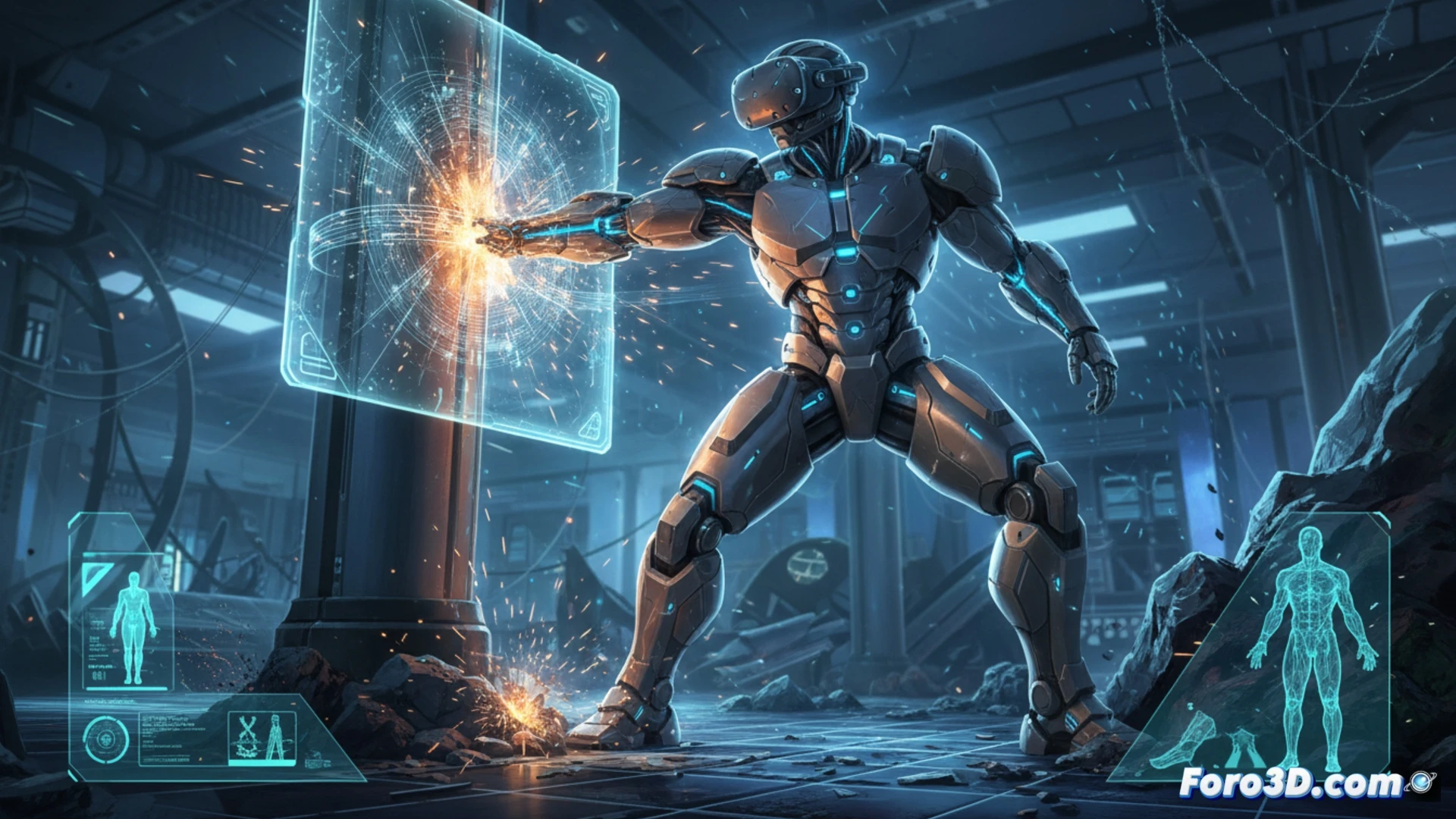
The Marrow Engine, Stress Level Zero's proprietary engine based on Unity, redefines interaction in virtual reality through the Full Body Presence system. Unlike titles that only track hands and head, Bonelab assigns a complete physical volume to the player's torso, arms, and legs. This approach allows each body segment to collide with the environment, generating dynamic responses that break the barrier between the avatar and the user, elevating immersion to a surgical level of precision. 🎮
Collision detection and joint dynamics 🦾
The technical implementation relies on a system of overlapping capsule collisions that follow the inverse kinematics of the limbs. Each virtual joint has an independent rigidbody, but is limited by torque and mass constraints. When the player pushes an object with their chest or blocks a hit with their forearm, the engine calculates momentum transfer in real-time. This contrasts with standard Unity solutions that often use simple colliders without assigned mass, resulting in ghost interactions. In Bonelab, even the impact of a knee against a table generates a verifiable physical reaction.
Lighting and its role in physical presence 💡
The physically based rendering (PBR) lighting of the Marrow Engine is not merely an aesthetic adornment, but a functional tool for spatial navigation. By projecting dynamic shadows and precise specular reflections onto the player's body, the brain receives visual depth cues that reinforce the sensation of occupying a real space. Compared to basic Unity implementations that use static directional light, Bonelab synchronizes the position of light sources with the headset's movement, eliminating the lag that causes motion sickness in other VR titles.
How does the realistic body physics system of the Marrow Engine in Bonelab VR affect player immersion and the resolution of technical issues such as clipping and latency in complex interactive environments?
(PS: optimizing for mobile is like trying to fit an elephant in a Mini Cooper)