The legendary library of Ivan the Terrible, known as the Libereya, is one of the greatest mysteries of Slavic archaeology. It is a collection of ancient manuscripts and rare books that, according to tradition, was hidden in the underground labyrinths of the Moscow Kremlin during the 16th century. Although its existence is not confirmed, the possibility of applying digital archaeology technologies to locate and document it opens a fascinating field of study for heritage preservation.
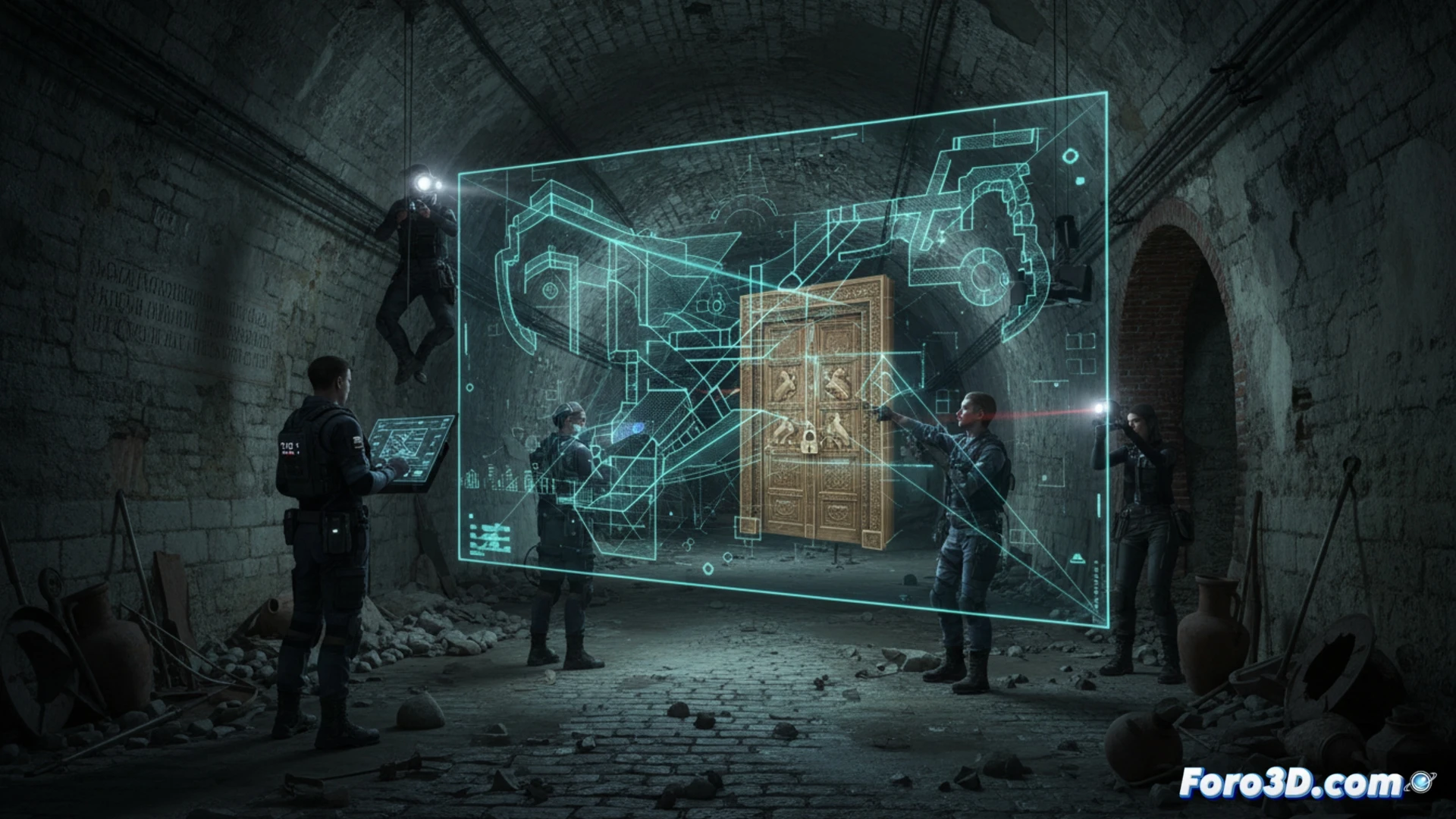
Photogrammetry and GPR for non-invasive subsurface prospection of the Kremlin 📡
Detecting the library would require a multidisciplinary approach combining ground-penetrating radar (GPR) with LiDAR laser scanning to generate digital terrain models. Once cavities are identified, photogrammetry could reconstruct the interior of the vaults in 3D without the need for destructive excavations. Techniques such as electrical resistivity tomography would help differentiate stone masses from possible metal or wooden containers where the codices might rest. Similar projects, such as mapping the catacombs of Paris or the tunnels beneath Prague Castle, demonstrate that generating digital twins of complex underground environments is feasible.
The value of virtual reconstruction beyond the physical discovery 🏛️
Even if the library is never found, the research process itself would have a tangible impact on digital archaeology. Modeling the tunnels and virtually recreating the lost volumes, based on historical inventories such as that of Tsar Ivan, would allow researchers to analyze the circulation of knowledge in medieval Russia. Furthermore, creating an interactive 3D archive would serve as an educational and outreach tool, digitally preserving a heritage that, if it exists, could be at serious risk of deterioration from humidity and the passage of time.
How can 3D mapping with laser scanners and photogrammetry techniques applied in the Kremlin tunnels help differentiate between real structural anomalies and possible hidden chambers of the lost library of Ivan the Terrible without damaging the historical heritage?
(PS: If you dig at a site and find a USB drive, don't plug it in: it could be malware from the Romans.)