Mannequin presents itself as a VR project that redefines enemy interaction through an active camouflage system and dynamic poses. Developed in Unity, its clean sci-fi aesthetic seeks not only visual impact but also performance optimization on virtual reality headsets. The key lies in a pipeline that combines efficient modeling in Blender, PBR texturing in Substance Painter, and VR-specific shader logic that maintains a stable 90 FPS.
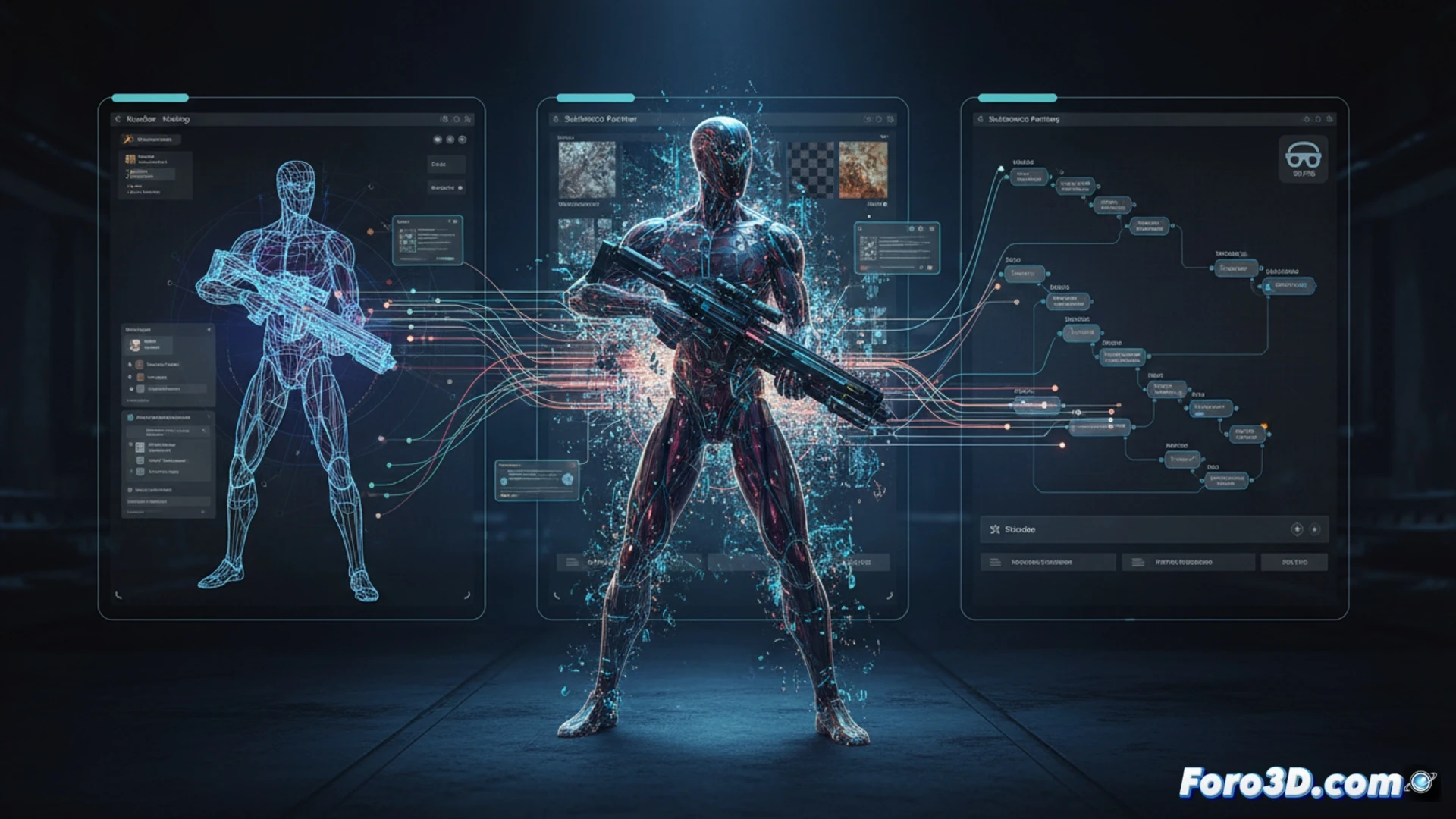
Asset Pipeline: From Blender to Substance Painter for VR 🎨
The modeling of the enemy mannequins is done in Blender with clean topology and reduced polygon count, prioritizing recognizable silhouettes for peripheral detection in VR. Each asset goes to Substance Painter where metallic and camouflage base textures are applied, using height masks for details without extra geometry. The dynamic pose system is achieved through modular rigging in Blender and an animation controller in Unity that alternates between idle, alert, and transparency states, all managed by a pooling script to avoid costly instantiations.
Reflective Optimization: Immersion Without Sacrificing Performance 🧠
Mannequin demonstrates that immersion in VR does not depend on visual saturation, but on technical coherence. The camouflage is not a simple fade, but a shader that uses Unity's depth buffer to calculate occlusions and reduce draw calls. This approach, along with the use of LODs generated from Blender and texture atlases in Substance Painter, allows the experience to feel smooth even on mid-range hardware. It is a reminder that designing for VR requires thinking of every polygon as an interaction resource.
As a developer, what was the biggest technical challenge when integrating the dynamic pose system with the active camouflage in Unity to ensure a smooth and believable VR experience?
(PS: 90% of development time is polishing, the other 90% is fixing bugs)