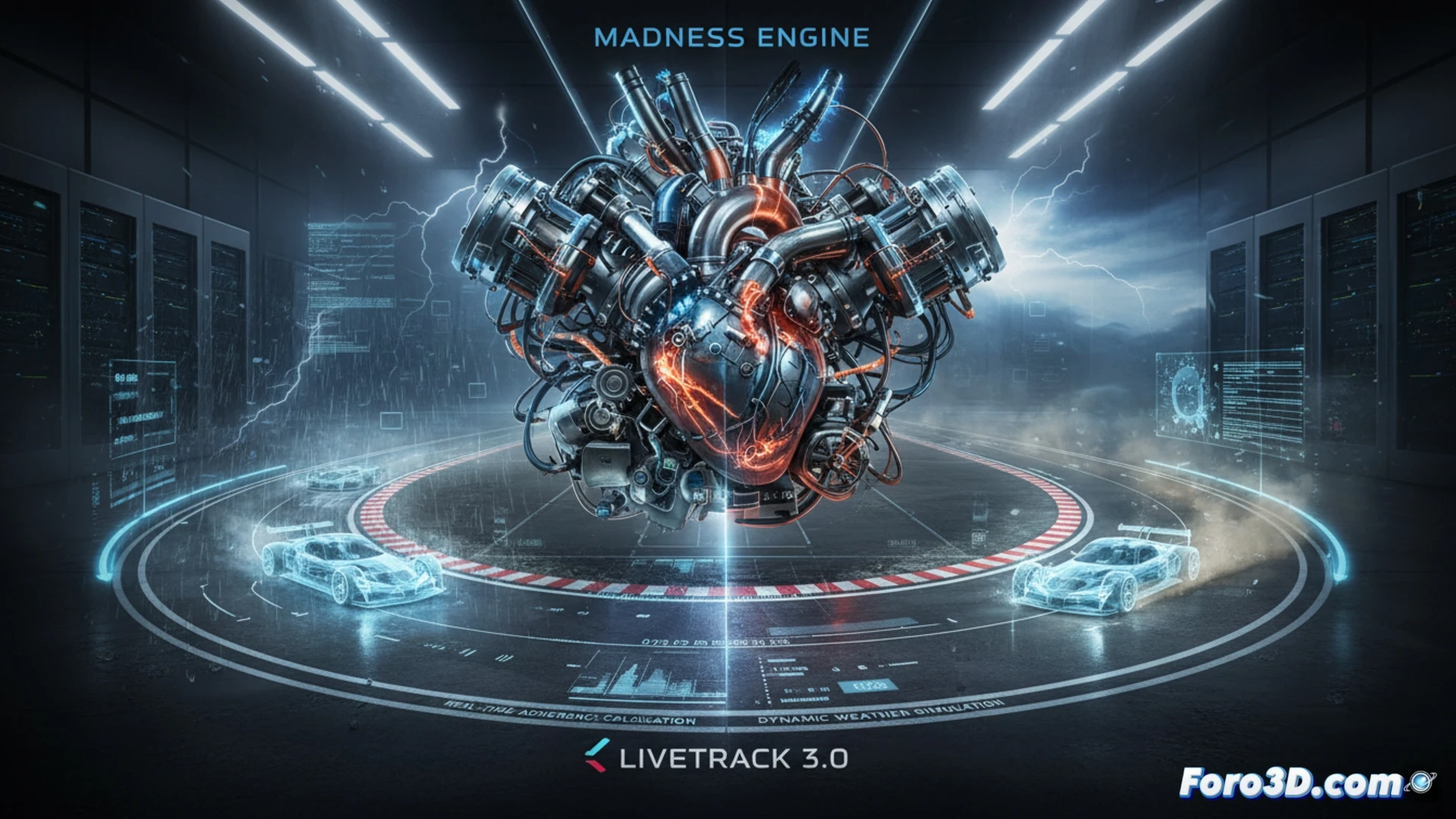
The development of racing simulators demands a perfect balance between realistic physics and efficient rendering. Automobilista 2, based on the Madness Engine (heir to the Project CARS 2 engine), demonstrates how a dynamic weather system can transform gameplay. Its flagship tool, LiveTrack 3.0, not only modifies the asphalt texture with rain but also recalculates grip in real-time, offering a unique technical challenge for simulation programmers.
Technical workflow: Maya, Substance Painter, and legacy lighting 🎨
For developers looking to replicate this level of detail, the asset pipeline in Automobilista 2 is a case study. Modelers use Maya to create car bodies and tracks, applying clean topology that supports the Madness Engine's dynamic tessellation. Subsequently, Substance Painter handles PBR materials, generating wear and dirt maps that react to weather. The qualitative leap comes with atmospheric lighting: inherited from Project CARS 2, it uses a real solar time system and volumetric scattering. This allows light to bounce off clouds and wet asphalt without the need for horrible static precomputations. A key tip for indies: prioritize dynamic weather shaders over excessive polygons; the perception of realism improves more with good atmospheric lighting than with a 10-million-face model.
Lessons for indie developers: Realism is in the ground 🏎️
The brilliance of LiveTrack 3.0 lies not only in the render but in the game logic. By simulating how water accumulates in corners or how the sun dries the asphalt, the engine forces the player to adapt their driving. For an indie developer, implementing a similar system does not require an AAA engine: simply modifying the friction coefficient of colliders in real-time based on a moisture map is enough. Combining this with procedural textures in Substance Painter (which change the asphalt's shininess) can achieve 80% of Automobilista 2's visual impact on a reduced budget. Immersion is born not from raw power, but from the coherence between what the player sees and what the car feels.
How does the Madness Engine integrate LiveTrack 3.0 to offer dynamic real-time physics without sacrificing graphical performance in Automobilista 2?
(PS: a game developer is someone who spends 1000 hours making a game that people complete in 2)