A firefighter suffers a shoulder dislocation during a rescue operation. Their assistive exoskeleton, designed to alleviate the load of heavy equipment, performed an unexpected abrupt movement. This incident, far from being a simple mechanical failure, exposes a critical error in the load compensation algorithm. To understand it, we have reconstructed the accident in a 3D environment, analyzing the suit's kinematics and the human body's response.
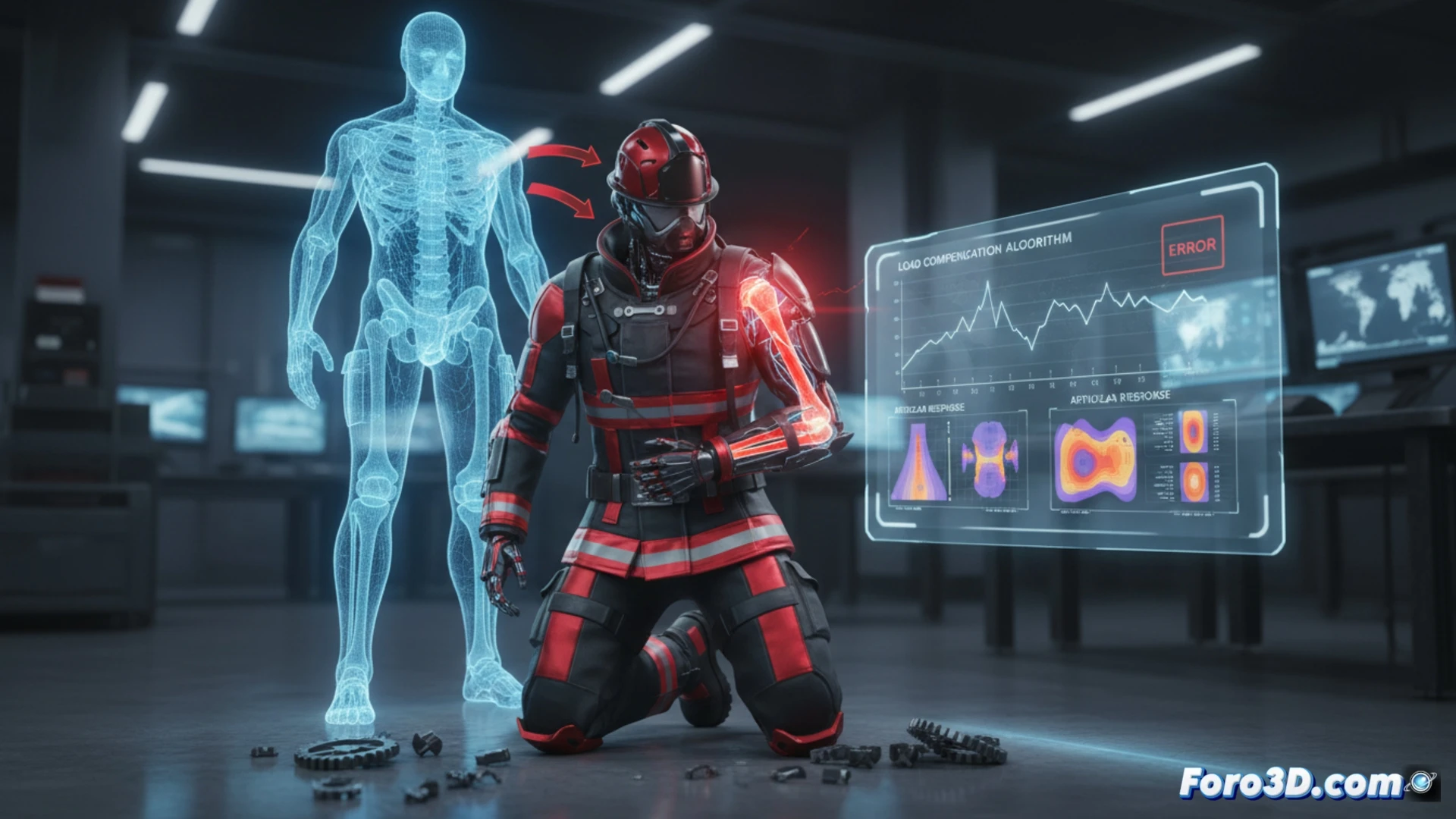
Kinematic reconstruction and error detection 🛠️
Using Artec Studio, we scanned the firefighter's torso and joints to create an accurate volumetric model. This model was imported into Autodesk Fusion 360, where the exoskeleton geometry was integrated. The movement simulation was performed in OpenSim, a biomechanics software. By replaying the accident sequence, we detected that the compensation algorithm applied excessive torque on the shoulder's rotation axis during a lateral elevation phase. The error lay in the reading of the inertial sensors: the system interpreted a posture change as an imminent fall, triggering a sudden correction that exceeded the joint's physiological limit. The calculated tension on the rotator cuff exceeded 150 Nm, enough to cause the dislocation.
Towards a design focused on joint safety 🦾
This case demonstrates that 3D simulation is not only useful for design but also for predicting failures. The technical recommendation is to implement a safety filter in the algorithm that limits joint torque based on the user's angular position and movement speed. In Unity, a haptic alert system can be prototyped to warn the firefighter before the exoskeleton executes an aggressive correction. The future of assistive devices lies in integrating human biomechanics as the main variable of the software, not as an accessory to the hardware.
How can 3D biomechanical modeling predict and prevent shoulder dislocation in rescue exoskeleton users, considering the interaction between assisted load and physiological joint limits?
(PS: and if the printed organ doesn't beat, you can always add a little motor... just kidding!)