For over a century, the Marfa Lights have puzzled scientists and curious minds in the Texas desert. These colored luminous spheres move erratically, merge, and split without conclusive explanation. However, modern scientific visualization tools, such as VGSTUDIO MAX for volumetric analysis and COMSOL Multiphysics for multiphysics simulation, offer a path to unravel this enigma through 3D models that contrast hypotheses like thermal mirages, electromagnetic fields, or gas emissions.
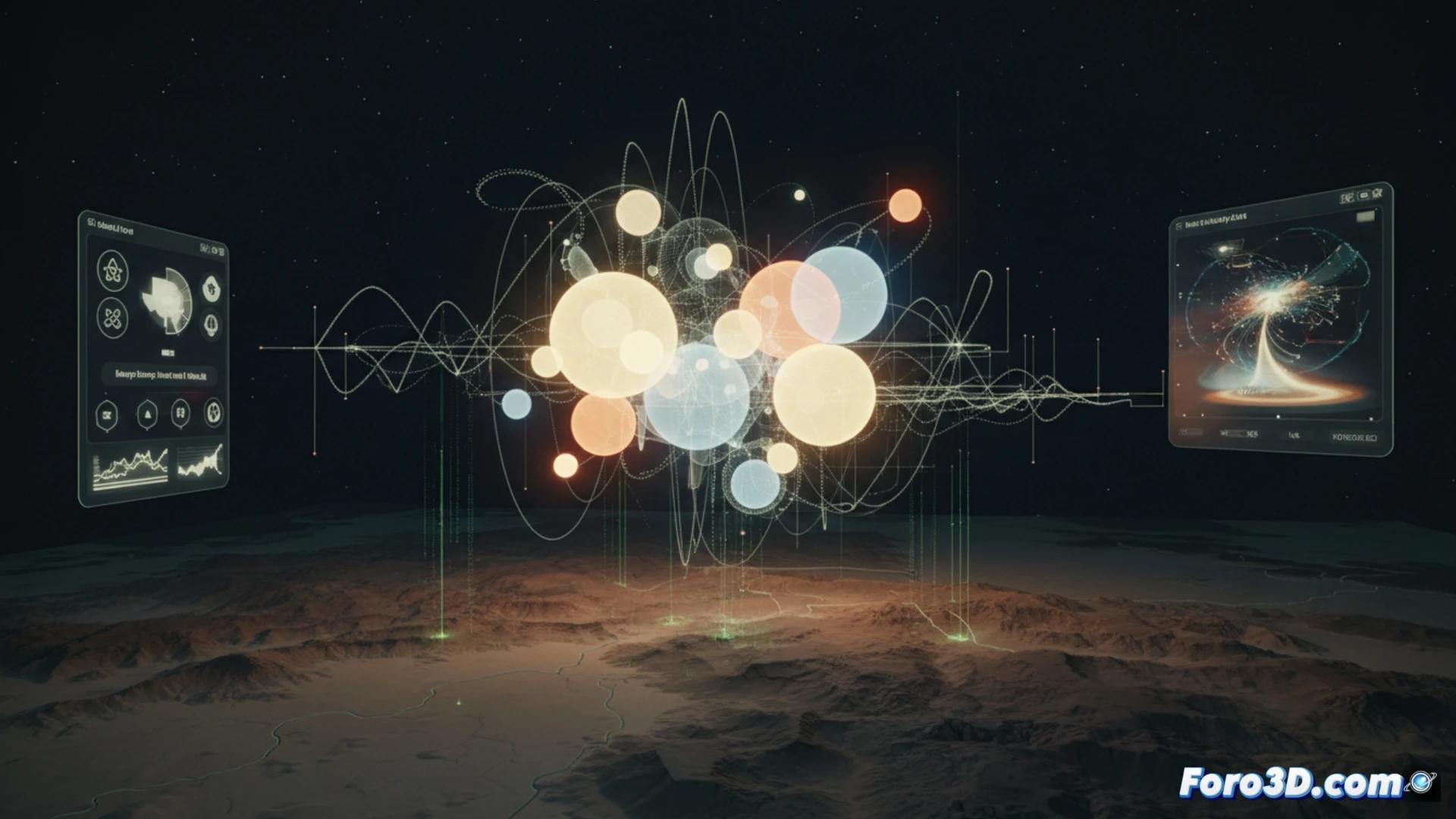
Multiphysics simulation and volumetric analysis of luminous hypotheses 🔬
To address the phenomenon, researchers can use COMSOL Multiphysics in its Bio-electromagnetism module to model how variations in the Earth's electric field, enhanced by the soil composition in Marfa, could ionize particles and generate visible cold plasmas as spheres. In parallel, VGSTUDIO MAX allows processing atmospheric tomography data or high-speed images to reconstruct the trajectory and morphology of the lights in 3D, analyzing their density and reflectivity. Materialise Mimics complements this workflow by segmenting complex visual structures from sensor data, facilitating the creation of precise meshes to simulate light refraction in layers of hot air, typical of mirages.
From data to wonder: Visualizing the inexplicable ✨
The true power of these tools lies not only in validating theories but in making the invisible visible. By integrating methane gas dispersion simulations with optical distortion models, scientists can generate 3D animations that reproduce the erratic behavior of the lights. This transforms a folkloric mystery into a subject of rigorous study, allowing the scientific community to debate on solid visual foundations and bringing the public closer to the complexity of atmospheric phenomena through scientific visualization.
As a 3D modeler, what is the most effective strategy to simulate the differential atmospheric refraction that produces the erratic trajectories and color changes of the Marfa Lights in a real-time rendering engine?
(PS: fluid physics for simulating the ocean is like the sea: unpredictable and you always run out of RAM)