Loddlenaut proves that a relaxing aquatic world doesn't require an AAA engine or cutting-edge hardware. Developed in Unity and modeled in Blender, this indie game achieves a whimsical low-poly aesthetic that prioritizes visual serenity over realism. For developers seeking an efficient and appealing style, the game offers valuable lessons on asset optimization and submerged level design.
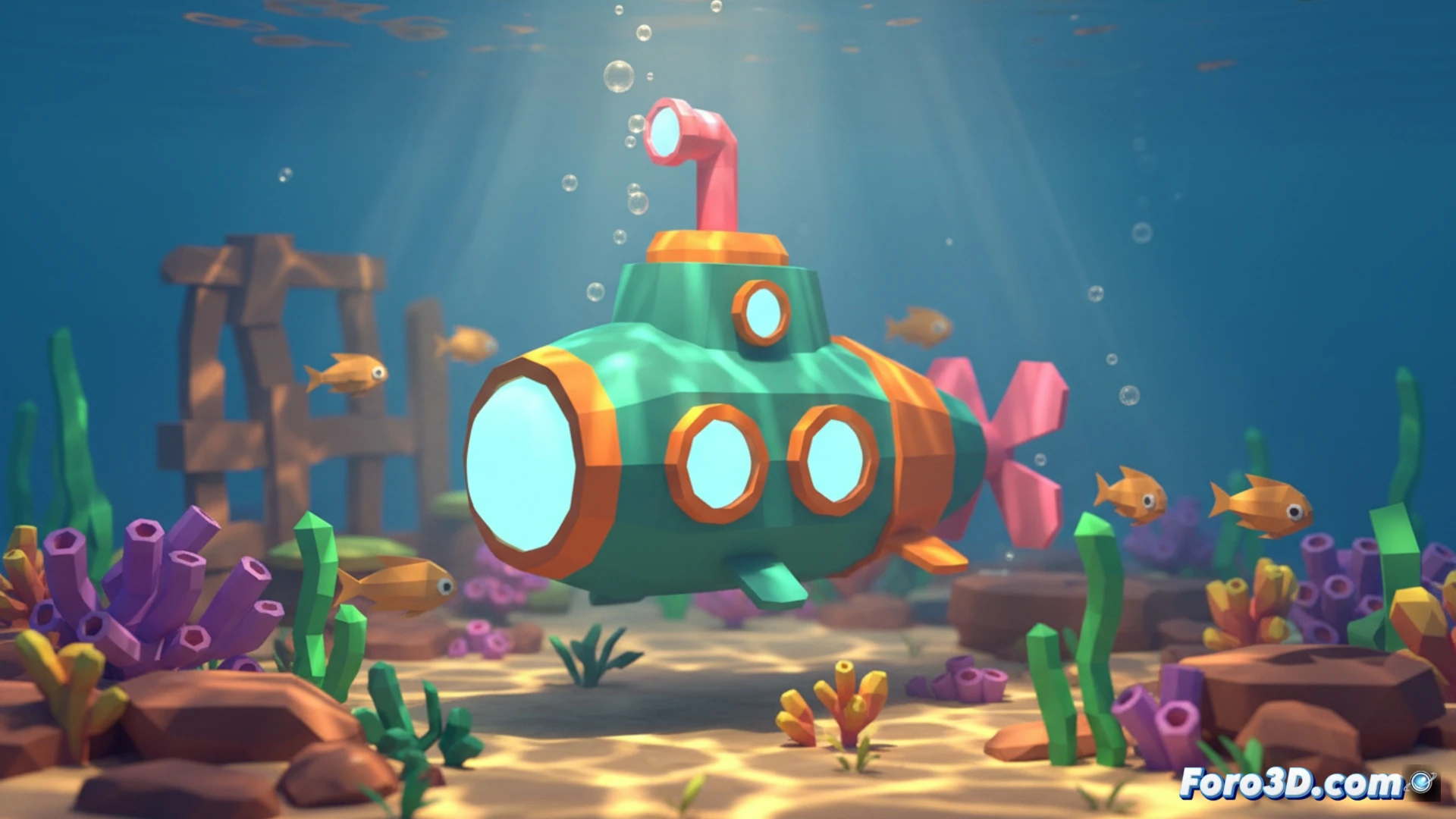
Optimization of aquatic assets with Blender and Unity 🌊
The key to performance in Loddlenaut lies in geometry management. Creature and coral models, created in Blender, maintain an extremely low polygon count, using flat shading instead of complex normal maps. This reduces the lighting cost in Unity. For the water, a simple shader with transparency and slight vertex displacement is used, avoiding costly particle systems. Developers can replicate this using Blender's decimation tool and applying textureless materials in Unity, achieving a clean look and high frame rate even on modest hardware.
Level design: depth without complexity 🐠
Loddlenaut's underwater design avoids disorientation through clear visual landmarks: pastel-colored rock formations and ascending bubbles that guide the player. Instead of a vast open ocean, the game segments the space into closed zones with natural boundaries, which reduces rendering load and simplifies navigation. For an indie game, this technique is ideal: building bounded spaces and using Unity's lighting with soft tones (blues and greens) creates an immersive atmosphere without the need for heavy post-processing.
How did you manage to optimize ocean and lighting performance in Loddlenaut so that a low-poly underwater world runs smoothly in Unity without requiring high-end hardware?
(PS: a game developer is someone who spends 1000 hours making a game that people complete in 2)