The success of Loop Hero lies not only in its addictive gameplay loop but in FourQuarters' bold technical decision: building a custom engine in Pascal (FourQuarters) to emulate the aesthetic of Commodore 64 computers. This approach, combined with low-resolution pixel art, demonstrates that technical limitations can be the best creative ally. We analyze how the engine and design tools forged the game's visual identity. 🎮
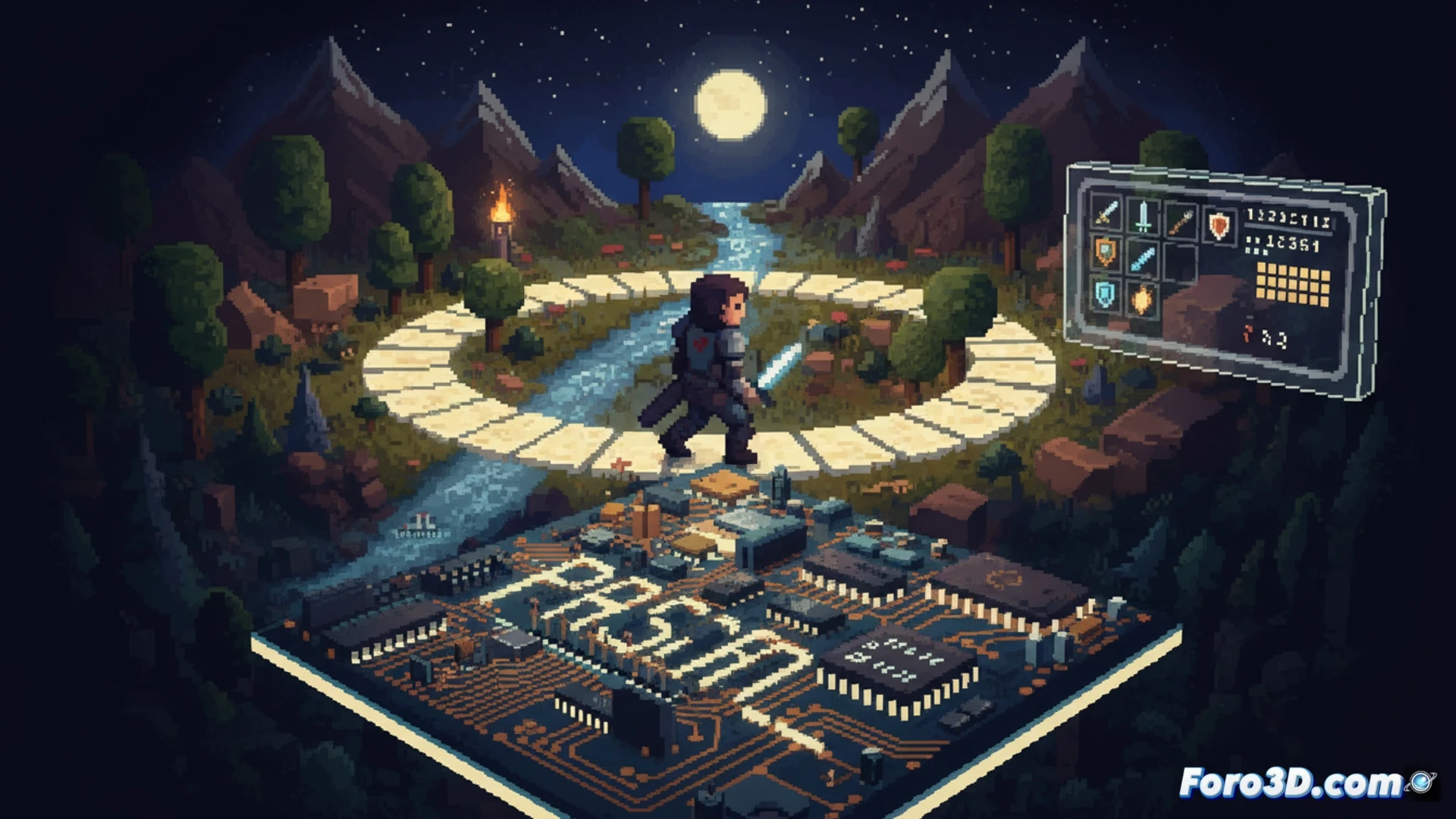
FourQuarters Engine and Low-Resolution Pixel Art 🖥️
The FourQuarters engine, programmed in Pascal, is not a nostalgic whim but a tool that imposes calculated restrictions. By limiting the color palette and resolution, the engine forces designers to work with a very low pixel density, similar to that of 8-bit machines. For the map tiles, the studio used Aseprite, software that allows pixel-by-pixel control and efficient management of limited palettes. Each terrain tile, from the forest to the castle, was optimized to be legible and evocative despite its low detail, allowing the player to visually complete the missing information.
The Gothic Interface and Visual Coherence in Photoshop 🎨
While Aseprite handled the world, Photoshop was the workshop for the user interface. The decision to use a dark, gothic aesthetic for menus and icons was not arbitrary; it responds to the need to create contrast with the pixelated map. Work in Photoshop allowed applying texture filters and subtle gradients that simulate an ancient scroll or a retro terminal interface. This technical duality—hard pixels in the game and smooth textures in the UI—creates a visually rich and coherent experience that reinforces the game's atmosphere without breaking the illusion of being in front of an 80s classic.
What performance and compatibility challenges did FourQuarters face when implementing a modern Pascal game engine to replicate the 80s pixel art aesthetic in Loop Hero, and how did they manage to overcome them without resorting to commercial engines like Unity or Unreal?
(PS: optimizing for mobile is like trying to fit an elephant into a Mini Cooper)