Tatsuki Fujimoto demonstrates in Look Back that the strength of a story lies not in the realism of the linework, but in its ability to convey emotion. The work, which follows two students united by manga, employs loose and dynamic drawing that prioritizes visual rhythm over anatomical perfection. For a 3D professional, this is a masterclass in how to approach pre-production: the expressiveness of the initial sketch can be more powerful than a hyper-realistic render.
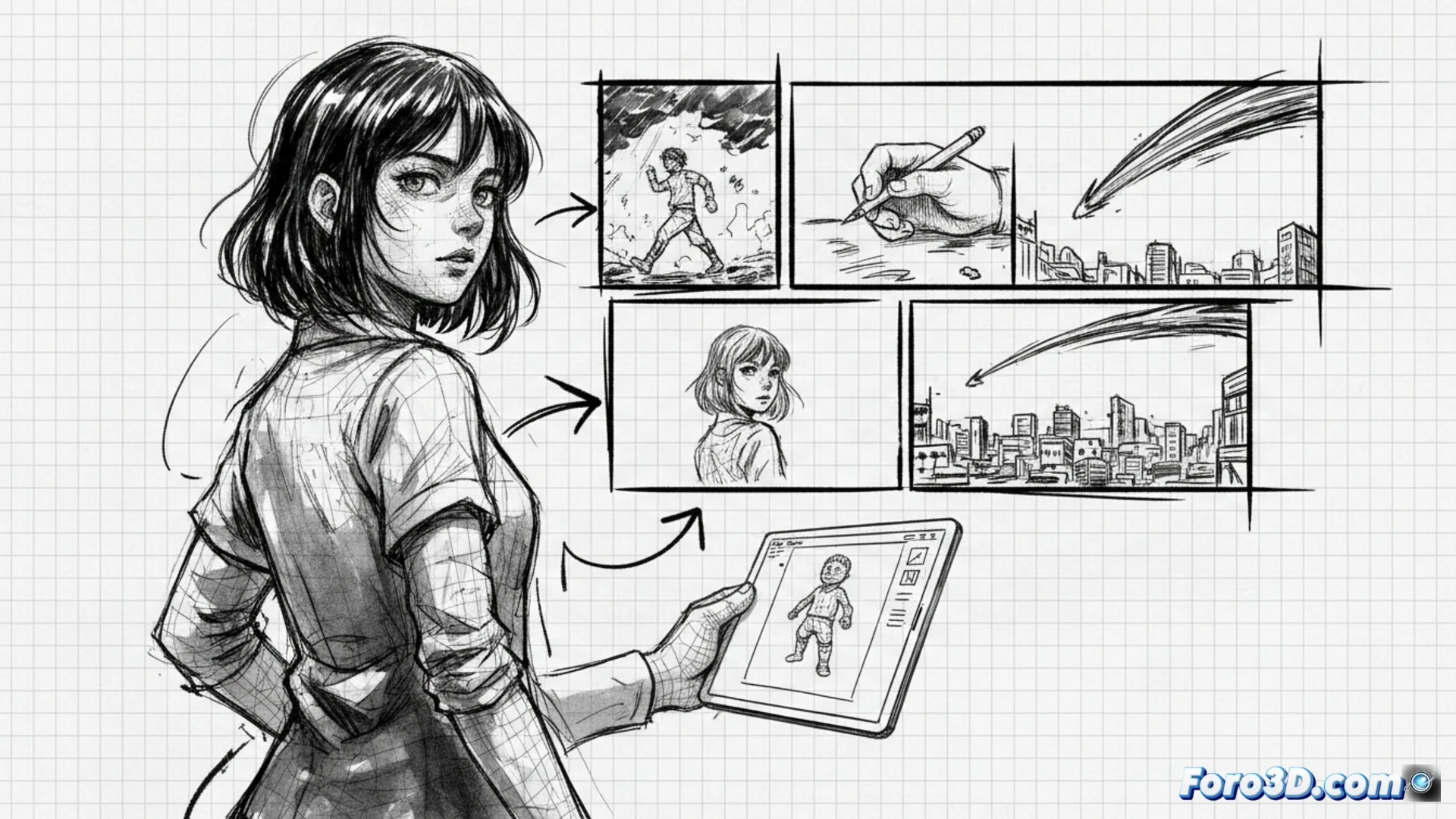
How to apply Fujimoto's visual rhythm to the animatic 🎬
In 3D pre-production, the animatic is the direct equivalent of Fujimoto's panels. Just as he avoids rigidity to focus on emotional narrative, a digital storyboard must prioritize the fluidity of movement and the intention of the scene. Observe how Fujimoto uses white space and large panels to mark emotional pauses; this translates directly into the duration of shots and the cadence of the edit. Don't obsess over 3D model details at this stage. Instead, use exaggerated poses and dynamic framing that capture the feeling of the scene, just as the author does with his expressive linework.
Emotion over technical realism ❤️
The great lesson of Look Back is that the viewer's emotional connection does not depend on skin texture or global illumination. Fujimoto reminds us that 3D cinema, like manga, is a medium for telling stories. By applying his philosophy, we must ask ourselves: what feeling do we want to convey? A shaky camera movement, a stylized silhouette, or flat lighting can be more effective tools than empty realism. The key lies in the soul of the line, not its precision.
How can the expressiveness of a 2D line that prioritizes emotion over realism be translated into the language of a 3D storyboard, without losing the author's original narrative intention?
(PS: Previs in film is like the storyboard, but with more possibilities for the director to change their mind.)