Forensic biomechanics has evolved towards the quantitative analysis of human locomotion. When a suspect is captured by surveillance cameras, their gait pattern becomes a unique physical signature. This article breaks down the technical pipeline for extracting, modeling, and simulating in 3D the trajectory and gestures of a subject from low-resolution videos or crime scene scans.
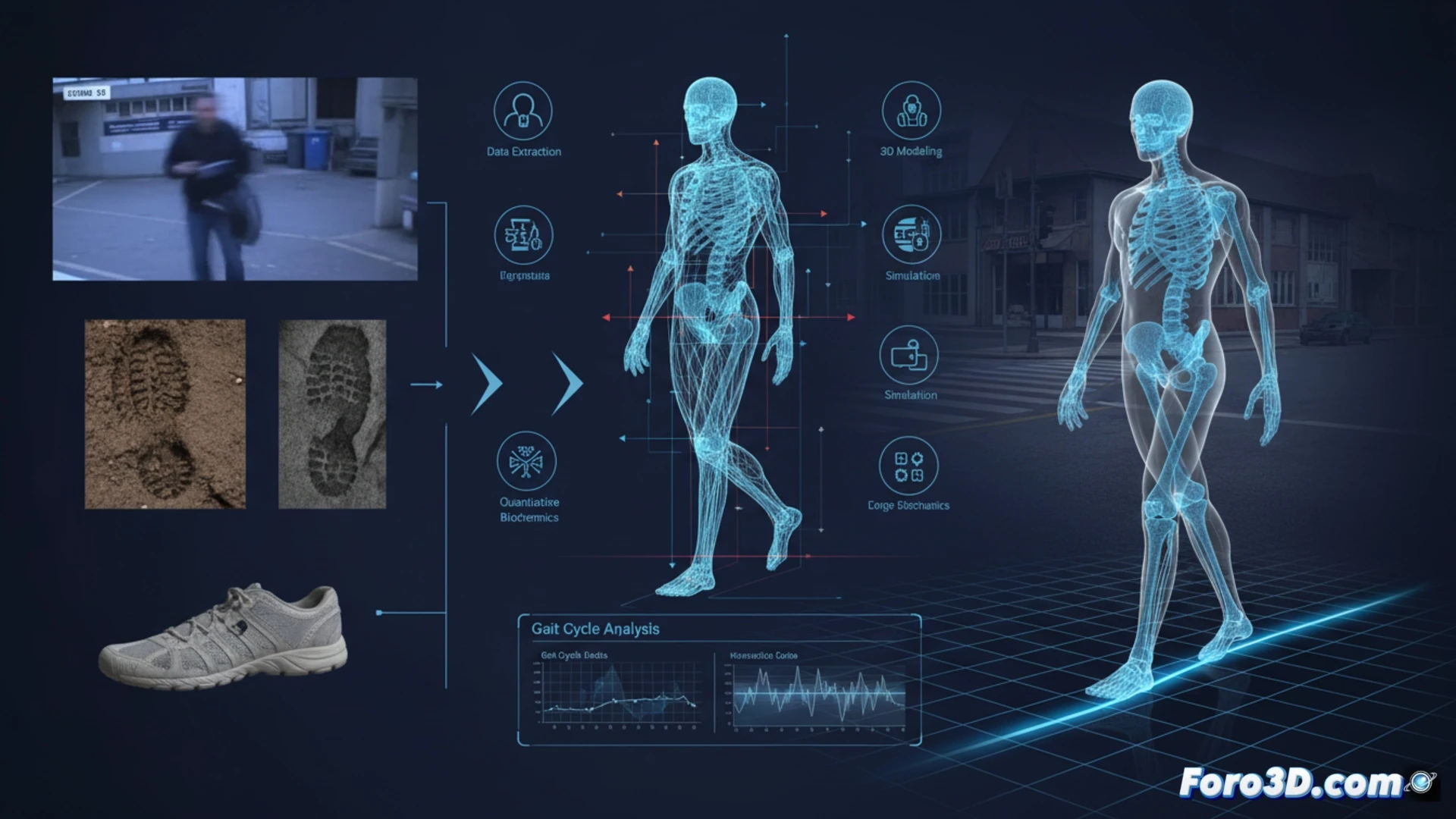
Capture and Biomechanical Modeling Pipeline 🦿
The process begins with calibrating the surveillance camera using inverse photogrammetry, employing known reference points in the scene to eliminate lens distortion. Subsequently, an optical tracking algorithm (OptiTrack or camera solve in Blender) is applied to extract the 3D coordinates of the suspect's joints (hip, knee, ankle). This data is imported into Maya or Unreal Engine to generate a skeletal rig. Inverse kinematics allows calculating angular velocity and stride length, critical data for determining whether the suspect ran, walked, or stopped at a specific point. Finally, the model is overlaid onto the original video to validate temporal coincidence.
Legal Implications and Technical Biases ⚖️
Although 3D simulation offers a compelling visual representation, the expert must document the margin of error. The resolution of the original video, partial body occlusion, and lighting can generate gait artifacts. In a real case, an error in hip interpolation led to accusing an individual of feigned limping. Transparency in the forensic pipeline requires publishing the smoothing parameters and the number of frames used, preventing the animation from becoming an argument of visual authority without statistical basis.
How can the accuracy of a 3D gait reconstruction be validated when the only available evidence is a low-resolution, single-angle video from a security camera?
(PS: don't forget to calibrate the laser scanner before documenting the scene... or you might be modeling a ghost)