In May 1956, the agricultural areas of Henan, China, witnessed an unusual meteorological phenomenon: a rain of pure salt particles falling from the sky. This event, attributed to high-altitude winds transporting crystals from distant salt lakes, presented a unique challenge for visual effects recreation. To capture its essence, our team combined three key tools: Houdini for grain simulation, Maya XGen for surface scattering, and RealFlow for atmospheric fluid dynamics. The goal was to achieve absolute realism in the interaction of the crystals with the air and terrain.
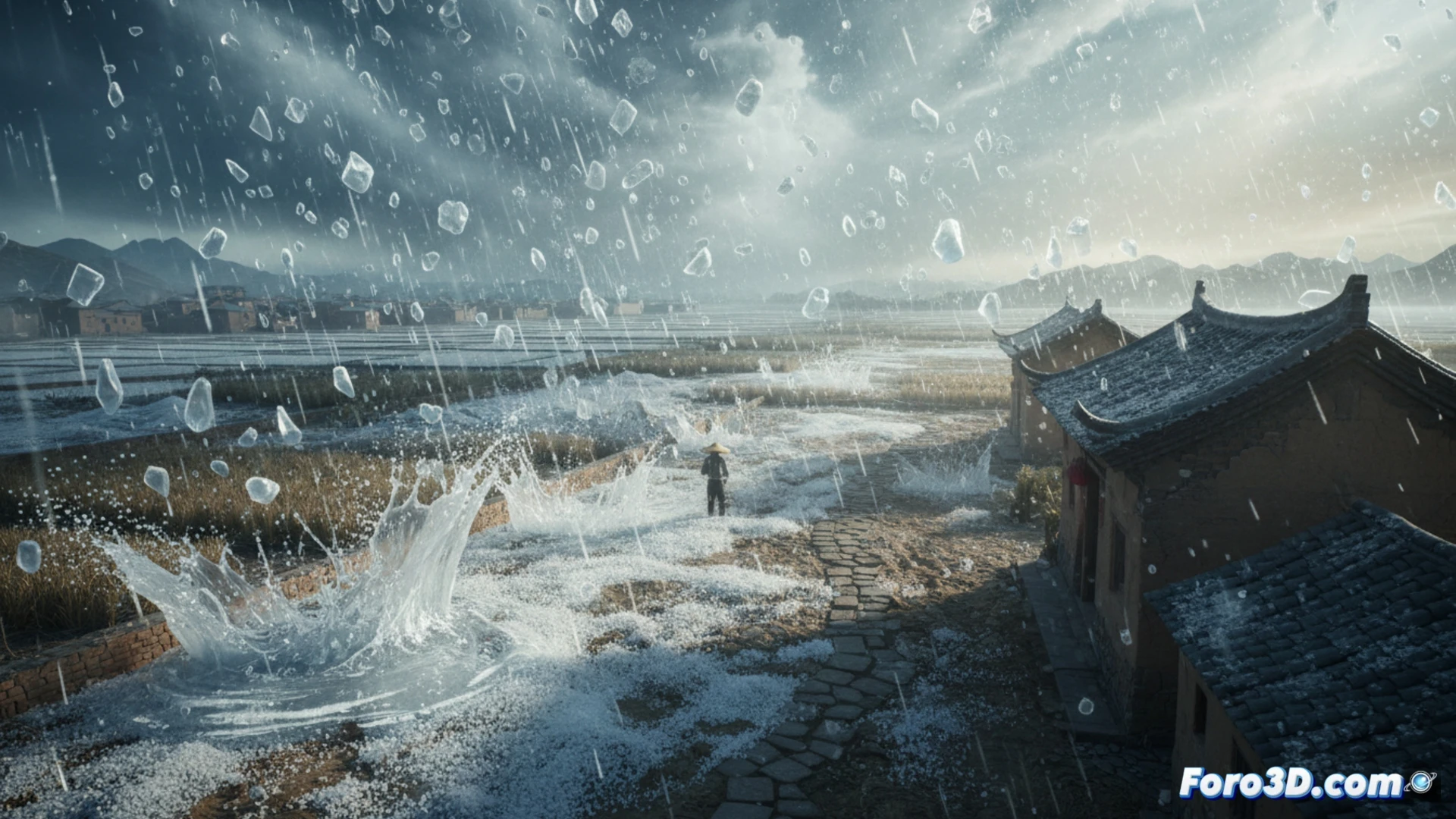
Technical Process: Emitters, Wind and Collisions 🌪️
The foundation of the simulation began in Houdini using the Grains system. We configured a massive volume emitter in the upper atmosphere, releasing millions of particles with a calibrated density to mimic the weight of salt crystals. For transport, we applied a wind force field with procedural turbulence, replicating the high-altitude currents that traveled hundreds of kilometers. The biggest challenge was the collision with the agricultural terrain: in RealFlow, we modeled the interaction of solid particles with vegetation and soil, adjusting friction and scattering to prevent the grains from bouncing unnaturally. Finally, Maya XGen handled the surface layer, generating a scattering of crystals over crops and ground dust, using growth guides so that the salt accumulated organically on leaves and furrows. Rendering was done with a translucent crystal shader, capturing the refraction of light on each particle.
The Realism of the Unusual ✨
The final result achieved a realism that surprised even the consulted meteorologists. The key was not treating the salt as a homogeneous fluid, but as solid particles with chaotic behaviors. The integration of Houdini for aerial dynamics, RealFlow for terrestrial interaction, and Maya XGen for microscopic detail allowed the salt rain to not only be seen, but to feel physical. This project demonstrates that the strangest natural phenomena can come to life when simulation tools are mastered.
How was the simulation of the interaction between salt particles and rice crops in Houdini approached to achieve realistic physical behavior without compromising render performance?
(PS: VFX are like magic: when they work, nobody asks how; when they fail, everyone sees it.)