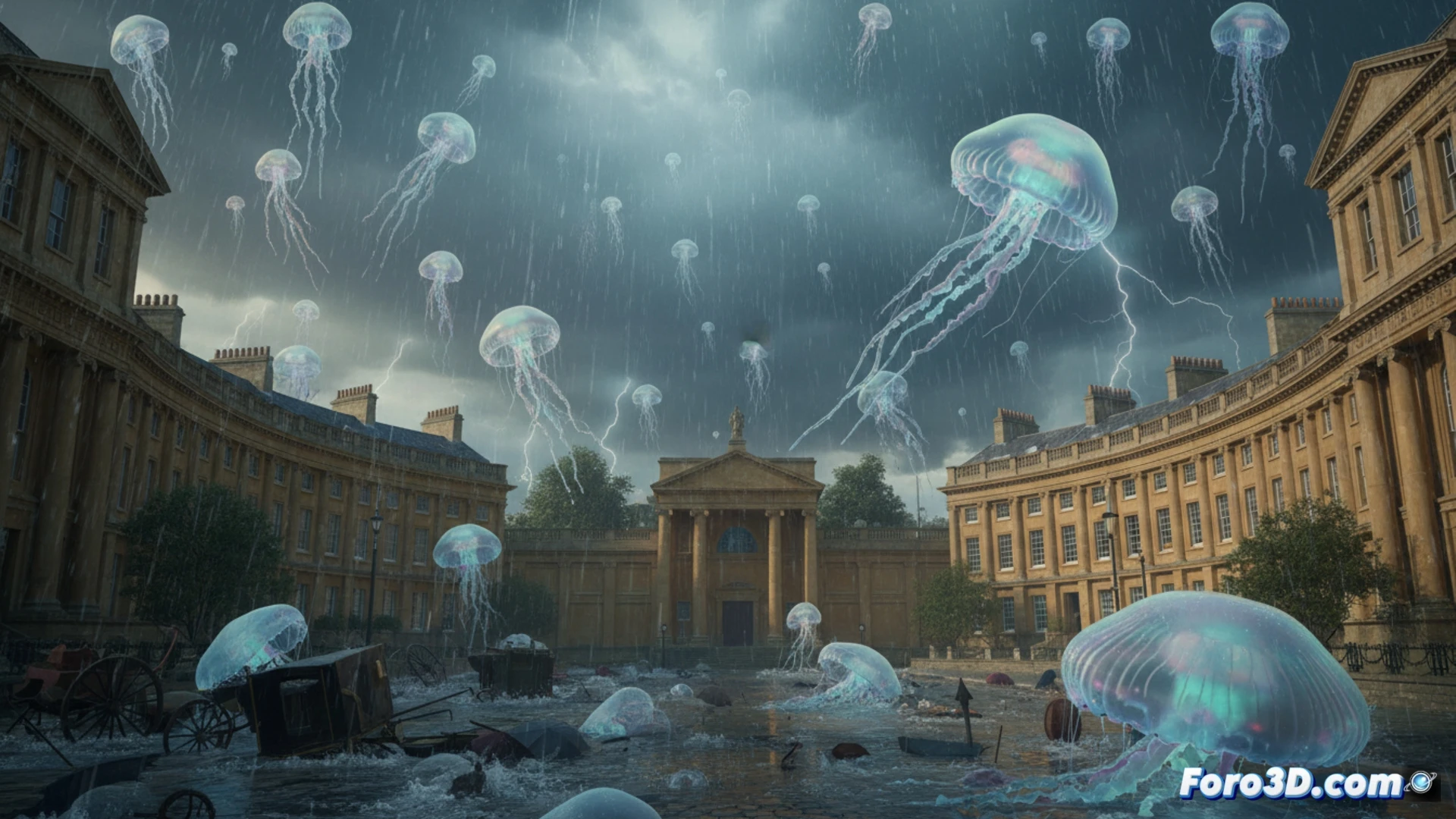
On June 14, 1894, the city of Bath, England, witnessed a meteorological phenomenon as absurd as it was real: a rain of jellyfish. After a violent storm, thousands of gelatinous creatures fell from the sky, swept from the sea miles away. This event, documented by the local press, defies logic and offers a perfect case study for simulating natural disasters with 3D tools. How to recreate such chaos? The answer lies in combining Houdini for fluids, Blender for organics, and Maya for the choreography of the disaster. 🌩️
Technical Pipeline: From Steam Cloud to Gelatinous Body 🎨
To reconstruct the storm, the first step is to model the jellyfish in Blender. We use meshes with subdivision and smoothing modifiers, applying translucent materials with scattering nodes to mimic marine jelly. Then, in Houdini, we simulate the wind system and updrafts with a pyro smoke solver, lifting particles from the Bristol Channel to Bath. The jellyfish become agents in a crowd sim, controlled by turbulence and vorticity forces. Finally, in Maya, we animate the fall with nCloth dynamics so the bodies deform upon impact with roofs and streets, synchronizing everything with a particle system that reproduces the exact density of the event: thousands of specimens per square meter.
Scientific Validation and Visual Narrative 🔬
Beyond the spectacle, this simulation allows for validating meteorological hypotheses. By adjusting wind speed and cloud height in Houdini, we can calculate whether a waterspout sucked up the jellyfish or if they were carried by a low-altitude jet stream. The visual result not only documents the event but offers an educational tool to understand how extreme phenomena redistribute marine life. The combination of fluids, crowds, and soft dynamics turns a local myth into a practical case of climate reverse engineering.
As a 3D recreator, what fluid simulation and translucent material techniques do you consider most effective for representing the gelatinous texture and impact of the jellyfish in recreating a historical disaster like the Bath rain of 1894?
(PS: Simulating catastrophes is fun until your computer melts down and you become the catastrophe.)