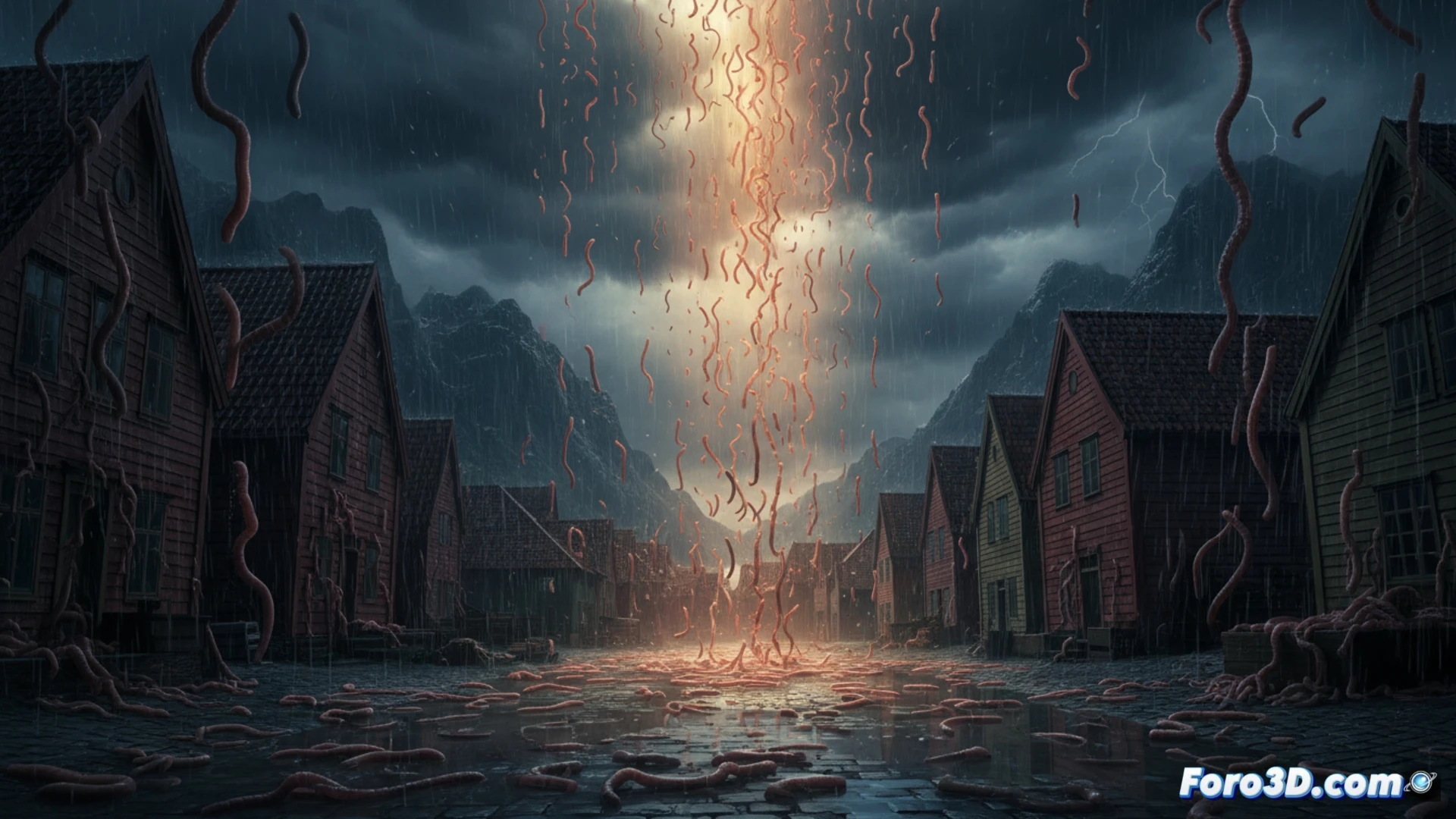
In April 2015, the city of Bergen, Norway, witnessed an unusual meteorological phenomenon: thousands of live worms fell from the sky onto the snow. The scientific community attributed the event to rising thermal currents that sucked the invertebrates from the damp ground, transporting them to high altitudes. For a visual effects artist, this event represents a fascinating technical challenge: simulating atmospheric fluid dynamics and the behavior of countless organic agents. Below, we break down a professional pipeline combining Houdini, Maya, and Blender to recreate this biological rain.
Technical Pipeline: From Thermodynamics to Particles 🌪️
The workflow begins in Houdini, where the thermal current is modeled using fluid simulations (FLIP or Pyro). A volume of ascending vortices is created, acting as a force field. Over this field, a multitude of agents (the worms) are instanced using the Crowd or POP Net system. Each worm is defined as a particle with rotation and orientation attributes to simulate its writhing in the air. This system is exported to Maya, where individual particle control is refined. In Maya, secondary forces such as local turbulence and collisions with the ground are applied, adjusting the rain density in layers. Finally, the camera and lighting file is passed to Blender, where it is rendered with Cycles. The snow is textured with a subsurface scattering (SSS) shader, and the worms receive a translucent material to capture the ambient light of the Nordic landscape.
Lessons for the Visual Effects Artist 🎨
This case demonstrates that the strangest natural phenomena are a direct source of inspiration for VFX. The technical key lies in data transfer between software: Houdini handles the complex physics of fluids and crowds, Maya offers granular control over the animation of each creature, and Blender provides a robust, open-source rendering engine. In professional productions like Arrival or Annihilation, similar pipelines are used to simulate rain of organisms. The trick is not to overload the simulation: a common mistake is using too many particles without scale variation, which breaks the organic illusion. Nature always has both chaos and patterns.
How Houdini's procedural simulation was integrated with modeling pipelines in Maya and Blender to recreate the realistic physics of the worm rain in Bergen, and what technical challenges the synchronization between these three tools presented in the VFX workflow
(PS: VFX are like magic: when they work, no one asks how; when they fail, everyone sees it.)