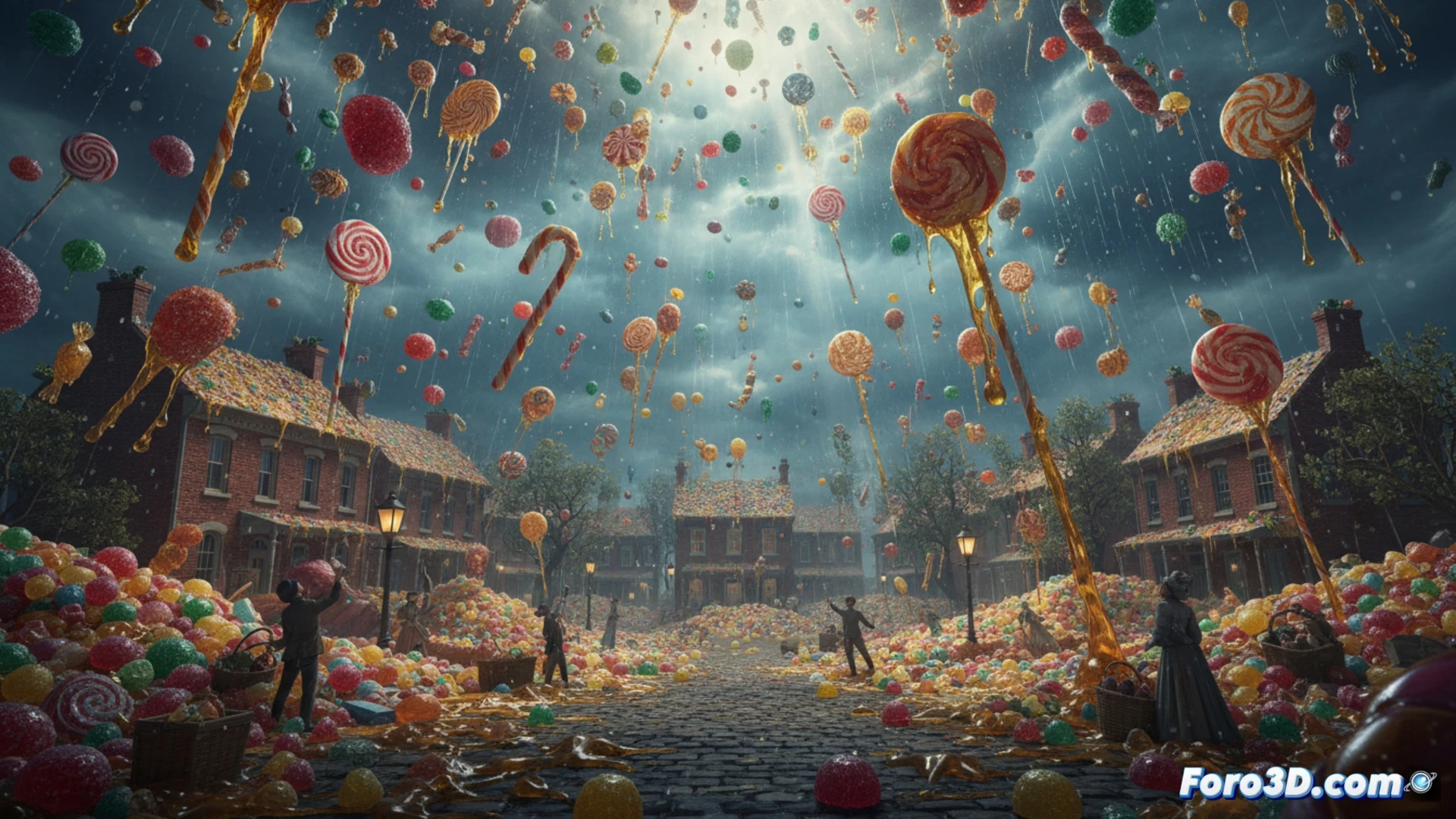
In September 1857, an unusual meteorological phenomenon shook Lake County, California: a precipitation of sugar crystals that witnesses described as candies. To recreate this event in a visual effects environment, the technical pipeline requires combining particle dynamics, fluids, and geometry generation. We will use Houdini Grains for aerial dispersion, RealFlow for syrup viscosity, and Maya XGen for crystalline texture.
Technical Pipeline: From Particle to Crystal 🍬
The simulation starts in Houdini with a Grains system, setting up an emission source from a point cloud in the sky. We adjust friction and turbulence to replicate the intense wind of 1857, causing the sugar grains to collide without merging. Then, we export the simulation to RealFlow to apply hybrid fluid dynamics: a liquid phase for the sticky syrup and a granular phase for the dry crystals. Finally, in Maya XGen, we create hair descriptors to generate microscopic fibers that mimic the edges of sucrose crystals, using color maps that alternate between translucent white and amber.
Realism in the Unusual: Lessons from the Past ✨
This case demonstrates that the strangest natural phenomena require a multidisciplinary approach. The candy rain of Lake County not only challenges meteorological logic but also forces the technical artist to think about sugar chemistry: how it crystallizes when drying and how wind transports it. By integrating Houdini, RealFlow, and Maya XGen, we achieve a result that is not only visually credible but also pays homage to a real event that continues to fascinate scientists and filmmakers alike.
How would you integrate Houdini simulations with RealFlow to ensure that the candies in the 1857 rain maintain realistic physical properties of collision and density without sacrificing final render performance?
(PS: VFX is like magic: when it works, no one asks how; when it fails, everyone sees it.)