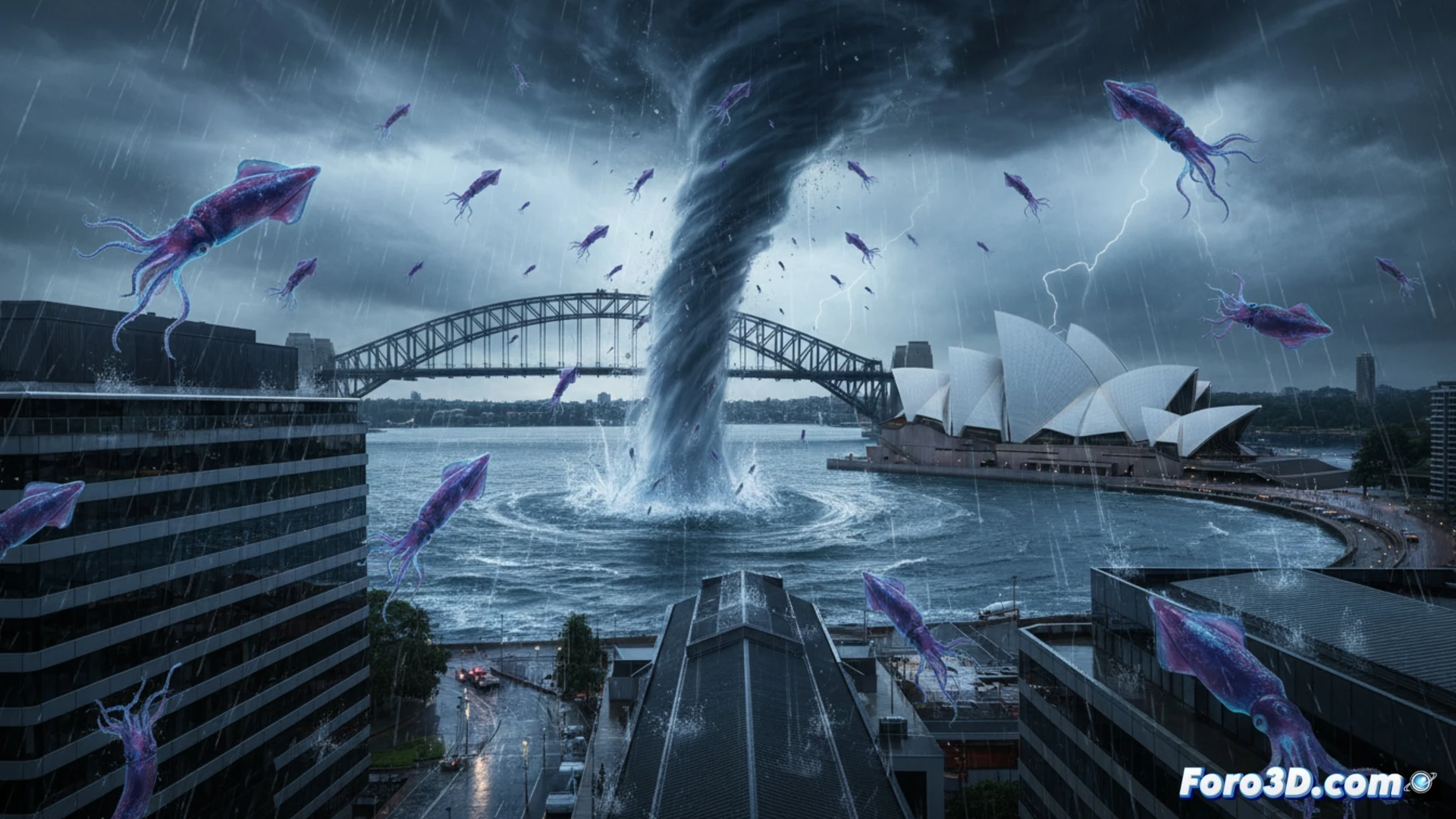
In July 1996, a waterspout sucked hundreds of small squid from the ocean off the coast of Sydney, Australia, and deposited them over an urban area. This natural phenomenon, known as squid rain, has become a case study for visual effects artists seeking to recreate extreme weather events and the interaction of soft bodies with fluids. In this article, we analyze the technical pipeline used to simulate this event, combining Houdini, RealFlow, and Autodesk Maya.
Simulation pipeline: soft bodies, fluids, and compositing 🌊
The foundation of the simulation lies in Houdini, where the squid were modeled as soft bodies with elastic deformation dynamics. Torsion resistance constraints and variable gravity were applied to replicate the limpness of the bodies as they were sucked up. The waterspout was generated in RealFlow, using a particle emitter with vorticity and an upward velocity field to create the suction effect. The squid were imported as deformable rigid objects within the fluid, allowing the water to drag and expel them. Finally, in Maya, the layers were integrated: the ocean with procedural textures, the squid with translucent shaders, and the urban environment with proxy geometry. Lighting was adjusted with HDRIs of stormy skies to maintain atmospheric coherence.
Technical lessons on simulating extreme events 🐙
The biggest challenge was calibrating the interaction between fluid turbulence and the response of the soft bodies. In early tests, the squid disintegrated upon exiting the vortex due to excessive stiffness. Adjusting the damping and mass of the bodies in Houdini, along with the water viscosity in RealFlow, allowed for organic behavior. Integration in Maya required secondary rigging so that the tentacles retained residual motion after impact with the ground. This case demonstrates that combining specialized simulators and a modular workflow is key to recreating complex natural phenomena with visual credibility.
What specific technical challenges does simulating the interaction between waterspout turbulence and the soft body physics of squid in Houdini and RealFlow present, and how were they resolved to achieve a realistic result in the Sydney squid rain?
(PS: VFX are like magic: when they work, nobody asks how; when they fail, everyone sees it.)